News & Ideas is a daily letter for anyone who wants the day's science in one place, not a feed. Each day is 4 news items and 3 ideas across AI & Tech, Physics & Engineering, Biology & Nature, and Mind & Society, and every story names a primary source you can check. The Shorts use a declared synthetic voice.
One email a day. 4 science stories, 5 quick results, 1 idea. 3 minutes.
Plus a daily quiz: Answer & Learn. Free, unsubscribe anytime.
Issue
27 November 2026
2 min read · 1 Short
Physics & Engineering: a pulsar that escaped its supernova, 5G leakage in weather forecasts, a semiconductor that stretches, molecular cages as catalysts. Then pulsar kicks, the blast wave, the transition state.
One email a day. 4 science stories, 5 quick results, 1 idea. 3 minutes.
Plus a daily quiz: Answer & Learn. Free, unsubscribe anytime.
Physics & Engineering
A Pulsar That Escaped Its Own Supernova
Physics & Engineering: a pulsar that escaped its supernova, 5G leakage in weather forecasts, a semiconductor that stretches, molecular cages as catalysts. Then pulsar kicks, the blast wave, the transition state.
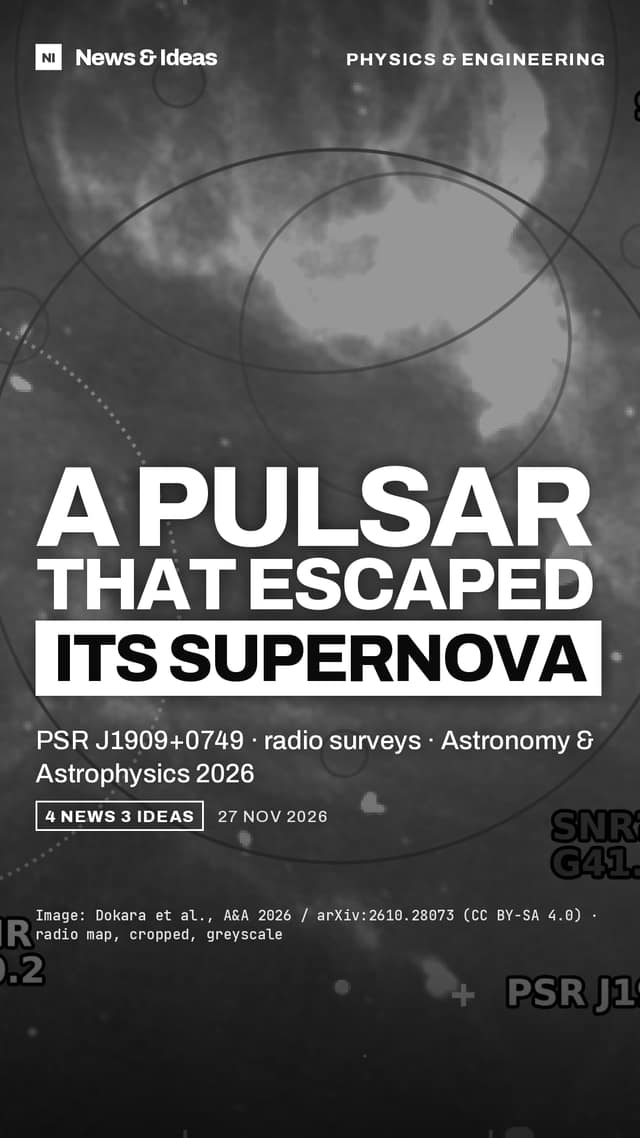
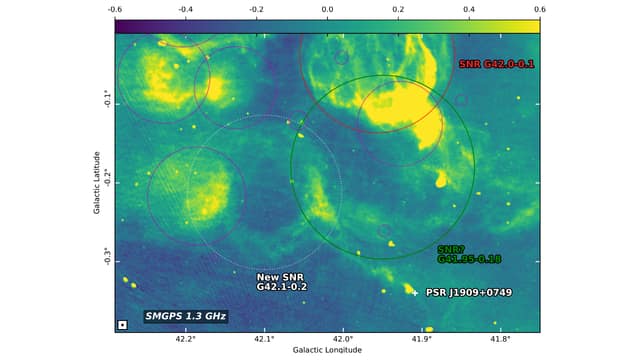
Combining radio surveys, astronomers found a faint supernova remnant by chance. A known pulsar sits well outside it, with a comet-like tail pointing back toward the shell's center. If they share an origin, the pulsar is racing at an estimated 1,460 kilometers per second, among the fastest in our galaxy.
Image: Dokara et al., A&A 2026 / arXiv:2610.28073 (CC BY-SA 4.0) · radio map, top panel of Fig. 1, cropped
One email a day. 4 science stories, 5 quick results, 1 idea. 3 minutes.
Plus a daily quiz: Answer & Learn. Free, unsubscribe anytime.
Engineering · Weather
5G Leakage vs Weather Forecasts
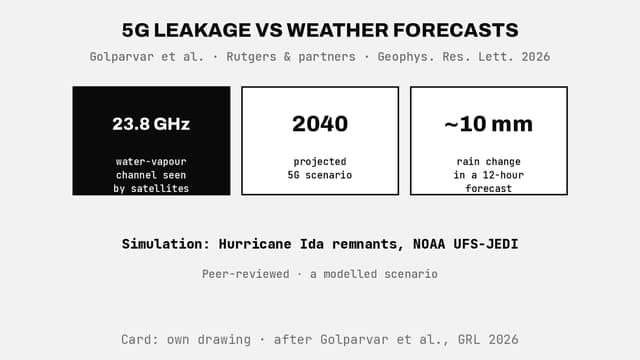
Weather satellites read water vapor at 23.8 gigahertz, right next to a 5G band. A Rutgers-led team fed a simulated 2040 scenario of 5G leakage into a NOAA forecast of Hurricane Ida's remnants. Rainfall in the 12-hour forecast changed by up to about 10 millimeters, even downstream.
Card: own drawing · after Golparvar et al., GRL 2026
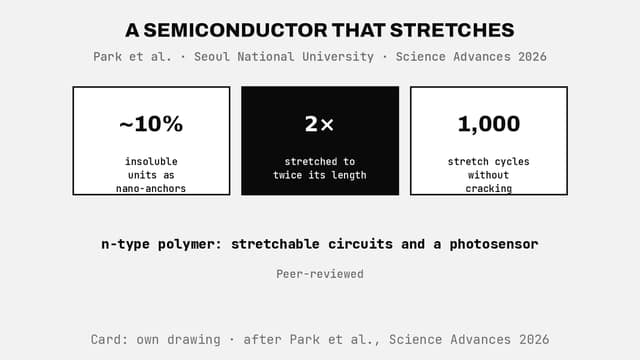
Stretchable electronics need semiconductors that behave like rubber, but most crack. A team led by Seoul National University added about 10 percent of a poorly soluble unit to an electron-carrying polymer, creating nano-anchors. The film survived 1,000 stretches to twice its length, and still conducted well.
Card: own drawing · after Park et al., Science Advances 2026
Molecular cages trap molecules and speed up reactions, like tiny enzymes. Chemists from Birmingham, Edinburgh and Oxford tested 30 palladium cages directly in the reaction mix. The best beat the worst by more than 10,000 times, and machine learning pointed to cage shape and electrostatics.
Card: own drawing · after Bickerton et al., JACS 2026
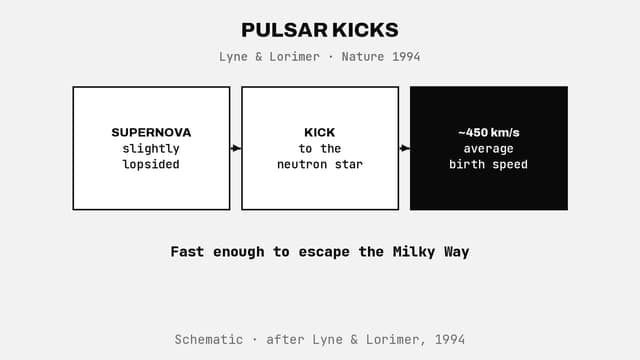
Pulsar kicks. In 1994, Andrew Lyne and Duncan Lorimer estimated that pulsars are born moving about 450 kilometers per second on average, likely kicked by lopsided supernovae. That beats the Milky Way's escape speed. Today's runaway is estimated at about three times that.
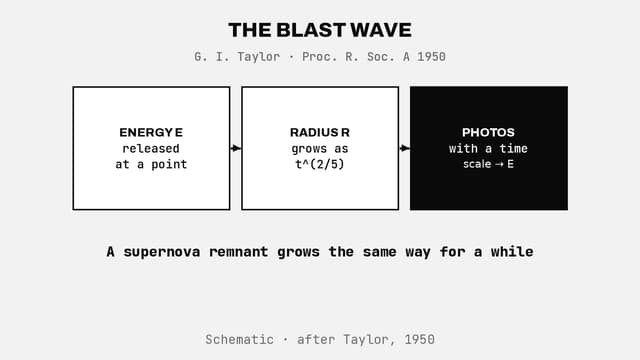
The blast wave. In 1950, Geoffrey Taylor showed that a very strong explosion grows simply: its radius depends only on energy, air density and time. From published photos of the first atomic test, he estimated its energy. Young supernova remnants follow similar math.
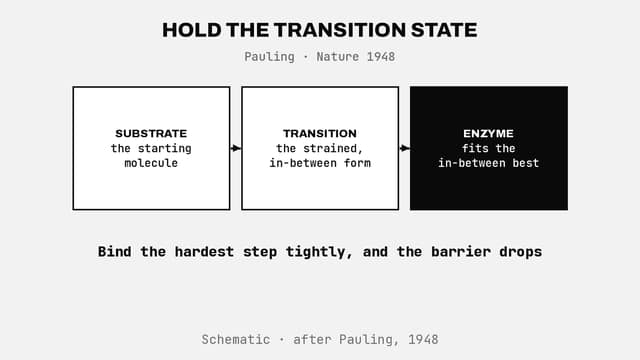
Hold the transition state. In 1948, Linus Pauling proposed that enzymes fit best not the starting molecule, but the strained, in-between form of the reaction. Stabilize that hardest step, and the energy barrier drops. Chemists building cage catalysts are chasing the same trick.