News & Ideas is a daily letter for anyone who wants the day's science in one place, not a feed. Each day is 4 news items and 3 ideas across AI & Tech, Physics & Engineering, Biology & Nature, and Mind & Society, and every story names a primary source you can check. The Shorts use a declared synthetic voice.
One email a day. 4 science stories, 5 quick results, 1 idea. 3 minutes.
Plus a daily quiz: Answer & Learn. Free, unsubscribe anytime.
Issue
25 November 2026
2 min read · 1 Short
Physics & Engineering: four radiation belts, a record quasar, a simple metal with p-wave magnetism, more lightning ahead. Then a third belt, black hole seeds, lightning from heat and rain.
One email a day. 4 science stories, 5 quick results, 1 idea. 3 minutes.
Plus a daily quiz: Answer & Learn. Free, unsubscribe anytime.
Physics & Engineering
Earth Briefly Had Four Radiation Belts
Physics & Engineering: four radiation belts, a record quasar, a simple metal with p-wave magnetism, more lightning ahead. Then a third belt, black hole seeds, lightning from heat and rain.
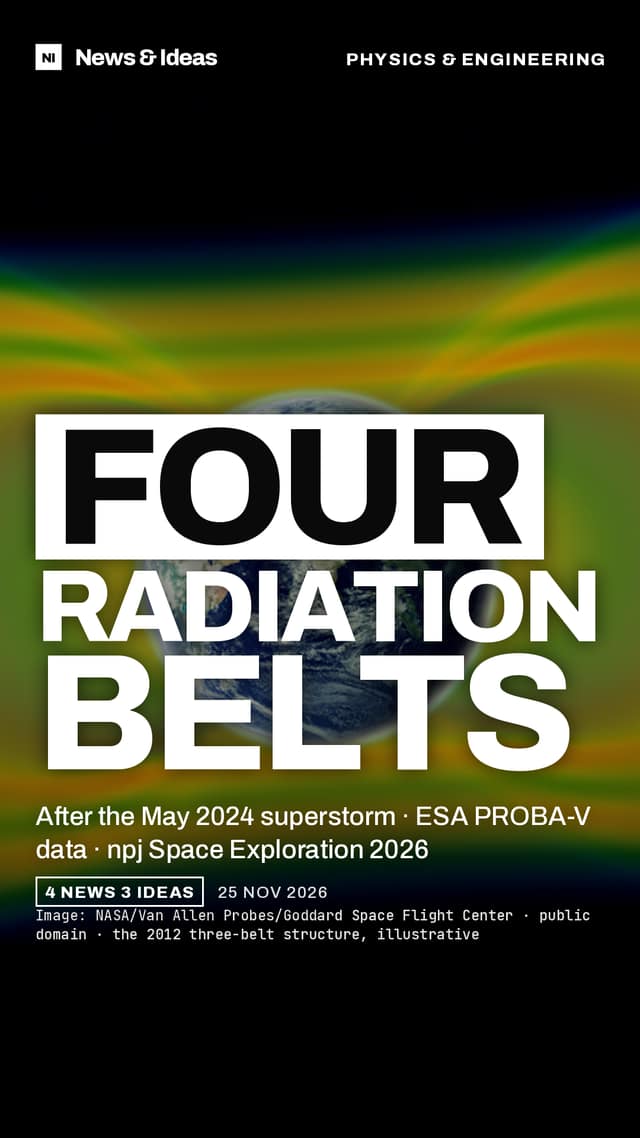
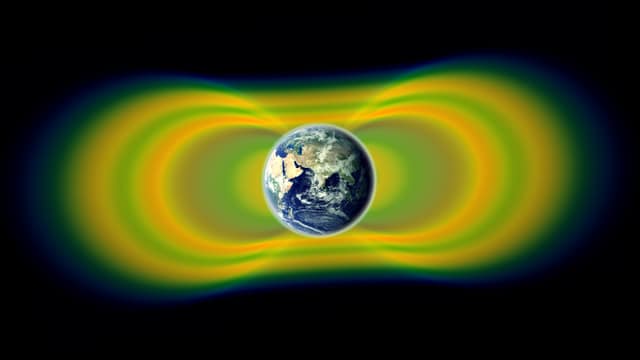
Earth normally has two Van Allen radiation belts, separated by a gap. After the May 2024 geomagnetic storm, a Belgian team saw four distinct electron belts in data from ESA's PROBA-V satellite. They formed in June and lasted over four weeks, and extra belts returned after later storms.
Image: NASA/Van Allen Probes/Goddard Space Flight Center · public domain · the 2012 three-belt structure, illustrative
One email a day. 4 science stories, 5 quick results, 1 idea. 3 minutes.
Plus a daily quiz: Answer & Learn. Free, unsubscribe anytime.
Astronomy · Quasars
A Record Quasar
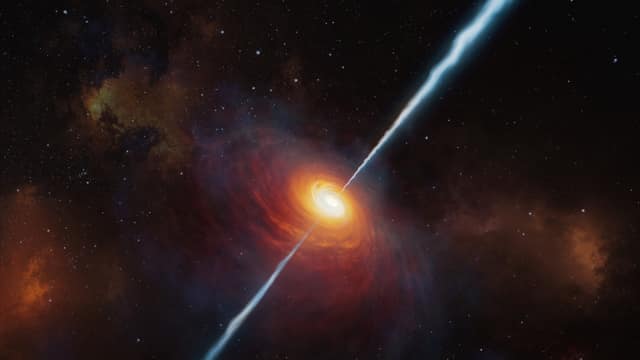
A new record for the most distant quasar. Found in images from ESA's Euclid telescope and confirmed with Webb, it shines from just 630 million years after the Big Bang, about 39 million years earlier than the previous record. Its black hole holds several hundred million suns.
Illustration: ESO/M. Kornmesser · Wikimedia Commons (CC BY 4.0) · artist’s impression of a distant quasar
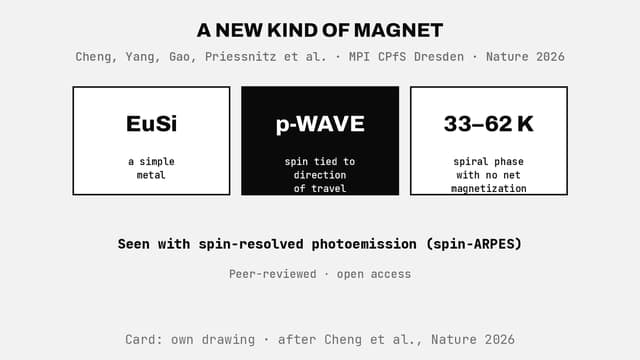
A simple metal hides an unusual magnet. Researchers at the Max Planck Institute in Dresden found evidence of p-wave magnetism in europium silicide: no overall magnetization, but each electron's spin is linked to the direction it travels. It appears between 33 and 62 kelvin. Published in Nature.
Card: own drawing · after Cheng et al., Nature 2026
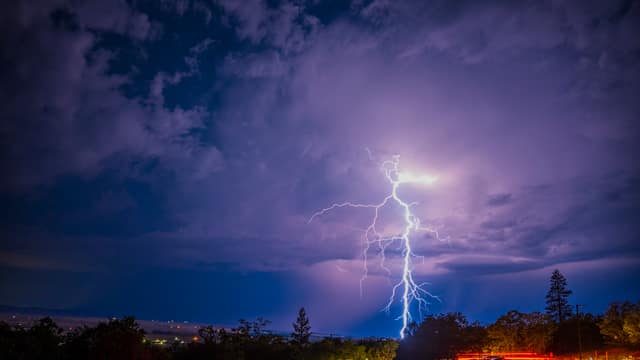
Lightning may strike far more often. A machine learning model trained on lightning observations found cloud-to-ground strikes rose 11 percent over the 20th century. Under high emissions, they could become 76 to 140 percent more common by the end of this century, about 30 percent per degree of warming.
Photo: The Modern Polymath · Wikimedia Commons (CC BY 4.0) · a cloud-to-ground lightning strike
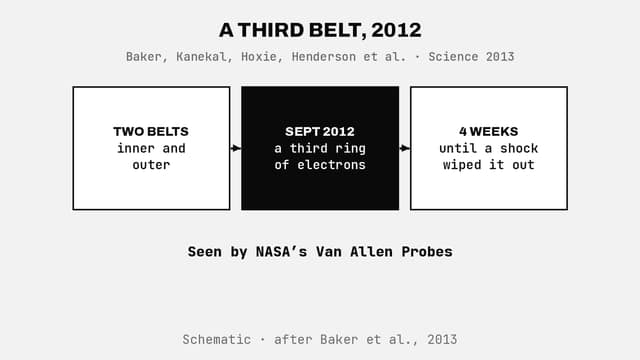
A third belt. In 2013, Daniel Baker and colleagues reported that NASA's Van Allen Probes saw a third ring of electrons form in September 2012. It lasted about four weeks, until a shock wave from the Sun wiped it out. Now Earth has shown four.
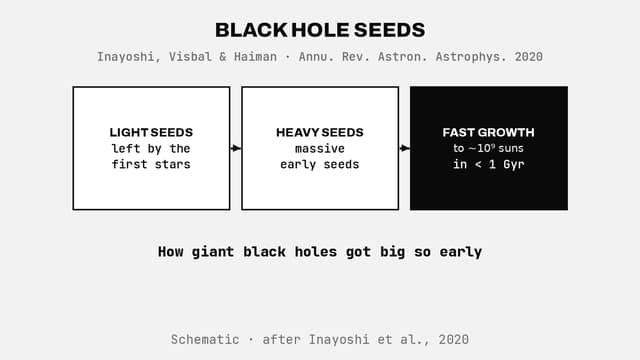
Black hole seeds. How did black holes reach a billion suns in under a billion years? Kohei Inayoshi and colleagues reviewed two kinds of seed: small ones left by the first stars, and heavier ones born massive. Each record quasar narrows the options.
Inayoshi et al. · ARA&A 2020
Schematic · after Inayoshi et al., 2020
The Assembly of the First Massive Black HolesAnnual Review of Astronomy and Astrophysics · Aug 2020 · Primary · Inayoshi, Visbal & Haiman, Annu. Rev. Astron. Astrophys. 58, 27 (2020)
Idea · Atmosphere
Lightning From Heat and Rain
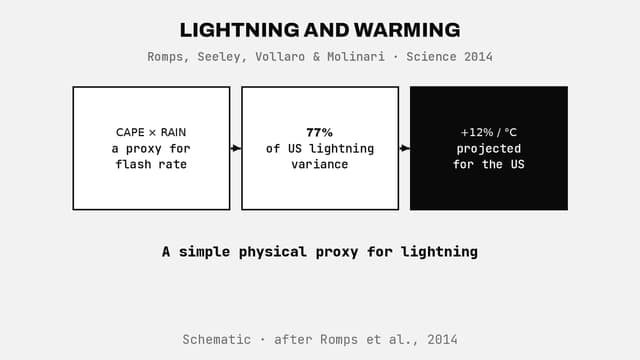
Lightning from heat and rain. In 2014, David Romps and colleagues proposed that flash rate tracks storm energy, called CAPE, times rainfall. That proxy explained 77 percent of US lightning variation and predicted 12 percent more strikes per degree of warming.