News & Ideas is a daily letter for anyone who wants the day's science in one place, not a feed. Each day is 4 news items and 3 ideas across AI & Tech, Physics & Engineering, Biology & Nature, and Mind & Society, and every story names a primary source you can check. The Shorts use a declared synthetic voice.
One email a day. 4 science stories, 5 quick results, 1 idea. 3 minutes.
Plus a daily quiz: Answer & Learn. Free, unsubscribe anytime.
Issue
20 November 2026
3 min read · 1 Short
Physics & Engineering: Hera at the asteroid NASA hit, a star system that should not exist, X-rays that tear water apart, antiferromagnets switched by current. Then thermal inertia, Auger decay, spin-transfer torque.
One email a day. 4 science stories, 5 quick results, 1 idea. 3 minutes.
Plus a daily quiz: Answer & Learn. Free, unsubscribe anytime.
Physics & Engineering
Hera's Heat Vision Spots the Moonlet NASA Hit
Physics & Engineering: Hera at the asteroid NASA hit, a star system that should not exist, X-rays that tear water apart, antiferromagnets switched by current. Then thermal inertia, Auger decay, spin-transfer torque.
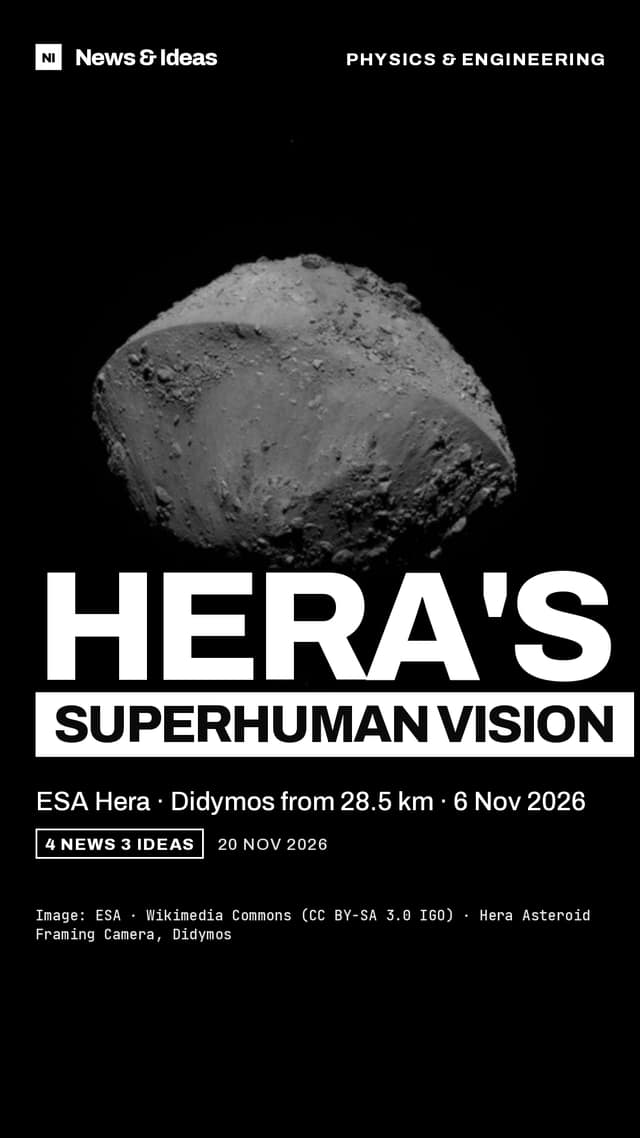
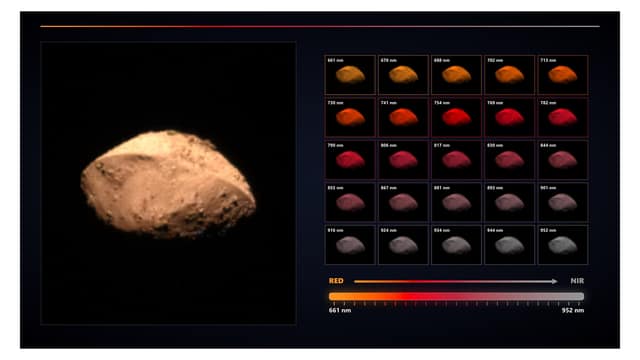
ESA released Hera's first science views of the Didymos system, taken on 6 November 2026 from 28.5 km. The Asteroid Framing Camera shows the 780-m Didymos at about 2.7 m per pixel: a spinning-top shape with boulder-rich areas, clearer regions and possible landslides towards its equatorial ridge; it rotates every 2.2 hours, which may push material to the equator. HyperScout H observes in 25 bands from visible red to near-infrared, to compare with meteorites and minerals. JAXA's Thermal Infrared Imager (TIRI) maps temperature, which indicates solid, porous or broken rock; the 151-m moonlet Dimorphos, almost entirely in shadow in visible light, appears whole in TIRI. Detailed images of both asteroids are due on 25 November. Mission release, not a peer-reviewed paper.
Image: ESA · Wikimedia Commons (CC BY-SA 3.0 IGO) · HyperScout H, Didymos in 25 colours
One email a day. 4 science stories, 5 quick results, 1 idea. 3 minutes.
Plus a daily quiz: Answer & Learn. Free, unsubscribe anytime.
Astronomy · Stars
A Star System That 'Should Not Exist'
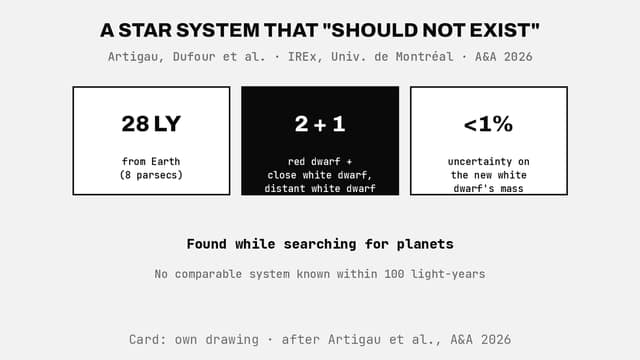
Étienne Artigau, Patrick Dufour and colleagues (IREx, Université de Montréal) were searching for planets with SPIRou at the Canada-France-Hawaii Telescope when a nearby red dwarf showed velocity variations of nearly 16 km/s, over 1,000 times larger than expected. Years of follow-up showed an unseen companion of more than half a solar mass; Gemini North's 'Alopeke imager then detected it directly as a white dwarf. A second, distant white dwarf was already known, making Welopōʻai the closest known triple system with two white dwarfs, about 8 parsecs away; no comparable system is known within 100 light-years. The new white dwarf's mass is measured to better than 1%. Its progenitor was about 40% more massive than the Sun and expanded to hundreds of times its size, yet the red dwarf survived on a wide, stable orbit. 'This system should not exist,' says Dufour.
Card: own drawing · after Artigau et al., A&A 2026
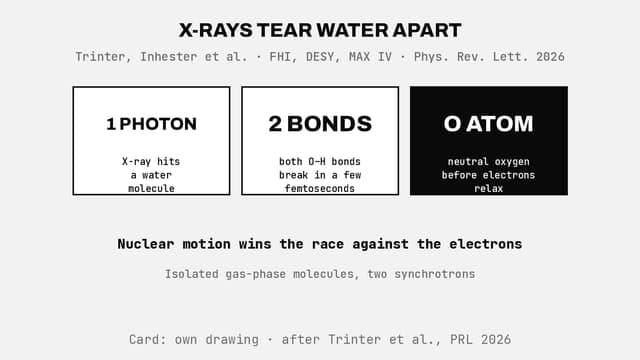
Florian Trinter (Fritz Haber Institute), Ludger Inhester (CFEL, DESY) and colleagues exposed isolated gas-phase water molecules to X-rays at PETRA III (DESY, Hamburg) and MAX IV (Lund). After a photon removes an oxygen inner-shell electron, the core-ionised molecule normally relaxes within femtoseconds by emitting an Auger electron. High-resolution electron spectra showed unusually sharp features that matched, in calculations, the decay of an excited neutral oxygen atom: both O–H bonds had broken within the lifetime of the core hole. The same fingerprint appeared at both facilities. Signals once attributed to hydroxyl fragments are better explained as atomic oxygen, which matters for interpreting X-ray experiments and radiation chemistry.
Card: own drawing · after Trinter et al., PRL 2026
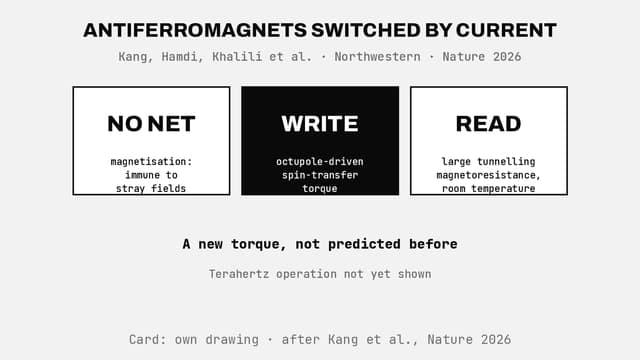
Jaimin Kang, Mohammad Hamdi, Pedram Khalili and colleagues (Northwestern) built nanoscale all-antiferromagnetic tunnel junctions from two noncollinear antiferromagnetic layers separated by a thin insulating barrier. At room temperature they showed large tunnelling magnetoresistance, a way to read the state, and current-induced switching of one layer by another through a torque governed by the material's magnetic octupole rather than net spin polarisation: octupole-driven spin-transfer torque, which the authors say had not been theoretically predicted, with a new theoretical framework. Antiferromagnets have no net magnetisation, so stored data would resist external fields; their dynamics can reach terahertz frequencies, but terahertz operation was not demonstrated.
Card: own drawing · after Kang et al., Nature 2026
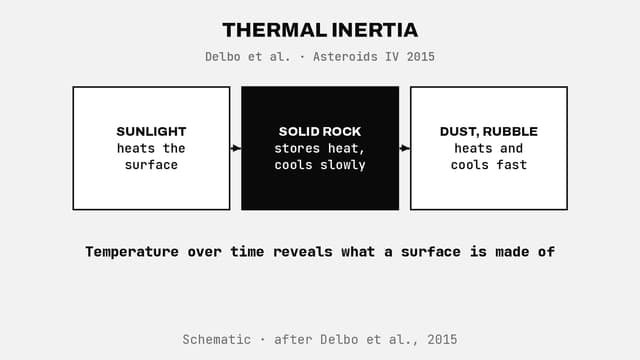
Thermal inertia measures how strongly a surface resists temperature change. Delbo, Mueller, Emery, Rozitis and Capria (Asteroids IV, 2015) review how thermophysical models turn infrared observations into thermal inertia, which distinguishes fine regolith and dust (low) from boulders and bare rock (high). Hera's TIRI maps temperatures across Dimorphos over time to tell solid, porous or broken rock from loose material.
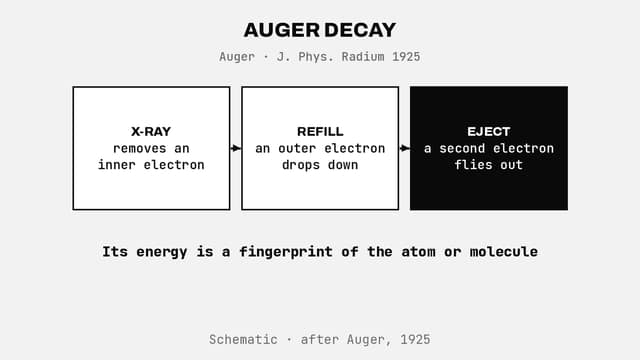
When an X-ray removes an inner-shell electron, an outer electron can drop into the vacancy and the released energy ejects another electron instead of a photon. Pierre Auger described this compound photoelectric effect in 1925 (J. Phys. Radium). Auger electron energies identify the emitting atom or molecule and its state, the fingerprint used to recognise excited neutral oxygen in the water experiment.
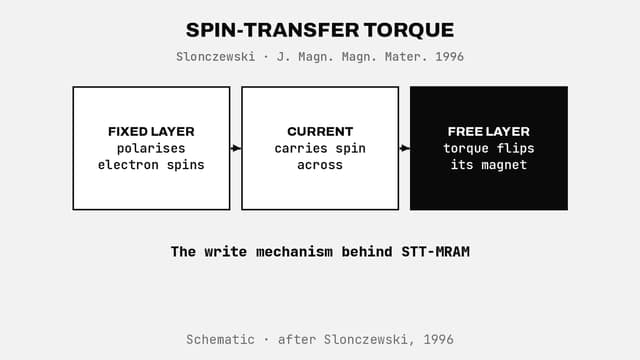
Slonczewski (J. Magn. Magn. Mater., 1996) showed theoretically that a spin-polarised current flowing between magnetic layers transfers angular momentum and can excite or reverse the magnetisation of a thin free layer. Spin-transfer torque is the write mechanism of STT-MRAM. The Northwestern result shows a related torque in antiferromagnets, governed by the magnetic octupole instead of net spin polarisation.