News & Ideas is a daily letter for anyone who wants the day's science in one place, not a feed. Each day is 4 news items and 3 ideas across AI & Tech, Physics & Engineering, Biology & Nature, and Mind & Society, and every story names a primary source you can check. The Shorts use a declared synthetic voice.
One email a day. 4 science stories, 5 quick results, 1 idea. 3 minutes.
Plus a daily quiz: Answer & Learn. Free, unsubscribe anytime.
Issue
21 November 2026
4 min read · 1 Short
Physics & Engineering: a dying star caught mid-transition, a theory for the fusion H-mode, a record X-ray laser, Europa's steady sodium cloud. Then light from electrons, the H-mode surprise, an ocean under ice.
One email a day. 4 science stories, 5 quick results, 1 idea. 3 minutes.
Plus a daily quiz: Answer & Learn. Free, unsubscribe anytime.
Physics & Engineering
ALMA Catches a Dying Star's Last Gasps
Physics & Engineering: a dying star caught mid-transition, a theory for the fusion H-mode, a record X-ray laser, Europa's steady sodium cloud. Then light from electrons, the H-mode surprise, an ocean under ice.
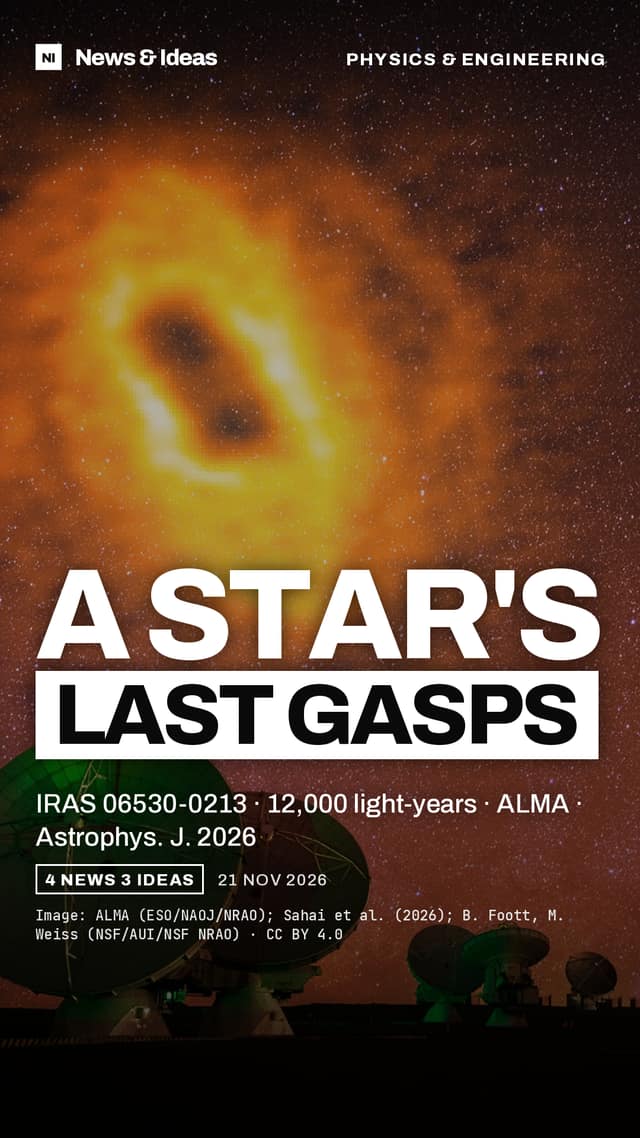
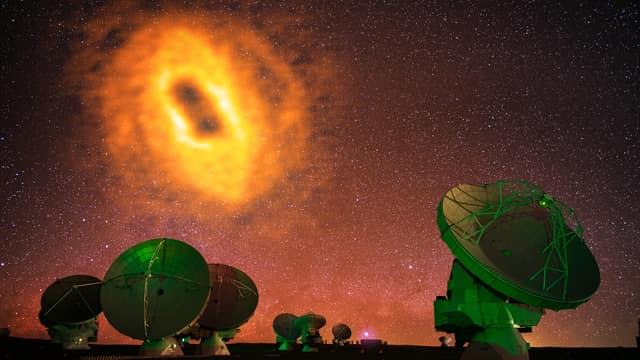
Raghvendra Sahai (NASA JPL) and colleagues used the Atacama Large Millimeter/submillimeter Array (ALMA) to observe IRAS 06530-0213, a star about 12,000 light-years away in Monoceros caught between the red-giant phase and a planetary nebula, a transition thought to last only a few thousand years. ALMA revealed a thin, spherical shell of gas appearing as a ring about half a light-year across; from its expansion, it was ejected about 6,500 years ago, which the team calls the first direct evidence of the last thermal pulse before a star of this type enters its final phase. After a lull of roughly 2,000 years, mass loss rose sharply for about 1,000 years, leaving curved filaments that seem to form a spiral, usually attributed to a companion star. The youngest structures, an hourglass-shaped nebula and a dense doughnut of gas, formed within the last ~700 years. Puzzles: an unusual excess of heavy carbon, oxygen and nitrogen isotopes, and no compact dusty disk near the star.
Image: ALMA (ESO/NAOJ/NRAO); Sahai et al. (2026); B. Foott, M. Weiss (NSF/AUI/NSF NRAO) · CC BY 4.0
One email a day. 4 science stories, 5 quick results, 1 idea. 3 minutes.
Plus a daily quiz: Answer & Learn. Free, unsubscribe anytime.
Physics · Fusion
A Theory for the Fusion H-Mode
Brenno De Lucca, Paolo Ricci and colleagues (EPFL Swiss Plasma Center) used simulations of a tokamak plasma under increasing heating power to identify what drives the transition from low to high confinement (L–H transition), discovered in 1982: turbulence generates flows moving at different speeds across the plasma edge, which suppress the turbulence itself. Their model also explains why the power threshold depends on plasma density, with a minimum at an intermediate density, and on the direction of the magnetic field, through the combined effect of flows and particle collisions. Compared with measurements from existing tokamaks, it predicts that ITER would need at least 43 MW of heating to reach H-mode, below its planned 73 MW, and that the compact SPARC tokamak would need about 26 MW, close to its planned 25 MW, leaving little margin.
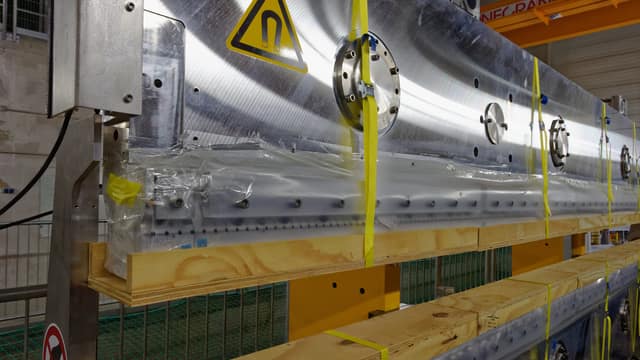
Ye Chen, Frank Brinker and colleagues at DESY and European XFEL demonstrated reliable fundamental-mode lasing at 30 keV, a wavelength of about 0.04 nanometres, raising their own world record for X-ray free-electron lasers. The wavelength is much shorter than typical distances between neighbouring atoms in solids, enabling higher-resolution studies of dense materials and of samples under extreme pressure. The team generated 800 flashes per second and transported them along a roughly one-kilometre beamline, with almost 60% of the light retained after the steering optics. The result followed years of electron-beam dynamics simulations and accelerator optimisation.
Photo: Dirtsc · Wikimedia Commons (CC BY-SA 3.0) · European XFEL undulator at DESY
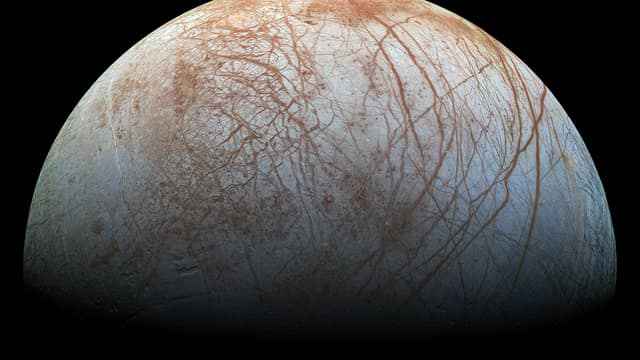
Emma Lovett, Carl Schmidt and colleagues (Boston University, Queen's University Belfast) combined new and archival spectra from the Keck Observatory's HIRES instrument, back to 1999, including observations of Europa in Jupiter's shadow, where sodium close to the moon's surface becomes visible without glare from the ice. The diffuse sodium cloud extends as far as 30 Europa radii, is elongated east–west and has stayed quasi-stable for more than two decades despite the changing plasma environment and the variable sodium output of volcanic Io. The authors conclude that the sodium originates in Europa's own salt water rather than in material from Io. The cloud is not a direct measurement of Europa's subsurface ocean; a Hubble search for magnesium is under way.
Image: NASA/JPL-Caltech/SETI Institute · Galileo, Europa (public domain)
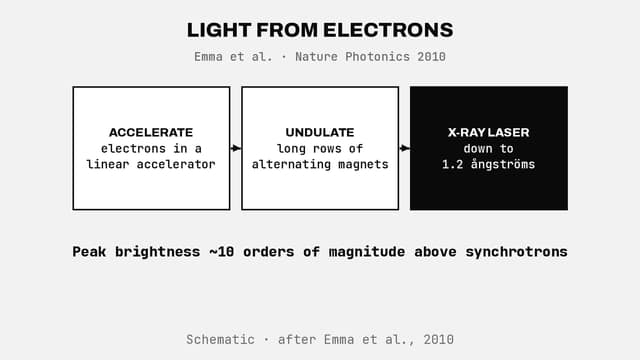
Emma et al. (Nature Photonics, 2010) reported first lasing and operation of the Linac Coherent Light Source at SLAC, an X-ray free-electron laser in which an electron beam from a linear accelerator passes through long undulator magnets. It produced coherent soft and hard X-rays with peak brightness nearly ten orders of magnitude beyond conventional synchrotron sources, pulses from 500 to under 10 femtoseconds, at wavelengths from 22 to 1.2 ångströms, enough to image matter at atomic size and timescales. European XFEL's 0.04-nanometre record extends this line.
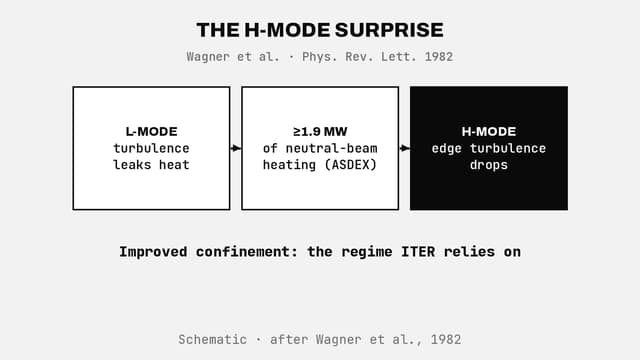
Wagner et al. (Physical Review Letters, 1982) observed a new operating regime in neutral-beam-heated divertor discharges of the ASDEX tokamak: above an injection power of about 1.9 MW, a mean density above 3×10^13 per cubic centimetre and q(a) of at least 2.6, plasmas reached high poloidal beta with energy confinement close to the Ohmic phase, instead of the degraded confinement seen otherwise. This high-confinement mode, H-mode, is essential for ITER; today's EPFL theory explains the power needed to trigger it.
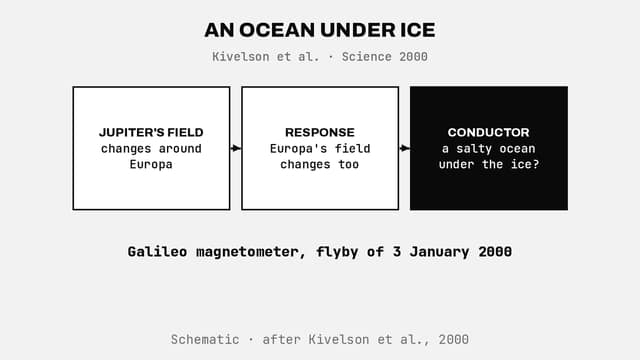
Kivelson et al. (Science, 2000) analysed a Galileo flyby of Europa on 3 January 2000, when the moon sat far south of Jupiter's magnetic equator and the external field had a previously unexamined orientation. The magnetometer recorded the changes predicted for an induced field from a current-carrying outer shell, such as a planet-scale liquid ocean beneath the ice, rather than a permanent internal dipole, strengthening the case for a subsurface ocean. Today's sodium study traces salts that may come from that ocean.