News & Ideas is a daily letter for anyone who wants the day's science in one place, not a feed. Each day is 4 news items and 3 ideas across AI & Tech, Physics & Engineering, Biology & Nature, and Mind & Society, and every story names a primary source you can check. The Shorts use a declared synthetic voice.
One email a day. 4 science stories, 5 quick results, 1 idea. 3 minutes.
Plus a daily quiz: Answer & Learn. Free, unsubscribe anytime.
Issue
21 November 2026
4 min read · 1 Short
Biology & Nature: river fish older than Montana, killer whales two million years ago, male bumblebees that help at home, reef fish and ocean acidification. Then bomb-pulse dating, fish-eaters and mammal-eaters, a result that didn't replicate.
One email a day. 4 science stories, 5 quick results, 1 idea. 3 minutes.
Plus a daily quiz: Answer & Learn. Free, unsubscribe anytime.
Biology & Nature
River Fish That Live 131 Years
Biology & Nature: river fish older than Montana, killer whales two million years ago, male bumblebees that help at home, reef fish and ocean acidification. Then bomb-pulse dating, fish-eaters and mammal-eaters, a result that didn't replicate.
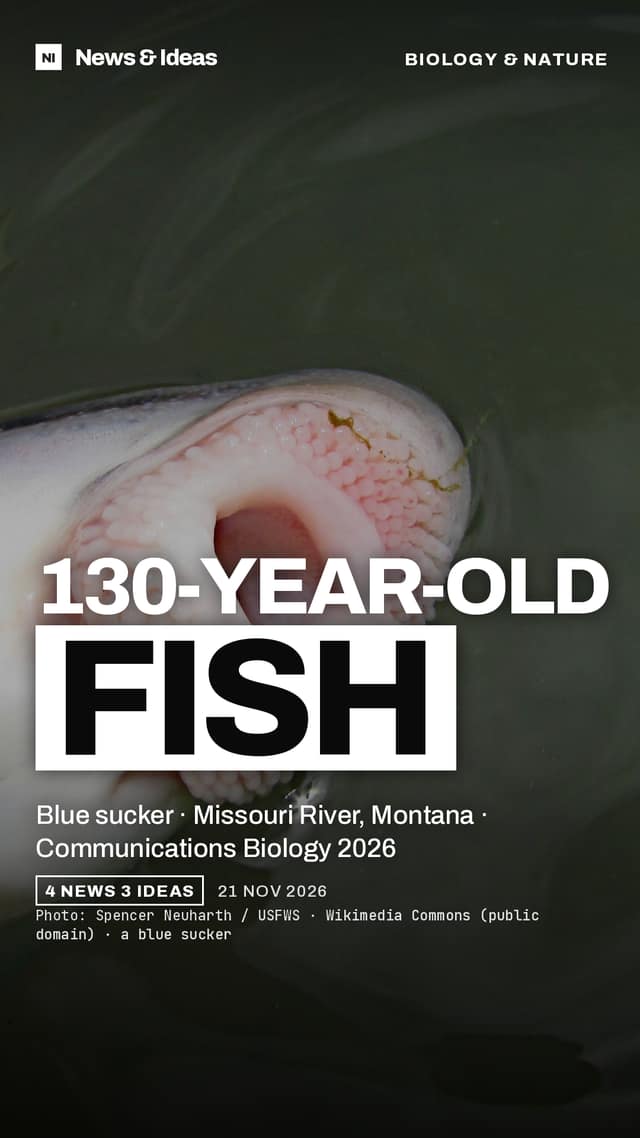
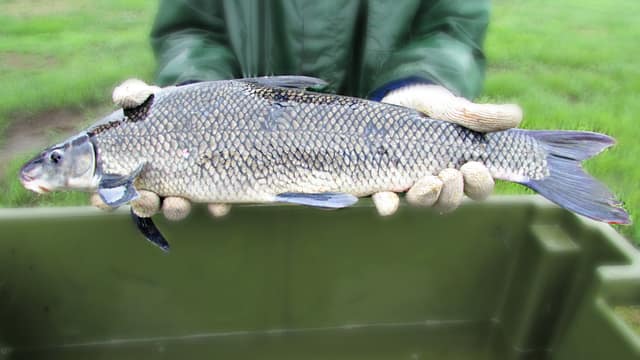
A team co-led by Alec Lackmann (University of Minnesota Duluth), Luke Holmquist (Montana Fish, Wildlife & Parks) and Allen Andrews (University of Hawai'i at Mānoa) examined otoliths, the ear stones, of 42 blue suckers (Cycleptus elongatus) from the Missouri River in Montana. Annual growth rings gave ages up to 131 years, 70 years older than previously reported, and the counts were validated with bomb radiocarbon dating, which uses the carbon-14 spike from mid-20th-century nuclear tests as a time marker. The oldest fish hatched in 1892, three years after Montana became a state in 1889. Three decades of Montana survey data show virtually no young blue suckers entering the population, suggesting recruitment failure possibly due to habitat fragmentation by large dams. The species is native to 23 US states and considered imperilled in 22 of them. It is the fourth sucker-family fish found to live more than 100 years, all since 2019.
One email a day. 4 science stories, 5 quick results, 1 idea. 3 minutes.
Plus a daily quiz: Answer & Learn. Free, unsubscribe anytime.
Nature · Fossils
Killer Whales Two Million Years Ago
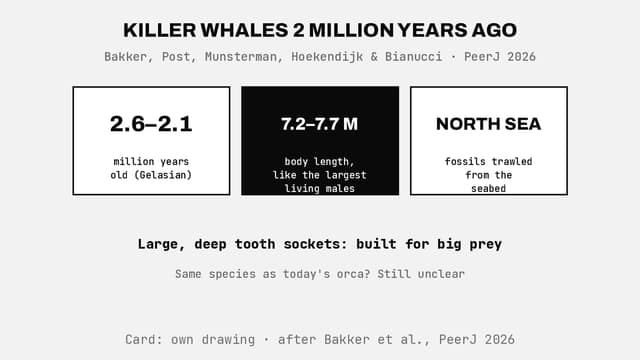
Hidde Bakker (Natural History Museum Rotterdam) and colleagues studied two skull fragments, part of a lower jaw and fused neck vertebrae of ancient orcas, recovered from the seabed of the southern North Sea by commercial fishing trawlers. Microfossils of marine algae in sediment attached to a skull fragment date them to the Gelasian, about 2.6 to 2.1 million years ago. 3D comparisons with a modern skeleton gave the larger individuals a body length of 7.2–7.7 metres, comparable to the largest living male Orcinus orca, and the jaw had large, deep, widely spaced tooth sockets suggesting large, strongly rooted teeth fit for big prey. Genetic studies had placed the emergence of orca hunting specialisations in the Middle Pleistocene, 770,000 to 120,000 years ago. It is unclear whether the fossils belong to O. orca or to an undescribed large species of the genus.
Card: own drawing · after Bakker et al., PeerJ 2026
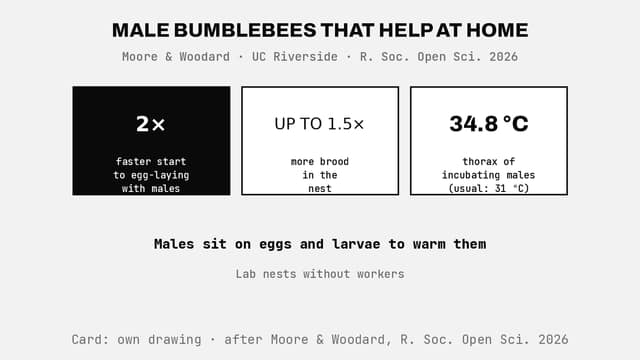
Meghan Moore and Hollis Woodard (University of California, Riverside) set up lab nests of the bumblebee Bombus impatiens, each with a mated queen and no males, one, three or five males, and no female workers, and tracked them for about a month with thermal imaging. Males adopted the incubation posture over eggs and larvae; incubating males had thorax temperatures of about 34.8 °C compared with a more usual 31 °C. Queens with males in their nests began laying eggs twice as fast and ended up with up to 1.5 times more brood. Caveats: the setup was artificial, since early nests normally contain a queen and workers, and males could not leave; how long males stay in wild nests is unknown.
Card: own drawing · after Moore & Woodard, R. Soc. Open Sci. 2026
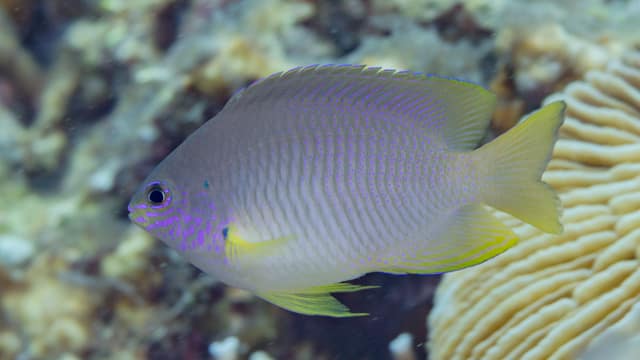
Dominique Roche, Sandra Binning (Université de Montréal) and colleagues worked at Lizard Island Research Station with 74 juvenile Ambon damselfish (Pomacentrus amboinensis). Each fish was filmed four times in a novel-object test: twice in present-day water, then twice after four to six days in water acidified to end-of-century levels or left untreated. Behaviour was consistent between trials and acidity made no difference, either to group averages or to individual behaviour. In a final trial with a predatory rock cod (Cephalopholis microprion), acidity did not change the odds of escape; fish that had spent the most time inspecting the strange object were about 2.7 times more likely to be eaten. A few days of exposure say nothing about lifelong exposure, the authors note.
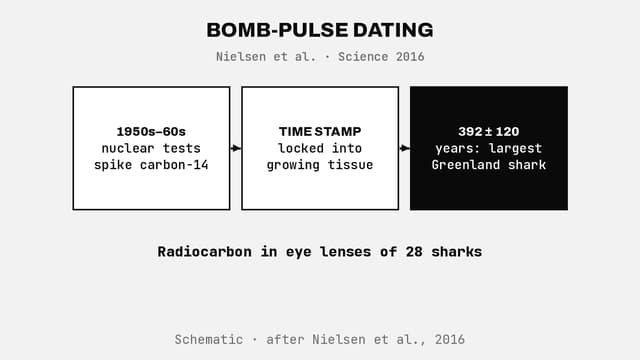
Nielsen et al. (Science, 2016) applied radiocarbon dating to eye-lens nuclei of 28 female Greenland sharks; only the smallest showed the bomb pulse, the early-1960s time marker from nuclear tests. The species' lifespan was at least 272 years, making it the longest-lived vertebrate known; the largest animal, 502 cm long, was estimated at 392 ± 120 years, and sexual maturity was put at no earlier than about 156 ± 22 years. The blue sucker study used the same bomb carbon signal to validate its otolith counts.
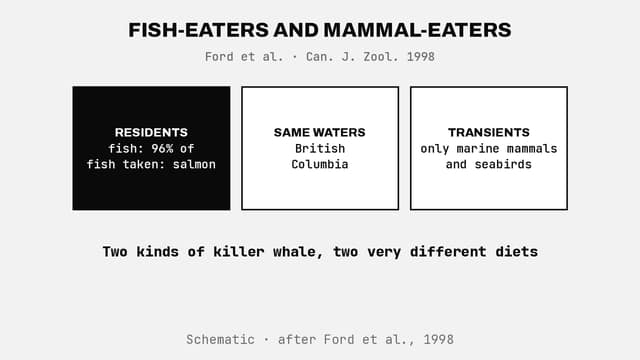
Ford et al. (Canadian Journal of Zoology, 1998) analysed 20 years of predation observations and stomach contents of stranded killer whales in coastal British Columbia, Washington and southeastern Alaska. Residents took 22 fish species and one squid, but 96% of fish taken in field observations were salmonids, mostly chinook salmon; transients were observed preying only on pinnipeds, cetaceans and seabirds, with over half of attacks on harbour seals. Diet specialisation between ecotypes living in the same waters helps explain how the species became such a versatile apex predator.
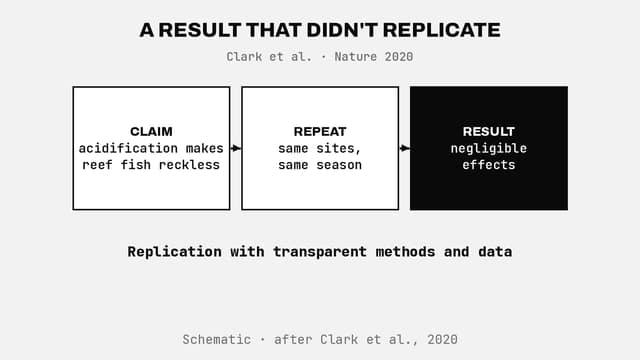
Clark et al. (Nature, 2020) tried to replicate prominent claims that end-of-century ocean acidification levels severely alter the behaviour of coral reef fishes, including predator avoidance. Returning to the sites and season of the original studies, with transparent methods and data, they found negligible effects of elevated CO2 on behaviours such as avoidance of predator cues and activity levels. Today's damselfish field study points the same way.