News & Ideas is a daily letter for anyone who wants the day's science in one place, not a feed. Each day is 4 news items and 3 ideas across AI & Tech, Physics & Engineering, Biology & Nature, and Mind & Society, and every story names a primary source you can check. The Shorts use a declared synthetic voice.
One email a day. 4 science stories, 5 quick results, 1 idea. 3 minutes.
Plus a daily quiz: Answer & Learn. Free, unsubscribe anytime.
Issue
10 November 2026
2 min read · 1 Short
Biology & Nature: One Coral Colony as Long as 100 Buses, A Hidden Lipid Shield Keeps Fly Pupae From Drying Out, Viral DNA Hides in Songbirds' Germline Chromosomes, Darwin Wasps Rarely Reverse Their Parasite Strategy. Then Clonal Colonies: Where Does an Individual End?, Cuticular Hydrocarbons: Waterproofing and Signal, Dollo's Law and One-Way Evolution.
One email a day. 4 science stories, 5 quick results, 1 idea. 3 minutes.
Plus a daily quiz: Answer & Learn. Free, unsubscribe anytime.
Biology & Nature
Coral Colony Mapped as Long as 100 Buses
Biology & Nature: One Coral Colony as Long as 100 Buses, A Hidden Lipid Shield Keeps Fly Pupae From Drying Out, Viral DNA Hides in Songbirds' Germline Chromosomes, Darwin Wasps Rarely Reverse Their Parasite Strategy. Then Clonal Colonies: Where Does an Individual End?, Cuticular Hydrocarbons: Waterproofing and Signal, Dollo's Law and One-Way Evolution.
Queensland Museum reports that researchers mapped a rose coral (Pachyseris) colony 1.56 km long on the outer reef of the Cocos (Keeling) Islands, about 100 buses end to end, between 14 and 65 m deep, averaging 36.5 m wide (about 56,940 m²). Lead researcher JP Hobbs (Adelaide University) used GPS to mark progress between dives; mapping took 12 dives. Local dive operator Dieter Gerhard first spotted it more than 30 years ago. It is not yet known whether it is one organism or several colonies fused together: genetic tests are under way. Source is a Queensland Museum press release (via phys.org); no paper has been published.
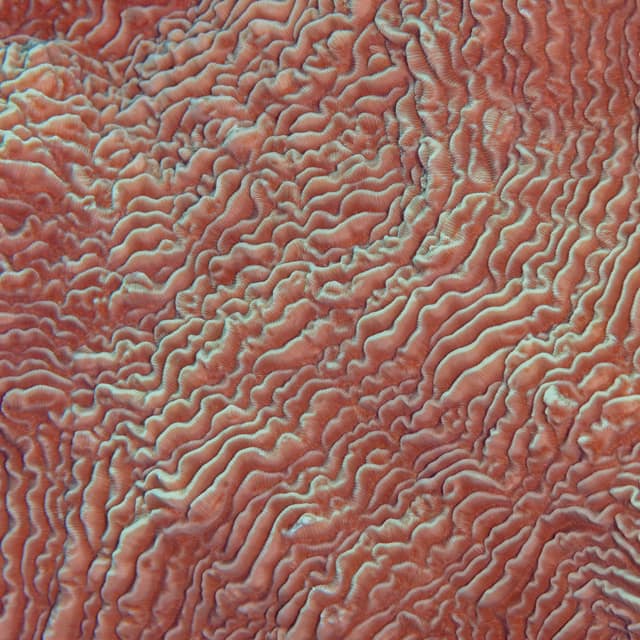
Photo: Diego Delso, Wikimedia Commons (CC BY-SA 4.0) · illustrative Pachyseris speciosa, Red Sea, not the Cocos colony
One email a day. 4 science stories, 5 quick results, 1 idea. 3 minutes.
Plus a daily quiz: Answer & Learn. Free, unsubscribe anytime.
Biology & Nature
A Hidden Lipid Shield Keeps Fly Pupae From Drying Out
Lampe, Gould and colleagues (Francis Crick Institute) identify a lipid barrier to water loss in the Drosophila pupa, made of hyperlong hydrocarbons produced by larval oenocytes and stored in the fat body; the elongase EloHL is required for it. In the desert species D. mojavensis, adults keep the hyperlong hydrocarbons (Science Advances, 6 Nov 2026).
Viral DNA Hides in Songbirds' Germline Chromosomes
Fang and Edwards (Harvard) report that germline-restricted chromosomes of the house finch, common rosefinch and blue tit are rich in endogenous retroviruses that remain active and expressed; their expansion coincided with bursts of songbird speciation (Current Biology). Correlation, not causation: "It's a mystery still," says Edwards.
Darwin Wasps Rarely Reverse Their Parasite Strategy
Santos, Brady and colleagues used DNA from nearly 700 species, including museum specimens up to 70 years old, to build the most comprehensive tree of Ichneumonidae. Living inside a still-active host evolved dozens of times and almost never reverted to host paralysis (Current Biology, 6 Nov 2026).
Many reef animals grow as modules that can fragment and spread, so one genetic individual (a genet) may span many physically separate pieces (ramets), and only genetics can tell. The Cocos Pachyseris colony is awaiting exactly such tests.
Insects coat themselves in waxy hydrocarbons that limit water loss and also act as chemical signals; chain length tunes drought resistance, as in the Drosophila pupa's hyperlong barrier.
Complex traits once lost or transformed are rarely regained in the same form; there are exceptions, but many transitions behave like one-way streets, as with Darwin wasps' parasitism.