News & Ideas is a daily letter for anyone who wants the day's science in one place, not a feed. Each day is 4 news items and 3 ideas across AI & Tech, Physics & Engineering, Biology & Nature, and Mind & Society, and every story names a primary source you can check. The Shorts use a declared synthetic voice.
One email a day. 4 science stories, 5 quick results, 1 idea. 3 minutes.
Plus a daily quiz: Answer & Learn. Free, unsubscribe anytime.
Issue
17 November 2026
3 min read · 1 Short
Biology & Nature: two gorillas build a living ladder, chicken neurons that survive without oxygen, a virus that crashed a frog population, the genetics of blue-eyed cats. Then choosing a partner, surviving without oxygen, incomplete penetrance.
One email a day. 4 science stories, 5 quick results, 1 idea. 3 minutes.
Plus a daily quiz: Answer & Learn. Free, unsubscribe anytime.
Biology & Nature
Two Gorillas Form a 'Living Ladder'
Biology & Nature: two gorillas build a living ladder, chicken neurons that survive without oxygen, a virus that crashed a frog population, the genetics of blue-eyed cats. Then choosing a partner, surviving without oxygen, incomplete penetrance.
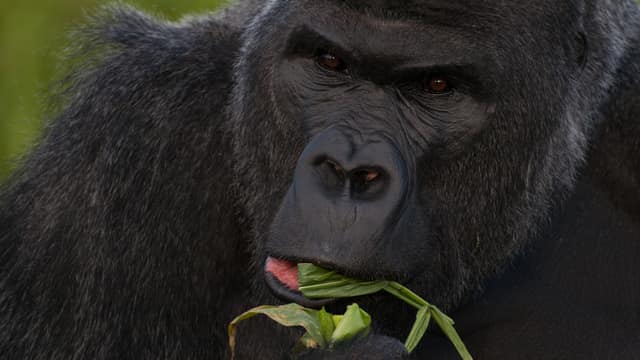
Michael Levitzky and Israel Hershkovitz (Tel Aviv University) describe a recurring cooperation between two captive adult female western lowland gorillas at the Ramat Gan Safari, the half-sisters Amelia (dominant) and Lisha (subordinate). In the main event, recorded by security cameras in 2024, Lisha stood on all fours on a rock and Amelia climbed onto her back to break off a Peltophorum dubium branch about 4.5 m above the ground; roles were the same in events from 2021 to 2025, and the behaviour was not trained. In 2024 they then fed together; in 2025 Amelia ate alone. The authors note the limits: two individuals, few events, no audio to tell how they coordinated. Primates (2026).
One email a day. 4 science stories, 5 quick results, 1 idea. 3 minutes.
Plus a daily quiz: Answer & Learn. Free, unsubscribe anytime.
Neuroscience · Physiology
Chicken Neurons That Outlast No Oxygen
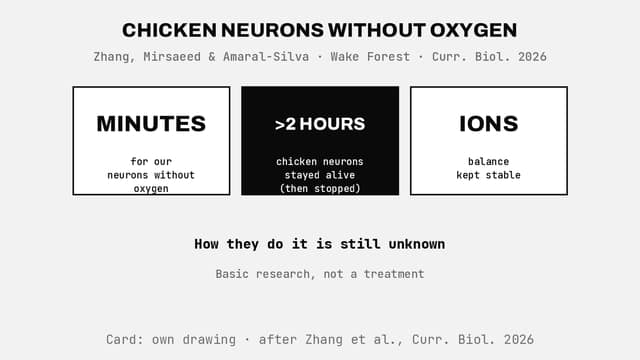
Tuokai Zhang, Mehrad Ghazi Mirsaeed and Lara do Amaral-Silva (Wake Forest University) report that chicken neurons survive severe hypoxia by preserving ionic homeostasis: in their experiments the cells kept a stable balance of ions and stayed alive for more than two hours without oxygen, the point at which measurements stopped, and regions involved in learning and memory kept working. Chickens are not adapted to low oxygen like turtles or diving seals, which makes the result surprising. The mechanism is not yet known; the authors hope it could inform neuroprotection research. Basic research, not a treatment. Current Biology (2026).
Card: own drawing · after Zhang et al., Curr. Biol. 2026
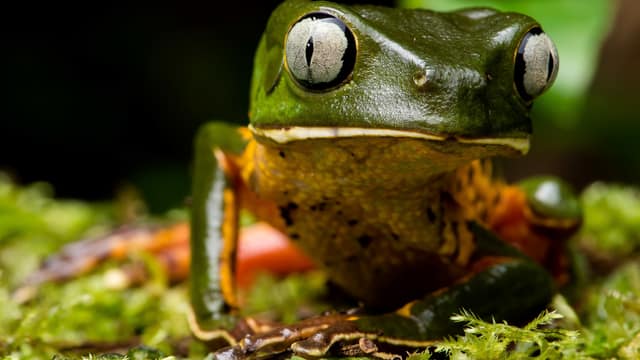
Aline Fonseca and colleagues (Federal University of Paraná, UNICAMP, Rã-Bugio Institute) linked recurring ranavirus outbreaks to the decline of the monkey frog Phyllomedusa distincta in a pond in Santa Catarina, Brazil. Three mass-mortality events (January 2024; November 2024–January 2025; November 2025–March 2026) left 324 dead tadpoles, 315 of them monkey frogs; 88.6% of the monkey frogs tested positive, and liver histology confirmed the disease. Compared with counts from 1999–2004, egg masses dropped by an estimated 83%. Outbreak risk rose sharply when humidity fell from 90% to 65% two weeks earlier. The authors call it the first proof in South America of ranavirus killing a native species. Biodiversity and Conservation, open access (CC BY 4.0).
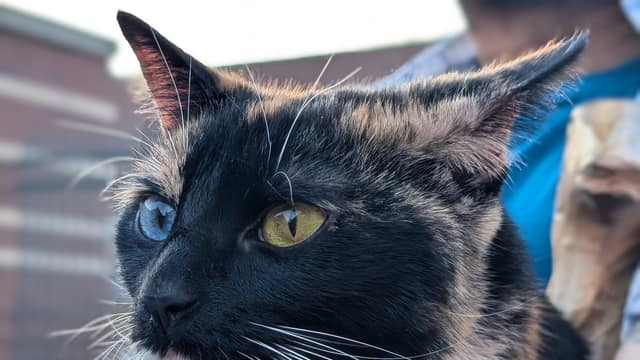
Olga Shatokhina and colleagues review 'dominant blue eye' (DBE) in cats with coloured coats. Unlike blue eyes in colourpoint cats (TYR) or white cats (KIT), the six DBE variants described in peer-reviewed literature involve the PAX3 gene; eight variants have now been reported, two of them only by a testing laboratory. Expression varies and penetrance is incomplete. DBE RE has been associated with deafness in some heterozygous cats and homozygosity is predicted to be lethal before birth; for other variants, BAER-confirmed deafness has not been reported, but few cats have been tested. The authors recommend identifying the variant and BAER hearing tests. Review, Companion Animal Health and Genetics, open access (CC BY-NC-ND 4.0).
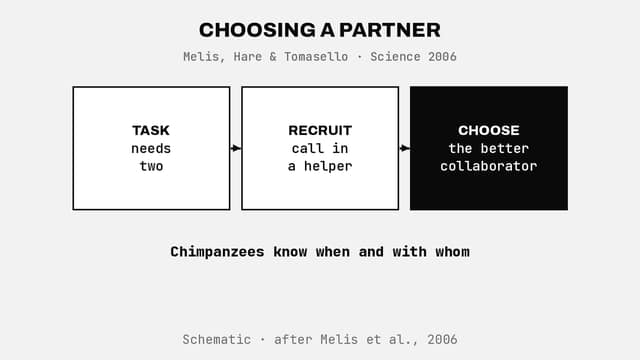
Melis, Hare and Tomasello (Science, 2006) showed that chimpanzees recognise when collaboration is necessary, recruit a partner, and learn which partner is the more effective collaborator, suggesting these skills may predate human cooperation. Gorillas have been studied less for spontaneous cooperation; the Ramat Gan 'living ladder' is a rare case of role-specialised teamwork between adult gorillas.
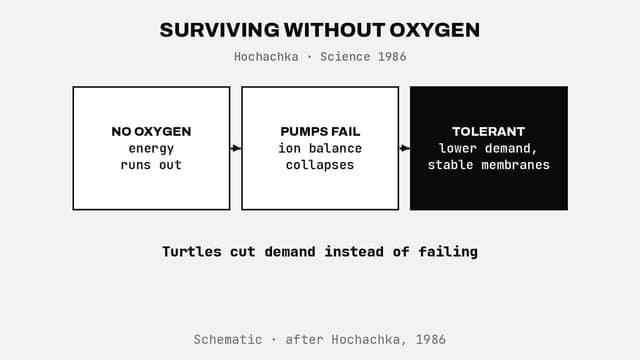
Without oxygen, cells run short of ATP, ion pumps fail and ion gradients collapse. Peter Hochachka (Science, 1986) reviewed how hypoxia-tolerant animals defend themselves: metabolic arrest (lower energy demand) and stabilised membrane functions, which keep ion balance with less energy. Chicken neurons, which are not hypoxia-adapted, also preserve ionic homeostasis without oxygen; the mechanism is still unknown.
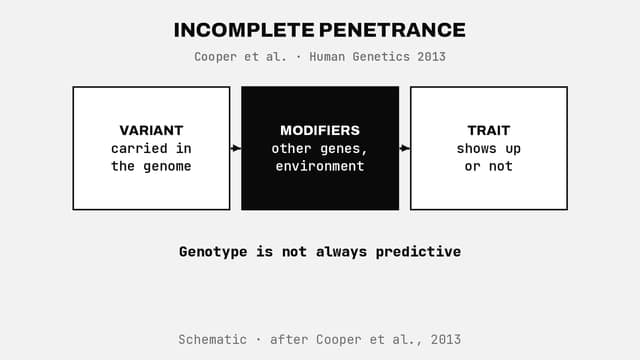
Penetrance is the share of carriers of a variant who show the associated trait. Cooper and colleagues (2013) reviewed why it is often incomplete: modifier genes, regulatory variation, epigenetics and environment can all change whether and how a variant is expressed, so genotype is not always predictive of phenotype. Some cats carrying a dominant blue-eye variant show no blue eyes. Open access (CC BY 2.0).