News & Ideas is a daily letter for anyone who wants the day's science in one place, not a feed. Each day is 4 news items and 3 ideas across AI & Tech, Physics & Engineering, Biology & Nature, and Mind & Society, and every story names a primary source you can check. The Shorts use a declared synthetic voice.
One email a day. 4 science stories, 5 quick results, 1 idea. 3 minutes.
Plus a daily quiz: Answer & Learn. Free, unsubscribe anytime.
Issue
4 November 2026
4 min read · 1 Short
Biology & Nature: Caribbean forest lizards raise their heat tolerance by 2 °C in a decade, two new armoured tardigrades from a seamount, a 6-gram 360° camera on a hunting hawk, common loons raising fewer chicks. Then the Bogert effect, saccade and fixate, long-lived birds.
One email a day. 4 science stories, 5 quick results, 1 idea. 3 minutes.
Plus a daily quiz: Answer & Learn. Free, unsubscribe anytime.
Biology & Nature
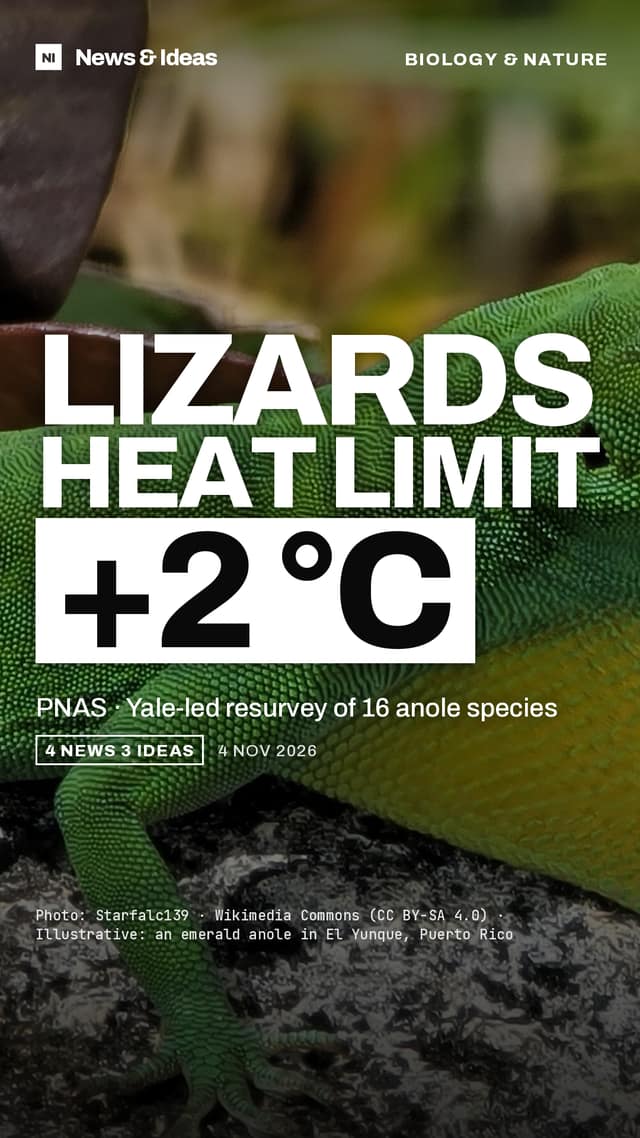
Forest Lizards Raised Their Heat Tolerance by 2 °C in a Decade
Biology & Nature: Caribbean forest lizards raise their heat tolerance by 2 °C in a decade, two new armoured tardigrades from a seamount, a 6-gram 360° camera on a hunting hawk, common loons raising fewer chicks. Then the Bogert effect, saccade and fixate, long-lived birds.
Forest Lizards Raised Their Heat Tolerance by 2 °C in a Decade
Caribbean forest lizards raised their heat tolerance by 2 °C in a decade
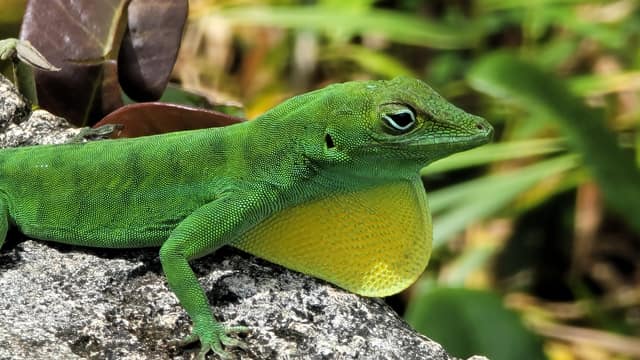
A team led by Yale remeasured the maximum temperature that 16 anole lizard species from Hispaniola, Jamaica and Puerto Rico can tolerate, comparing data from 2011 to 2013 with new data from 2022 to 2025. Species of open or edge habitats, such as dry forests, regulate their temperature by moving between sun and shade, and their heat tolerance rose little or not at all. Species of closed, thermally uniform forest, which cannot escape that way, raised their heat tolerance by 2 °C on average over the same period. Seasonal comparisons, acclimation experiments and lab rearing, including of offspring, point to a mix of rapid evolution and physiological plasticity. What mattered was thermal ecology, not relatedness or geography. The researchers warn of a likely evolutionary ceiling beyond which bodies can no longer adapt. Peer-reviewed.
Photo: Starfalc139 · Wikimedia Commons (CC BY-SA 4.0) · Illustrative: an emerald anole, El Yunque
One email a day. 4 science stories, 5 quick results, 1 idea. 3 minutes.
Plus a daily quiz: Answer & Learn. Free, unsubscribe anytime.
Biology · Deep sea
Two new armoured tardigrades from a seamount off Cape Verde
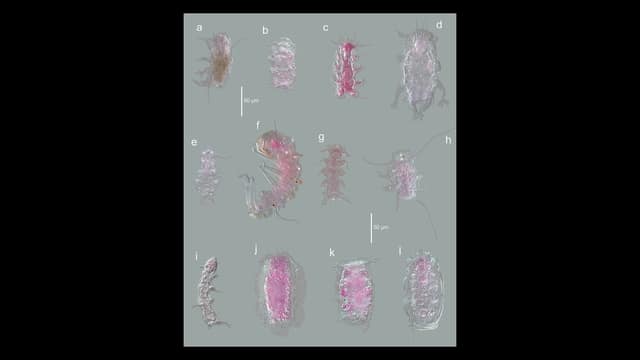
From sediment collected in 2009 by the research vessel Meteor on Senghor Seamount, an undersea mountain near Cape Verde, zoologists described two new species of armoured marine tardigrades, Megastygarctides hekatae and Parastygarctus potercha. On the seamount they found 20 tardigrade taxa, against only 2 at a reference site on the surrounding abyssal plain. M. hekatae has rare genital spines; P. potercha keeps juvenile features as an adult. The authors read this as confirmation that seamounts are diversity hotspots for tardigrades, an argument for protecting places also targeted by fishing and mining. Peer-reviewed, open access.
Figure: Trokhymchuk et al., ZooKeys 1295 (CC BY 4.0)
A 6-gram 360° head camera shows how a hawk tracks its prey
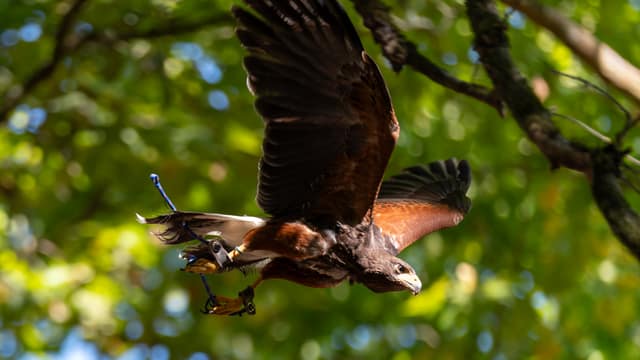
Researchers at the Max Planck Institute for Neurobiology of Behavior in Bonn built a head camera of about 6 grams with two 210° lenses that together cover the whole field around a bird's head, and reconstructed the bird's position to the centimetre over an open area of about 12,000 square metres mapped in 3D by drone. Two Harris's hawks chased a lure pulled on a car roof at up to 80 km/h. During the pursuit they kept the target ahead of the head with smooth movements; after the catch they switched to rapid head saccades. The authors caution that head direction is not gaze, and with 2 birds and 9 flights this is a proof of principle; a version with eye tracking is in development. Peer-reviewed, open access.
Photo: Jules Verne Times Two · Wikimedia Commons (CC BY-SA 4.0) · Illustrative: a Harris's hawk in flight, not a study bird
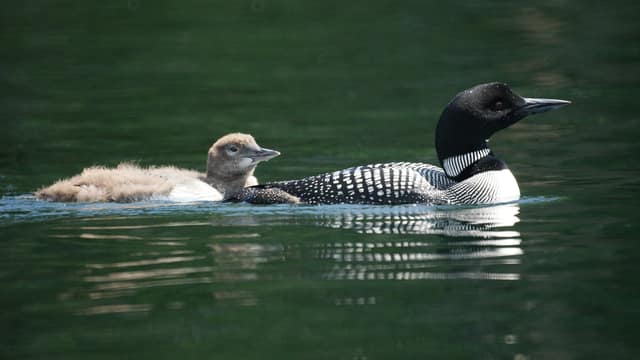
Common loons are raising fewer chicks across Canada and the northern US
A study pooled 45,591 breeding events from 12 populations of common loons on 3,421 lakes between 1975 and 2023, across Canada and the northern United States. Chicks per pair fell significantly in 7 regions, by 0.17% to 2.8% a year, fell non-significantly in 4 more, and rose, also non-significantly, only in Maine. All regions are still above the 0.48 chicks per pair thought necessary for stability. Suspected causes include heavier rain, lead fishing tackle and mercury. Because loons live long, adults can mask a breeding decline for years, so chick counts work as an early warning. Peer-reviewed, open access.
Photo: Mike's Birds from Riverside, CA, US · Wikimedia Commons (CC BY-SA 2.0) · a common loon with chick
Behaviour can shield an animal from natural selection. One that chooses where to be, sun or shade, rock or burrow, experiences a different climate from the average, so selection on its physiology weakens: the Bogert effect, or behavioural inertia. The same behaviour can expose it to new pressures and speed up the evolution of other traits, behavioural drive. On Hispaniola's mountains, the anole Anolis cybotes basks on sunny boulders at altitude, so it does not evolve different cold tolerance, but its skull and limbs change for life on rocks. In today's study, open-habitat species that can shelter changed little; closed-forest species that cannot shifted by 2 °C.
Saccade and fixate: why animals move their eyes in jumps
An image that moves across the retina blurs. So almost all animals with good eyes use the same strategy: they hold their gaze still, then shift it in very fast jumps, saccades, during which vision counts for little. Birds, whose eyes move little, do it with the head, which is why pigeons and chickens bob. The Harris's hawks kept their prey centred with smooth head movements during the chase and switched to head saccades after the catch; in 2015 a camera on a goshawk's head had shown it chasing prey while holding it at a constant visual angle.
Land, J. Comp. Physiol. A 1999 · Kane, Fulton & Rosenthal, J. Exp. Biol. 2015
Slow lives, late alarms: the demography of long-lived birds
In long-lived species that mature late and raise few young, population growth depends above all on adult survival. A drop in breeding therefore does not show at once in counts: adults keep returning for years, then the population ages and falls quickly. In short-lived species with big broods, fecundity matters more. The common loon is long-lived, which is why researchers track chicks per pair as an early warning, before adult numbers fall.