News & Ideas is a daily letter for anyone who wants the day's science in one place, not a feed. Each day is 4 news items and 3 ideas across AI & Tech, Physics & Engineering, Biology & Nature, and Mind & Society, and every story names a primary source you can check. The Shorts use a declared synthetic voice.
One email a day. 4 science stories, 5 quick results, 1 idea. 3 minutes.
Plus a daily quiz: Answer & Learn. Free, unsubscribe anytime.
Issue
4 November 2026
5 min read · 1 Short
AI & Tech: AI agents run a quantum-spin lab and rule their own passing run inconclusive, a model that rewrites another model's weights, latent sparse attention up to 10 million tokens, one robots.txt line to opt out of AI training. Then self-preference bias, directional ablation, routing attention.
One email a day. 4 science stories, 5 quick results, 1 idea. 3 minutes.
Plus a daily quiz: Answer & Learn. Free, unsubscribe anytime.
AI & Tech
AI Agents Ran a Quantum Experiment, Then Doubted Their Result
AI & Tech: AI agents run a quantum-spin lab and rule their own passing run inconclusive, a model that rewrites another model's weights, latent sparse attention up to 10 million tokens, one robots.txt line to opt out of AI training. Then self-preference bias, directional ablation, routing attention.
AI Agents Ran a Quantum Experiment, Then Doubted Their Result
AI agents ran a quantum-spin experiment and ruled their own passing run inconclusive (preprint)
At the Institute of Science Tokyo, a team of AI agents ran a real experiment on nitrogen-vacancy spins in diamond: one acted as principal investigator, others proposed ideas, ran computations and drove the instrument, and a safety agent enforced preset voltage and power limits. Humans built the apparatus. The agents proved that L squared plus one calibration measurements are necessary and sufficient to predict the ensemble's response to any sequence of up to L pulses, and fixed their predictions and acceptance criteria before seeing data. The first run met all ten accuracy criteria, but two control checks failed: the signal drifted up 7.6% during the morning, with a 2.9% step at 11:48 when a lab member switched on the room lights. The agents called the run inconclusive. A six-hour randomised rerun with 21,600 valid records passed every criterion and control: measured contrast 40.0 ± 0.4 against a predicted 39.7 ± 1.3 (×10⁻³). Preprint, not yet peer-reviewed.
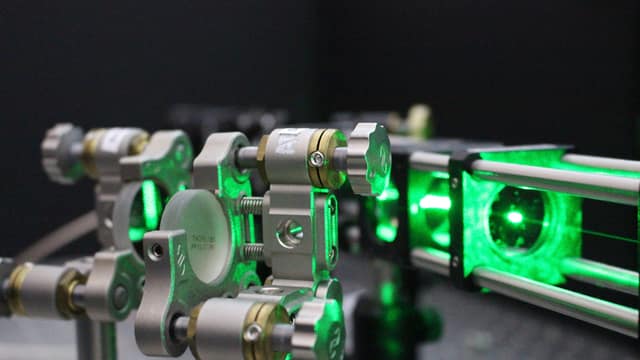
Photo: Gavin Morley · Wikimedia Commons (CC BY-SA 4.0) · Illustrative: NV-diamond setup at Warwick, not Tokyo
One email a day. 4 science stories, 5 quick results, 1 idea. 3 minutes.
Plus a daily quiz: Answer & Learn. Free, unsubscribe anytime.
AI · Interpretability
A model that reads and rewrites other networks' weights without training (research blog)
MIT CSAIL researchers report that GPT-6 Astra can read and write neural-network weights directly, with no gradient descent. From only the 17,253 weights of a game-playing policy, it identified the game, Breakout, for all four networks tested. It wrote small MinAtar networks from scratch in a single response that beat a PPO agent trained for 100 million steps in all three games; in Breakout, 517.4 against 15.8. In the small language model Qwen3.5-0.8B it traced reasoning loops to one direction written by two MLP layers and subtracted it from 131,072 weights, 0.016% of the model: MATH-500 rose from 7.9% to 48.1%, GSM8K from 13.8% to 67.1% and IFEval from 21.0% to 62.3%. The authors note the limits: on Gemma 3 270M, which does not loop, maths did not improve, because it could not add an ability the model lacked. A research blog post with public logs, not a peer-reviewed paper.
Photo: Egaowakaii · Wikimedia Commons (CC BY-SA 3.0) · Illustrative: the Stata Center, home of MIT CSAIL
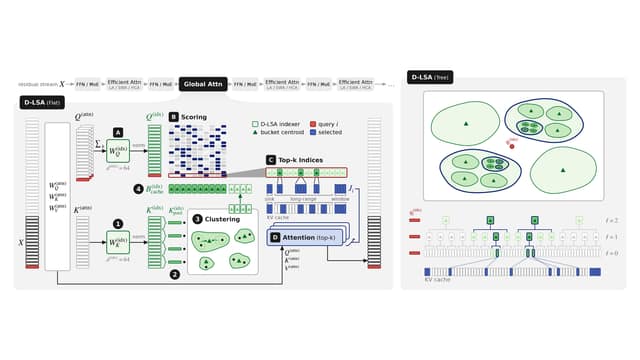
Latent Sparse Attention searches clusters of keys, not every key, up to 10M tokens (preprint)
In today's sparse attention, an indexer still scores every earlier key; at 10 million tokens, that indexing takes 98% of a sparse layer's prefill time. Latent Sparse Attention, from Prefrontal AI and ETH Zurich, groups keys into hierarchical clusters in a learned latent space, so each query scores only cluster centroids. Added to pretrained models by distilling small projections, it ran a single attention layer at 10 million tokens 22.7 times faster in prefill and 4.6 times faster in decode than GLM-5.3-Flash's own sparse attention, and 72.4 and 42.5 times faster than full attention on Qwen-3.8-27B, with similar accuracy on RULER and a new scientific-paper benchmark. A native version matched full attention while training 1.6 times faster per layer at 128k tokens. Speedups are per layer, not end to end. Preprint; code released.
Figure: Kubicek, Caciolai, Peng et al., arXiv 2610.42147 (CC BY 4.0)
One robots.txt line to opt out of AI training (company announcements, draft)
A new robots.txt token, __usage_ai-training, lets a website state one preference about AI training for all crawlers, used like a user-agent group with Allow and Disallow lines. It expresses a preference and does not block crawling; the catch-all User-Agent star group never triggers it, and existing robots.txt files count as no preference. It is described in an individual Internet-Draft by Kevin Kelley of Anthropic, not an IETF standard. Google says that if a site opts out with the token and does not name Google-Extended, it will treat it as if the publisher had disallowed Google-Extended, with support planned for 2027. According to The Verge, Anthropic has already adopted it, Microsoft plans support in 2027, OpenAI says in the coming months, and Meta voiced support without saying it will honour it. Company announcements.
Self-preference bias: keep the maker and the judge apart
Language models that grade outputs tend to favour their own. Panickssery, Bowman and Feng showed that models can recognise their own text, and that the stronger this self-recognition, the stronger the self-preference, in a roughly linear relation. That is a reason to separate the generator, the reviewer and criteria fixed in advance. In the Tokyo lab, proposals, the principal investigator and the experimentalist are distinct agents, and predictions and acceptance criteria were committed before seeing the targets. That is how a run that looked successful still got downgraded.
Many behaviours of a language model are written along a single linear direction in its activations. Remove that direction from the weights that write it and the behaviour switches off while the rest stays nearly intact. Arditi and colleagues showed this for refusal in 13 open models up to 72 billion parameters, which is also a warning about how fragile safety fine-tuning can be. In Weight-Space Programming, Astra found the direction behind reasoning loops in two MLP layers of Qwen3.5-0.8B and subtracted it from 131,072 weights; the blog cites this analogy itself.
Content-based sparse attention: cluster the queries and keys
Comparing every query with every key costs time that grows with the square of the sequence length. A content-based shortcut groups queries and keys into clusters and computes attention only within the matching cluster. The Routing Transformer did this with online k-means and brought the cost down to about n to the power 1.5, times the model dimension. Latent Sparse Attention takes the idea into the indexer, with hierarchical clusters of keys learned in a latent space: the query scores centroids, not keys.