News & Ideas is a daily letter for anyone who wants the day's science in one place, not a feed. Each day is 4 news items and 3 ideas across AI & Tech, Physics & Engineering, Biology & Nature, and Mind & Society, and every story names a primary source you can check. The Shorts use a declared synthetic voice.
One email a day. 4 science stories, 5 quick results, 1 idea. 3 minutes.
Plus a daily quiz: Answer & Learn. Free, unsubscribe anytime.
Issue
2 November 2026
3 min read · 1 Short
AI & Tech: AI edits to 3D code that run but build the wrong shape, Google's quantum circuit contest on Kaggle, an AI agent for immunotherapy side effects, Meituan's LongCat-2.5. Then uncomputation, MAP-Elites, self-consistency.
One email a day. 4 science stories, 5 quick results, 1 idea. 3 minutes.
Plus a daily quiz: Answer & Learn. Free, unsubscribe anytime.
AI & Tech
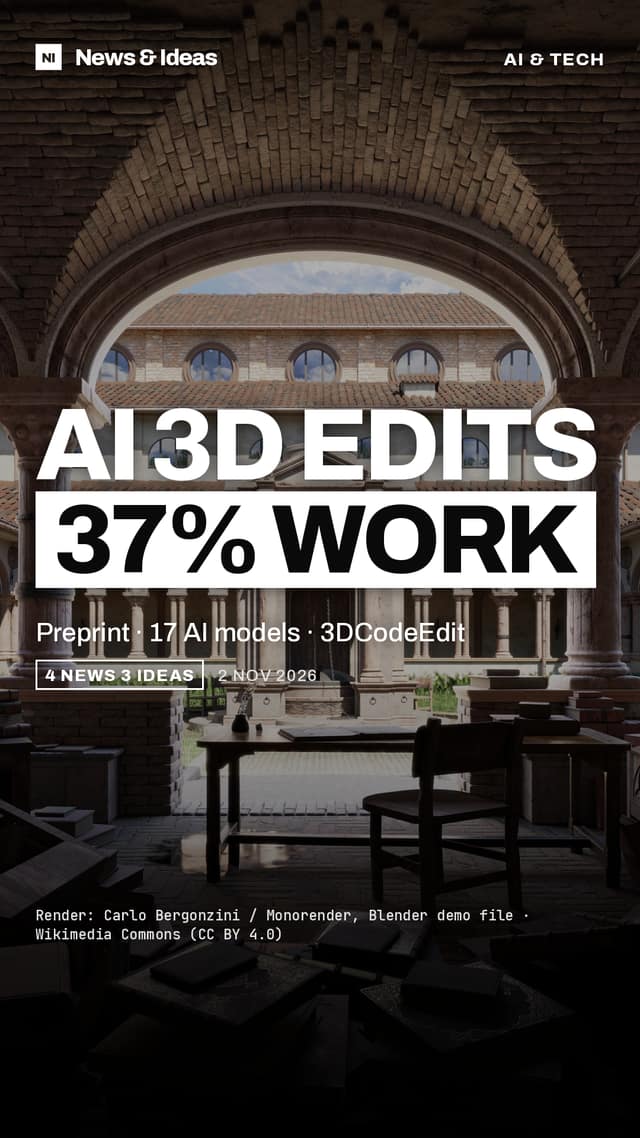
AI Edits 3D Blender Code: Only 37% Pass Every Check
AI & Tech: AI edits to 3D code that run but build the wrong shape, Google's quantum circuit contest on Kaggle, an AI agent for immunotherapy side effects, Meituan's LongCat-2.5. Then uncomputation, MAP-Elites, self-consistency.
AI Edits 3D Blender Code: Only 37% Pass Every Check
AI edits to 3D code often run but build the wrong shape (preprint)
In the 3DCodeEdit benchmark, a preprint from CMU, UNC, NYU and others, 17 AI models made 2,592 edits to 108 Blender programs. On average only 37.1 percent passed every check: 82.9 percent of number changes, 24.6 percent of structural ones. The best, Claude Opus 5.5 and GPT-6.1-sol, reached about 70 percent. A second model that compares the renders with the request lifted GPT-6.1-sol from 64.7 to 85.6 percent.
Render: Carlo Bergonzini / Monorender · Wikimedia Commons (CC BY 4.0) · illustration
One email a day. 4 science stories, 5 quick results, 1 idea. 3 minutes.
Plus a daily quiz: Answer & Learn. Free, unsubscribe anytime.
Computing · Quantum
Google's Kaggle contest: AI agents to shrink quantum circuits
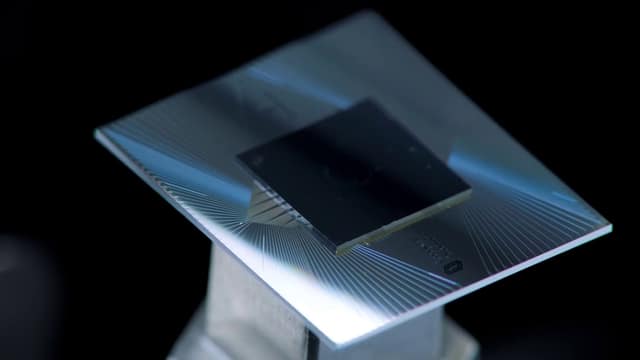
Google Quantum AI opened a Kaggle competition for AI agents that make quantum circuits cheaper, with 150,000 dollars in prizes. The circuits can be simulated classically, so every proposal is checked automatically with random tests. Teams compete to cut Toffoli gates and qubits, on tasks from chemistry to a Reed-Solomon decoder. Company announcement; the method paper is a preprint.
Photo: Google · Wikimedia Commons (CC BY 3.0) · the Sycamore chip, illustration
In Nature Cancer, a Mass General Brigham and Dana-Farber team tested AEGIS, an agent that reads clinical notes for six immune-related side effects of cancer immunotherapy. It scored an F1 of 0.92 at spotting an ongoing event. In a randomized crossover study with 17 reviewers, median time per note fell from 428 to 242 seconds. A simple keyword list did almost as well on yes-or-no detection. Research, not medical advice.
Meituan announced LongCat-2.5, a multimodal mixture-of-experts model with 1.6 trillion parameters, about 48 billion active per token. Meituan says it was trained and runs on Chinese accelerators with under 80 gigabytes of memory each, and that 4-bit inference raises throughput by about 43 percent over 8-bit. Benchmarks are company claims.
LongCat-2.5LongCat / Meituan (company announcement; figures claimed by Meituan) · 1 Nov 2026 · Primary
3 Ideas
Idea · Computing
Uncomputation: cleaning up costs gates
A quantum computer cannot simply erase its scratch work without disturbing the result. It has to uncompute: run the steps backwards to return helper qubits to zero, and that costs gates. In 1973 Charles Bennett showed that any computation can be made reversible. In 2018 Craig Gidney halved the cost of quantum addition by replacing part of the uncomputation with measurements. Much of what Google's Kaggle contest rewards is spending fewer Toffoli gates and qubits on this clean-up.
Bennett, IBM J. Res. Dev. 1973 · Gidney, Quantum 2018
Instead of chasing one best answer, MAP-Elites splits the search space into cells by chosen traits, say few qubits versus few gates, and keeps the best solution in each cell. The result is a map of trade-offs, and it often finds strong solutions a direct search misses. A Harvard-led team paired a language model with OpenEvolve and MAP-Elites to explore quantum circuit variants, and reported a decoder about 12 times cheaper.
Instead of trusting one answer, let the model reason several times independently and keep the answer most paths agree on. Random slips tend not to repeat; correct answers do. Wang and colleagues showed this improves chain-of-thought reasoning. In the Nature Cancer study, three runs plus a judge added 0.14 to the F1 score for spotting side effects.