Anthropic's Claude Security is now in public beta for Claude Enterprise. It scans code continuously as it changes, tracks fixes, and reopens a finding if the bug comes back. Anthropic says thousands of organizations have used it since April.
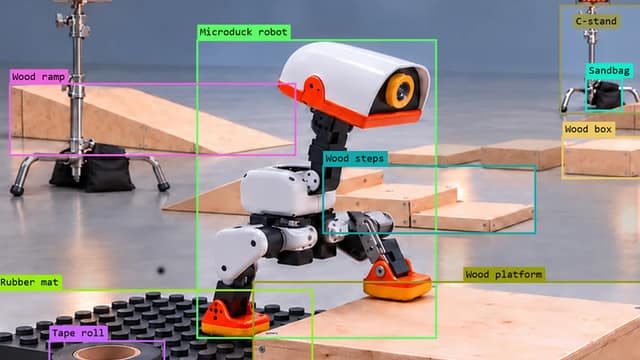
NVIDIA shows AI agents training the small open-source Microduck robot to walk. The Hermes agent, running a Nemotron model, planned the training. The walking policy trained in Isaac Lab across 4,096 parallel simulated environments. So far it was validated in simulation only.
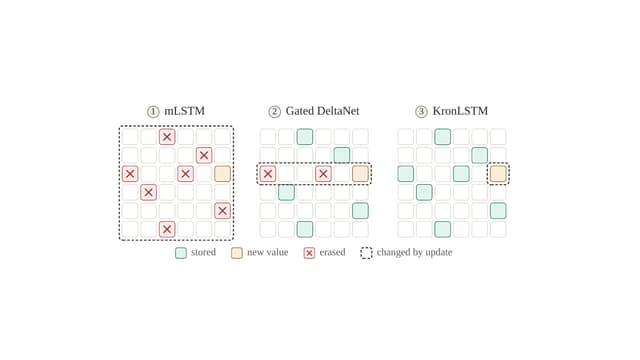
Researchers at JKU Linz and NXAI propose KronLSTM, a new member of the xLSTM family. Its Kronecker delta rule updates memory along a single direction, so new information interferes less with what is stored. On long contexts it is competitive with, and often better than, Gated DeltaNet.
Figure: Hartl et al., arXiv 2610.26834 · CC BY 4.0
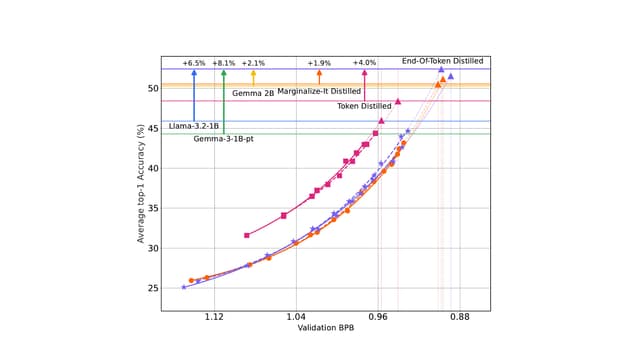
Meta FAIR and University of Washington researchers revisit language models that read raw bytes instead of tokens. Token models plateau, while byte models start worse but have a higher ceiling. Distilled from a token model, a one-billion-parameter byte model matches it with one sixth of the data.
Figure: Marathe et al., arXiv 2609.12303 · CC BY 4.0
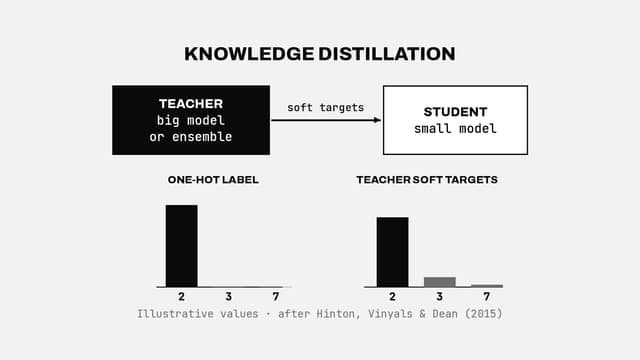
Knowledge distillation. A big teacher model trains a small student, not only on the right answers but on its full probabilities. Shown a handwritten two, the teacher might say: almost surely a two, a tiny chance of a three, even less of a seven. Those soft targets reveal which mistakes are reasonable, information a plain label throws away. That is how this week's byte model learns from a token model.
Hinton, Vinyals & Dean 2015 · arXiv:1503.02531
Diagram: own drawing · Hinton et al. 2015 (illustrative values)
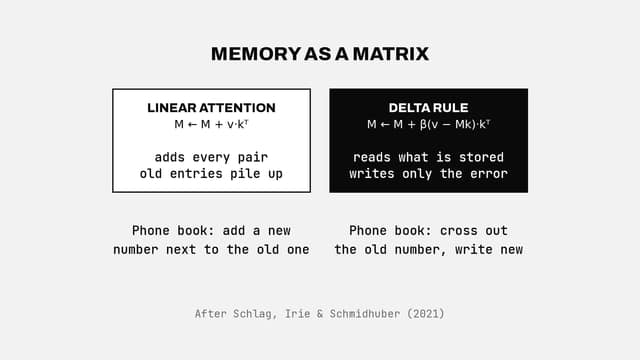
Linear attention can be read as a memory matrix. Each new key and value is simply added on top, so over a long context the entries pile up and blur. The delta rule first reads what the memory already returns for that key, then writes only the error. Like crossing out an old phone number instead of writing a second one beside it. KronLSTM refines exactly this update.
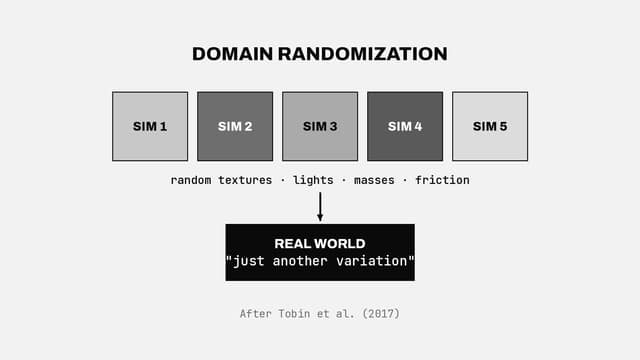
A simulator is never exactly the real world. Instead, make it varied: random textures, lights, masses and friction in every run. If a model copes with all of them, reality may look like just another variation. In 2017, a detector trained only on simulated images located real objects to within one and a half centimetres. Microduck's training uses the same trick.