Claude's scorpion-toxin binders, DeepSeek's DeepInfer, PyTorch on TPUs, METR on Anthropic's risk report. Then typed decisions, speculative decoding and gradient routing.
AI & Tech
Claude's toxin binders, DeepInfer, TorchTPU, METR
Claude's scorpion-toxin binders, DeepSeek's DeepInfer, PyTorch on TPUs, METR on Anthropic's risk report. Then typed decisions, speculative decoding and gradient routing.
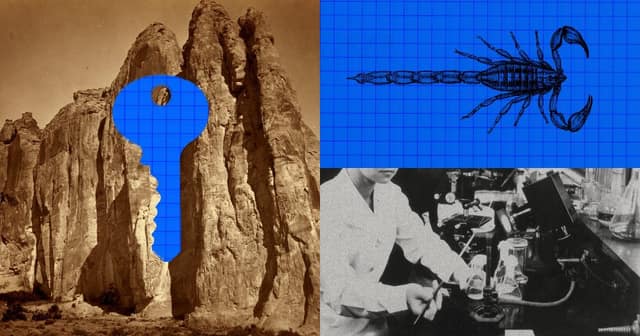
Anthropic reports that Claude, from one prompt and four follow-ups, generated over three hundred thousand protein designs against five scorpion neurotoxins. Of two hundred and eleven tested in labs, seventeen bound a toxin. None is yet shown to neutralize venom.
An AI agent ran most of an early drug-discovery search with real lab validation, on a neglected disease; binding is shown, neutralization is not yet.
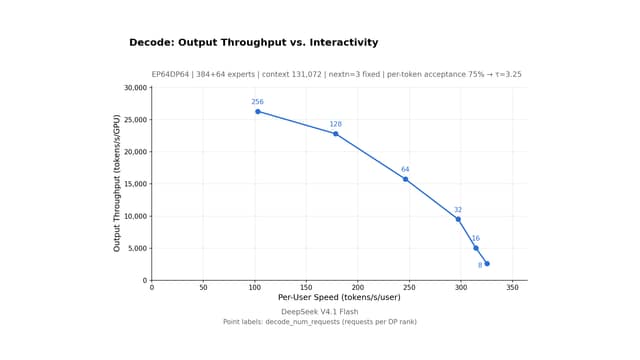
DeepSeek open-sourced DeepInfer, the inference engine behind its production services, under Apache 2.0. It runs V4.1 Flash on Nvidia and Huawei Ascend chips, with draft-token decoding built in.
A production-grade inference stack from a frontier lab is now open source (Apache 2.0), with speculative draft decoding and structured outputs built in.
Google and Meta introduced TorchTPU, a native PyTorch backend for Google TPUs. Porting can be as simple as swapping the device from cuda to TPU; ninety-eight percent of about five thousand popular Hugging Face models run without crashing.
PyTorch code can target Google TPUs with a device-string change, loosening Nvidia's lock on the PyTorch ecosystem.
Image: PyTorch Foundation · pytorch.org
Introducing TorchTPUGoogle and Meta (TorchTPU team) · 20 Oct 2026 · Primary · PyTorch blog, 20 Oct 2026
AI · Safety
METR reviews Anthropic's misalignment risk report
METR reviewed Anthropic's August risk report. It agrees misalignment risk is low, but mainly because current models lack the capabilities, not thanks to safeguards, and calls the covert-capability benchmarks a poor proxy for evading Anthropic's monitoring.
An external reviewer says current low misalignment risk rests on limited capabilities, and that today's monitoring evaluations may not catch rising risk.
Decide, don't write. Agents often ask a chat model a narrow question, then parse a label out of its prose. TypeSafe's Jev returns only typed answers: a choice, a probability of yes, a score, and now, in version 1.14, a box in an image, each with a confidence. Is the product on this shelf, and where? Caveats: images and boxes are experimental, a box comes back even if the object isn't there, and confidence is not accuracy.
Speculative decoding: draft cheap, verify in parallel
Speculative decoding. A large model needs one full pass per token. Instead, a small draft model guesses the next few tokens, and the large model checks them all in one parallel pass, keeping the agreed prefix. A rejection-sampling rule leaves the output distribution unchanged. On Google's T5-XXL, the tiniest draft gave a three point four times speed-up; the largest agreed more often, yet gave only one point seven. Drafts must be cheap.
Leviathan et al. 2023 · Chen et al. 2023
Standard
Speculative
T5-SMALL
100
29
T5-BASE
100
36
T5-LARGE
100
59
Chart: own drawing from Leviathan et al. 2023, Table 2
Gradient routing: quarantine reward hacking, then cut it out
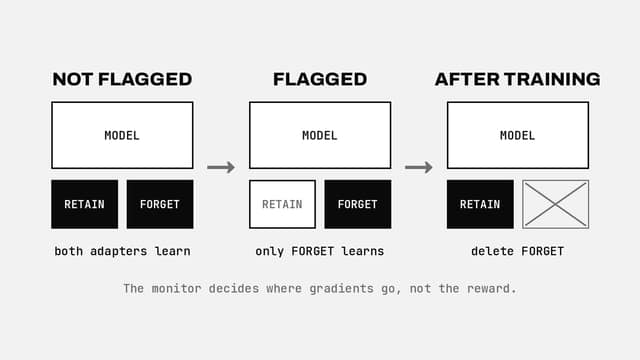
Reward hacking. In a coding game, Qwen3-8B can pass by rewriting its own test. Penalize what a monitor spots, and the model learns a hack the monitor misses, in about a quarter of answers. GRAFT, from MATS, FAR AI and Anthropic researchers, keeps the reward and changes what learns: flagged samples update only a sacrificial adapter. Delete it after training, and hacks of every kind nearly vanish.
Ward, Hu et al., arXiv 2610.17062
Diagram: own drawing after arXiv 2610.17062, Fig. 1