AI-found PHP flaws, the LiteLLM supply-chain attack, Recursive's Flint, Claude Duet. Then mixture of experts, .pth start-up code and memory-bound decoding.
AI & Tech
AI-found PHP bugs, LiteLLM hack, Flint, Claude Duet
AI-found PHP flaws, the LiteLLM supply-chain attack, Recursive's Flint, Claude Duet. Then mixture of experts, .pth start-up code and memory-bound decoding.
OpenAI says researchers at Calif used GPT-5.6 Sol to find a critical PHP flaw, while Wiz independently reported both vulnerabilities. PHP's maintainers led the fix, and OpenAI proposes a five-stage playbook for disclosing AI-found bugs.
AI models now find serious bugs in software that runs much of the web, so disclosure and patching have to scale at the same pace.
LiteLLM, a popular gateway for AI models, says attackers hijacked its release pipeline. A poisoned version sat on PyPI for about two hours, stealing credentials. The likely way in: GitHub tokens leaked into the logs of LiteLLM's own internal deployment.
A widely used AI gateway shipped malware for hours: secrets that leak into LLM logs can become a way into the release pipeline.
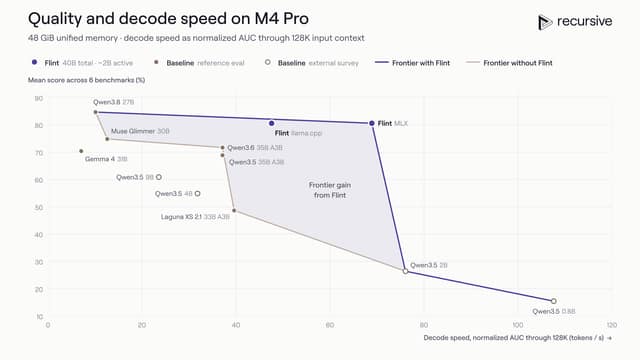
Recursive released Flint, an open-weight coding model: forty billion parameters, only two and a half billion active per token, over a hundred and twenty-five tokens per second on an M4 Pro MacBook. Its automated research system helped build nearly every part.
An open-weight coder fast enough for a laptop means private, offline coding agents without API fees, and the model was largely built by automated research.
RecursiveSI/flintRecursive (Hugging Face) · Oct 2026 · Primary · Model card and weights, Apache 2.0
Agents · Proactive
Anthropic previews Claude Duet, a proactive agent
Anthropic opened a research preview of Claude Duet, a proactive agent built around Claude Opus 5.5. It checks your connected apps every few hours, works in its own virtual machine, and asks approval before sending, paying, signing or deleting.
Agents that act on their own between prompts move the safety question to approvals, hard limits and what data may leave.
Mixture of experts. A dense model uses every weight for every token. A mixture-of-experts layer holds many expert networks, and a router sends each token to just a few. Mixtral stores forty-seven billion parameters but uses thirteen billion per token. Flint goes further: two hundred fifty-six experts per layer, six chosen plus one shared, so two and a half billion active out of forty. Memory must still hold every expert; compute pays only for the active ones.
Mixtral of ExpertsMistral AI (arXiv 2401.04088) · Jan 2024 · Primary · Jiang et al. (2024)
RecursiveSI/flintRecursive (Hugging Face) · Oct 2026 · Primary · Model card: 256 routed experts, 6 selected + 1 shared
Idea · Python
Code that runs before yours: .pth files
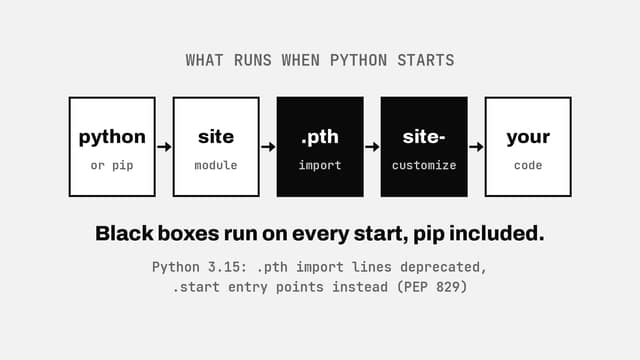
Code that runs before yours. When Python starts, its site module scans site-packages for .pth files. Most lines just add folders to the path, but any line beginning with import gets executed. Then sitecustomize is imported. That's why LiteLLM warned: don't clean up with pip install, because pip is Python too, and the planted files run again. Python 3.15 deprecates those import lines in favour of explicit .start files.
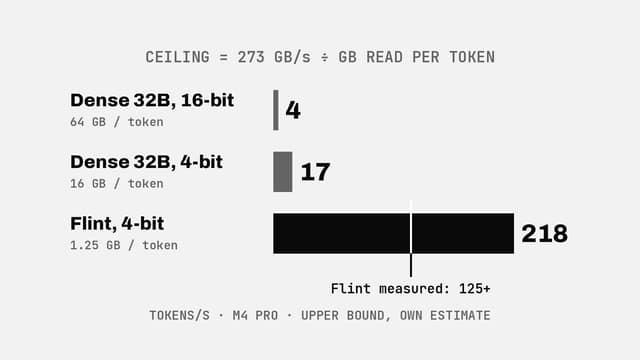
Why local models are memory-bound. To generate each token, the chip must read every active weight from memory. So a rough ceiling is bandwidth divided by bytes per token. An M4 Pro moves two hundred seventy-three gigabytes per second. A dense thirty-two billion model at four bits reads sixteen gigabytes: about seventeen tokens per second, at best. Flint reads about one and a quarter: a ceiling near two hundred. That's why Recursive quantized even its output layer.
Pope et al. 2022 · Apple M4 Pro specs · own estimate