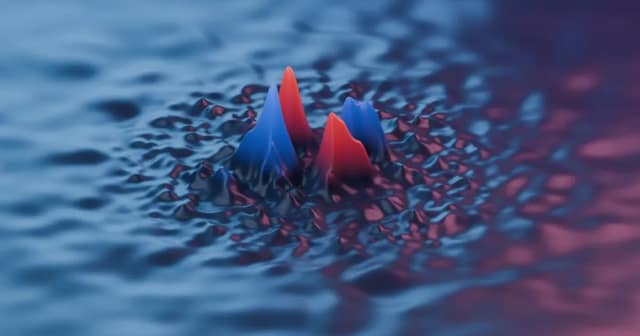
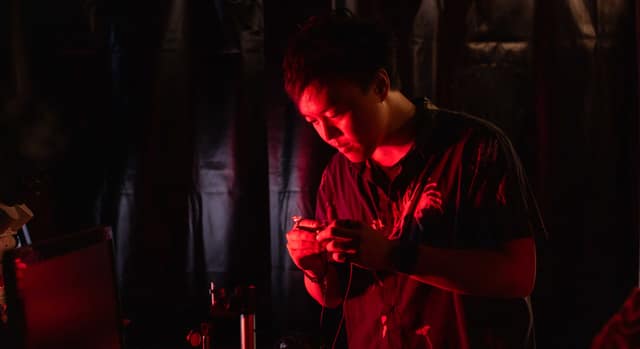
Columbia physicists report in Science the first electron waves trapped inside a metal. In two-dimensional palladium aluminum iodide, competing hopping paths cancel out and pin electrons near defects, an effect seen before only with light.
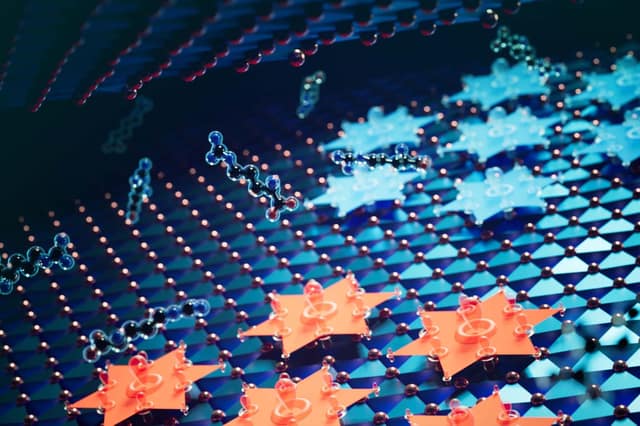
A UCLA-led team slipped the amino acid arginine between atom-thin layers of tantalum disulfide. An ordered electron pattern that normally needs about minus 93 Celsius now holds up to about 57 Celsius. Published in Nature Chemistry.
Image: Duan Lab / UCLA
Amino acid extends quantum properties above room temperatureUCLA · 2026 · Primary · Zhou, Zhou et al., "Molecular engineering stabilizes the commensurate charge density wave state in 1T-TaS2/arginine hybrid superlattices", Nature Chemistry 2026
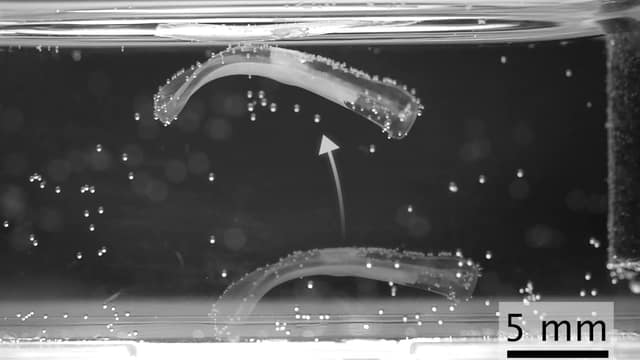
ETH Zurich engineers designed living muscle and its soft scaffold together on a computer. The centimetre-scale actuators move up to eleven times more than earlier ones, so tiny biohybrid robots can jump, swim, walk and grasp.
Image: Balciunaite et al. · CC BY 4.0 · ETH Zurich
One small leap for a muscle, one giant step for roboticsETH Zurich · 2026 · Primary · Balciunaite, Michelis et al., "Co-optimized volumetric muscle design for large dynamic deformations in versatile biohybrid robots", Nature Communications 17, 10732, 2026
UC Santa Barbara engineers made red gallium nitride micro LEDs with 20.8 percent efficiency, double their previous best. At 200 degrees Celsius they keep over 74 percent of their light. Good news for displays and optical links in data centres.
Ordered, but never repeated. In 2022, Flatiron and Quantinuum physicists pulsed ten ytterbium ion qubits with lasers following the Fibonacci sequence: A, A B, A B A, A B A A B. Like a quasicrystal, this rhythm is a projection of one with two frequencies, a bit like a second time direction, but only as a metaphor. Emergent symmetries protected the edge qubits from errors. With periodic pulses they stayed coherent about one and a half seconds. With Fibonacci pulses, for the whole 5.5 second run.
Dumitrescu et al., Nature 607, 463 (2022)
Edge qubits coherent, % of the 5.5 s run
Periodic
27
Fibonacci
100
Chart: own drawing from Simons Foundation / Flatiron (2022)
Why the sky is blue. Sunlight shakes electrons in air molecules, which re-radiate it sideways. As Feynman shows, this scattering grows with the fourth power of frequency. Red light at 700 nanometers scatters least. Green at 530 scatters about three times more, blue at 450 almost six times more. That scattered blue is the sky. At sunset, light crosses so much air that the blue is lost, leaving red.
Feynman Lectures, Vol. I, ch. 32
Light scattered by air, blue = 100
Red 700 nm
17
Green 530 nm
52
Blue 450 nm
100
Chart: own drawing from the fourth-power law
Shorter waves scatter more
Refraction, Dispersion, and AbsorptionThe Feynman Lectures on Physics (Caltech) · 1963 · Primary · Feynman, Leighton & Sands (1963); 32-5 Scattering of light
Idea · Structures
Euler buckling: why slender columns snap sideways
Why slender columns fail suddenly. Push on the ends of a thin rod and it stays straight, until the force hits a critical value, the Euler force, and it bows sideways. That force falls with the square of the length. Double the length and the column buckles at a quarter of the load. Triple it, about a ninth. That is why rockets and building columns are designed against buckling, not just crushing.
Image: Balciunaite et al. · CC BY 4.0 · ETH Zurich
Image: UC Santa Barbara
Chart: own drawing from Simons Foundation / Flatiron (2022)
Chart: own drawing from the fourth-power law
Chart: own drawing from Euler's formula
Voice: synthetic (neural text-to-speech).
Scripts written from the linked sources.
4 News 3 IdeasNews and Ideasphysics and engineeringphysicsengineeringbound states in the continuumquantum materialsscanning tunneling microscopycharge density wavetantalum disulfideargininebiohybrid robotsartificial musclesoft roboticsmicroLEDgallium nitridephotonicstime quasicrystalFibonaccitrapped ionsquantum computingtopological phaseRayleigh scatteringwhy the sky is blueEuler bucklingstructural engineering