Mind & Society: AI therapy feedback, rotated practice, preschool skills at 21, overrated money. Then the experience machine, the hedonic treadmill, motor equivalence.
Mind & Society
AI therapy, overrated money, the experience machine
Mind & Society: AI therapy feedback, rotated practice, preschool skills at 21, overrated money. Then the experience machine, the hedonic treadmill, motor equivalence.
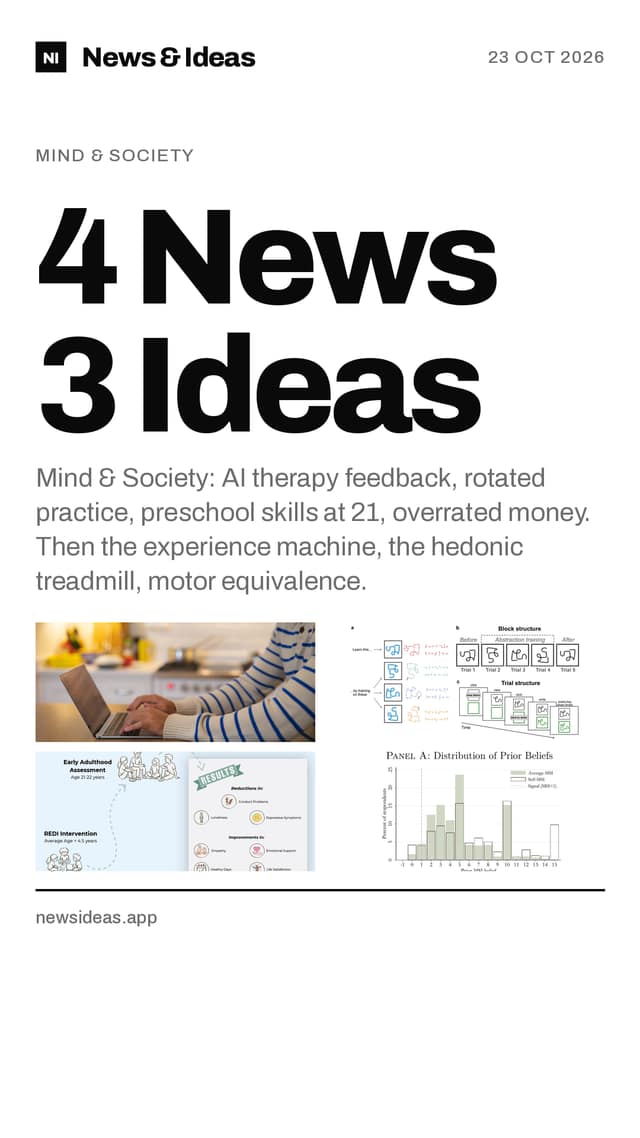
Stockholm University tested AI feedback in online therapy for social anxiety. In a trial with 263 adults, symptoms fell about as much with psychologist-checked AI feedback as with a therapist's, whoever people thought wrote it. One trial, and equivalence isn't proven yet.
Photo: Wavebreakmedia/Mostphotos · Stockholm University
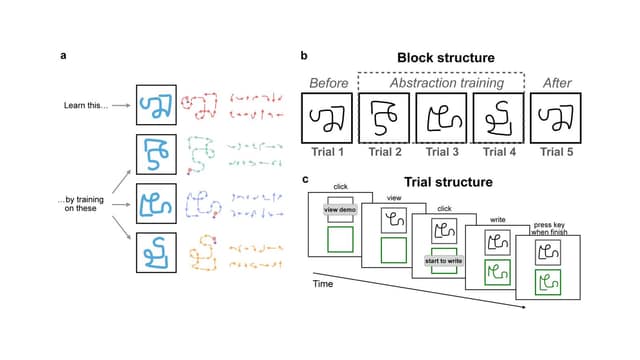
Yale researchers had people practise unfamiliar characters turned sideways or upside down. Copying them upright improved almost as much as direct practice, across eleven experiments, even in people with no mental imagery, and with the other hand. It's in Nature Human Behaviour.
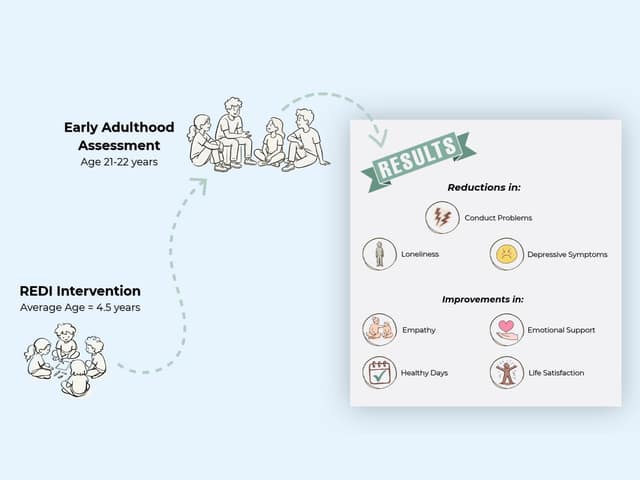
Penn State followed children from a Head Start programme that taught social and emotional skills. Eighteen years later, they reported fewer depressive symptoms, less loneliness and more life satisfaction than controls, better on seven of eleven measures. It's in American Psychologist.
Image: Kristin Camplese · Penn State · Creative Commons
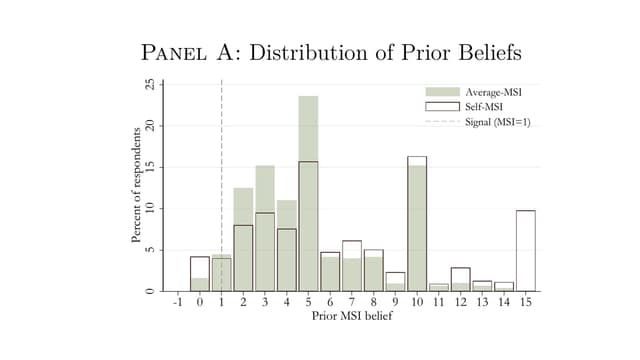
Do we overrate money? A UCLA-led working paper asked 2,775 people. They expected a 20 percent raise to lift life satisfaction five to seven points out of 100. The evidence says about one. It's not yet peer reviewed.
The experience machine. In 1974 Robert Nozick imagined a machine giving you any experiences you want, for life. He bet most of us would refuse, so pleasure can't be all that matters. In 2010 Felipe De Brigard flipped it: you're already plugged in. Told that reality meant prison, 87 percent chose to stay. Small samples, but a hint: we may prefer what we know, not what's real.
Nozick 1974 · De Brigard 2010
Go back
Stay
NO INFO
54
46
PRISON
13
87
MONACO
50
50
Chart: own drawing · De Brigard 2010
% choosing · already plugged in
Well-Being (Roger Crisp)Stanford Encyclopedia of Philosophy · 2026 · Primary · Crisp, "Well-Being", SEP (rev. 2026); on Nozick, Anarchy, State, and Utopia (1974)
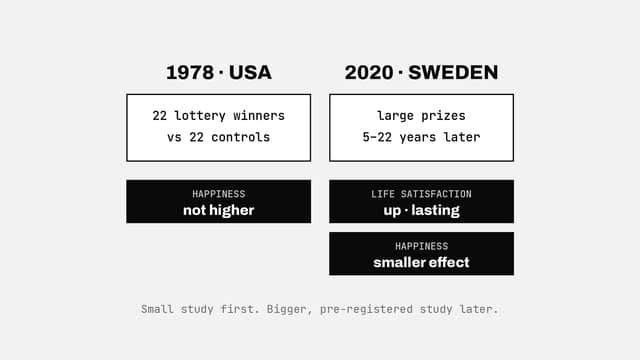
The hedonic treadmill. A famous 1978 study found that 22 lottery winners were no happier than people who hadn't won. The idea: we adapt, and joy drifts back to baseline. But the study was tiny. In 2020, a pre-registered study of Swedish lottery players found large prizes raised life satisfaction for over a decade, with smaller effects on happiness. Adaptation is real, just not total.
Brickman et al. 1978 · Lindqvist et al. 2020
Diagram: own drawing · Brickman 1978; Lindqvist 2020
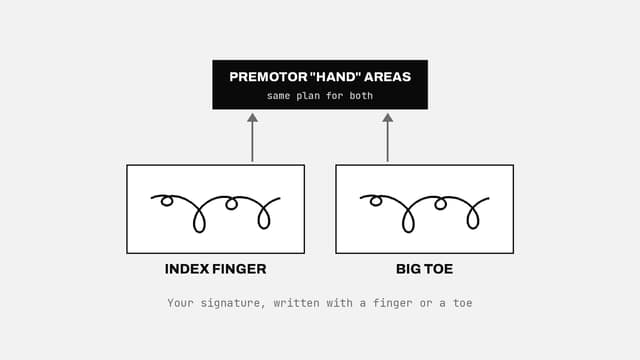
Motor equivalence. Write your name in the sand with your big toe, and it still looks like your signature. Karl Lashley named this in 1930. In 1999, an fMRI study had nine people sign with a finger and with a toe: both engaged premotor areas that normally serve the hand. Skills live as plans, not as muscle commands. That's why the Yale practice transferred.