News & Ideas is a daily letter for anyone who wants the day's science in one place, not a feed. Each day is 4 news items and 3 ideas across AI & Tech, Physics & Engineering, Biology & Nature, and Mind & Society, and every story names a primary source you can check. The Shorts use a declared synthetic voice.
One email a day. 4 science stories, 5 quick results, 1 idea. 3 minutes.
Plus a daily quiz: Answer & Learn. Free, unsubscribe anytime.
Issue
26 November 2026
2 min read · 1 Short
AI & Tech: data stored in living cells, one optical layer doing nonlinear math, a silicon neuron with one dial, AI that spots illegal wildlife. Then DNA as a hard drive, universal approximators, a simple spiking neuron.
One email a day. 4 science stories, 5 quick results, 1 idea. 3 minutes.
Plus a daily quiz: Answer & Learn. Free, unsubscribe anytime.
AI & Tech
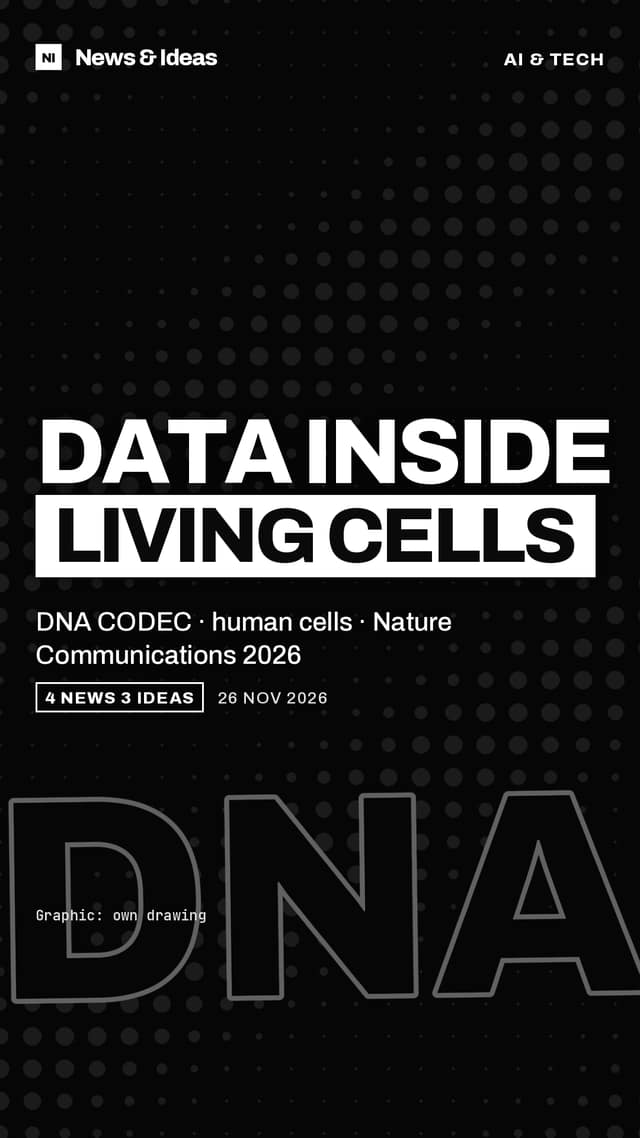
Data Stored Inside Living Human Cells
AI & Tech: data stored in living cells, one optical layer doing nonlinear math, a silicon neuron with one dial, AI that spots illegal wildlife. Then DNA as a hard drive, universal approximators, a simple spiking neuron.
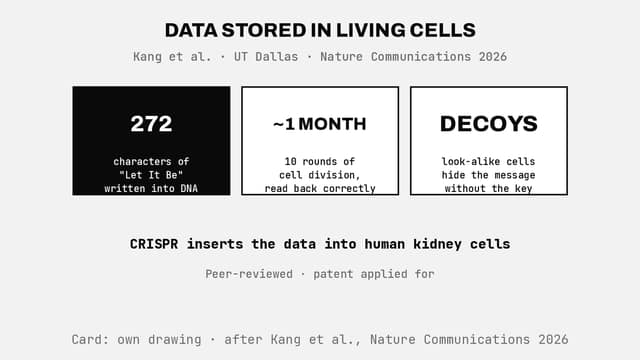
A University of Texas at Dallas team wrote 272 characters of Let It Be into the genome of human kidney cells. A month of cell division later, the text still read back correctly. Look-alike decoy cells hide the message from anyone without the key.
Card: own drawing · after Kang et al., Nature Communications 2026
One email a day. 4 science stories, 5 quick results, 1 idea. 3 minutes.
Plus a daily quiz: Answer & Learn. Free, unsubscribe anytime.
Tech · Optical computing
One Layer, Nonlinear Math
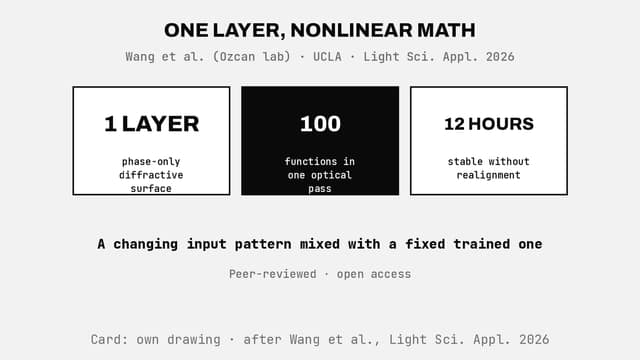
Optical computers struggle with nonlinear math, the step neural networks rely on. Aydogan Ozcan's lab at UCLA did it with one phase-only surface, mixing a changing input with a fixed, trained pattern. It computed 100 functions in a single pass.
Card: own drawing · after Wang et al., Light Sci. Appl. 2026
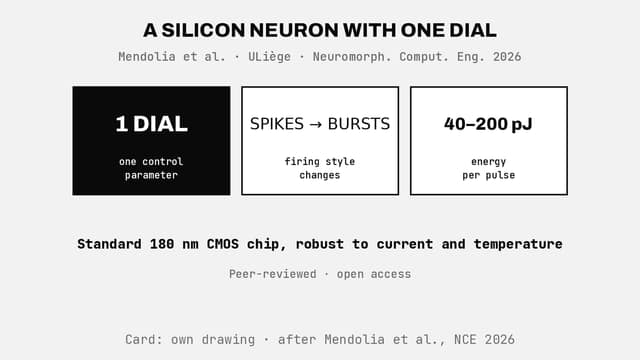
A team led by the University of Liège built a silicon neuron on a standard chip, with a single control parameter that shifts it from regular spikes to bursts, like real neurons under neuromodulation. It stayed predictable as current and temperature changed.
Card: own drawing · after Mendolia et al., NCE 2026
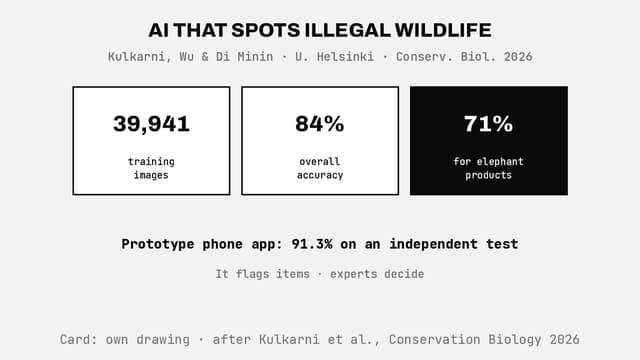
Can AI spot ivory sold online? University of Helsinki researchers trained a model on nearly 40,000 images of elephant, pangolin and tiger products. It was right 84 percent of the time, but only 71 percent for elephant items. Experts still decide.
Card: own drawing · after Kulkarni et al., Conservation Biology 2026
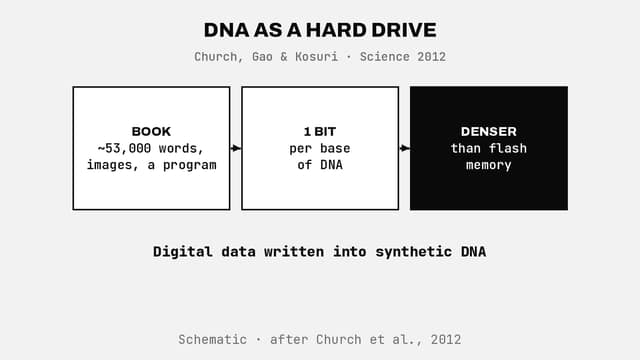
DNA as a hard drive. In 2012, George Church, Yuan Gao and Sriram Kosuri wrote a book draft of about 53,000 words, plus images and a program, into synthetic DNA. DNA can hold data far more densely than flash memory.
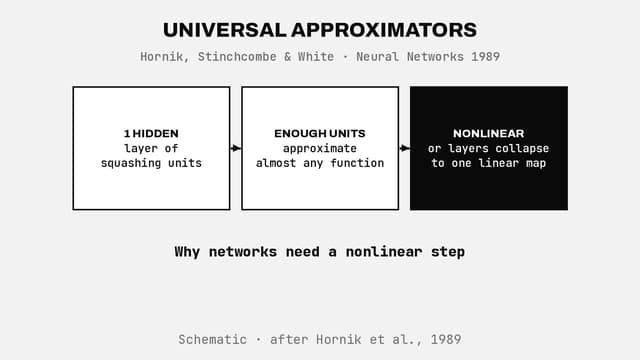
Universal approximators. In 1989, Kurt Hornik, Maxwell Stinchcombe and Halbert White proved that one hidden layer of squashing units can approximate almost any function, given enough units. Without that nonlinear squashing, stacked layers collapse into one linear map.
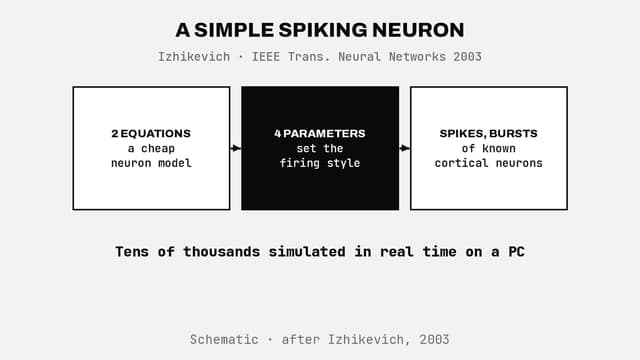
A simple spiking neuron. In 2003, Eugene Izhikevich published a model with two equations and four parameters that reproduces the spiking and bursting of known cortical neurons, cheap enough to simulate tens of thousands in real time.
Izhikevich · IEEE TNN 2003
Schematic · after Izhikevich, 2003
Simple model of spiking neuronsIEEE Transactions on Neural Networks · Nov 2003 · Primary · Izhikevich, IEEE Trans. Neural Netw. 14, 1569 (2003)
Credits
Card: own drawing · after Kang et al., Nature Communications 2026
Card: own drawing · after Wang et al., Light Sci. Appl. 2026
Card: own drawing · after Mendolia et al., NCE 2026
Card: own drawing · after Kulkarni et al., Conservation Biology 2026
Schematic · after Church et al., 2012
Schematic · after Hornik et al., 1989
Schematic · after Izhikevich, 2003
Voice: synthetic (neural text-to-speech).
Scripts written from the linked sources.
News and Ideas4 News 3 IdeasscienceresearchAI & TechDNA data storageDNA CODECCRISPRhuman cellsLet It Beoptical computingdiffractive opticsnonlinear functionsUCLAneuromorphic computingsilicon neuronneuromodulationCMOSwildlife tradeivorypangolincomputer visionuniversal approximationIzhikevich model
AI & Tech
Question of the day
Which wildlife products did the AI recognize least accurately?
Tiger products
Elephant products
Pangolin products
The ballot is in the email. Each choice there is counted once.