News & Ideas is a daily letter for anyone who wants the day's science in one place, not a feed. Each day is 4 news items and 3 ideas across AI & Tech, Physics & Engineering, Biology & Nature, and Mind & Society, and every story names a primary source you can check. The Shorts use a declared synthetic voice.
One email a day. 4 science stories, 5 quick results, 1 idea. 3 minutes.
Plus a daily quiz: Answer & Learn. Free, unsubscribe anytime.
Issue
19 November 2026
4 min read · 1 Short
AI & Tech: an AI that names wild animals right about one time in ten, gender bias in AI-written resumes, the fastest soft robot, a robo-insect with its own computer. Then long-tailed data, bias in word statistics, air as logic.
One email a day. 4 science stories, 5 quick results, 1 idea. 3 minutes.
Plus a daily quiz: Answer & Learn. Free, unsubscribe anytime.
AI & Tech
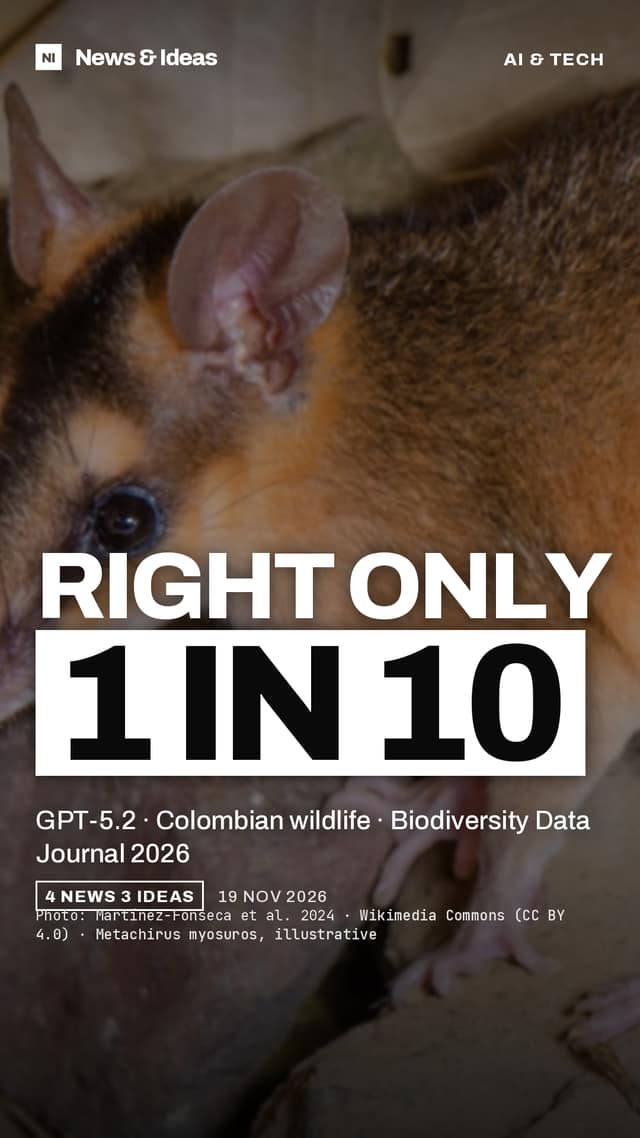
AI Named the Right Species in Only 1 in 10 Wildlife Photos
AI & Tech: an AI that names wild animals right about one time in ten, gender bias in AI-written resumes, the fastest soft robot, a robo-insect with its own computer. Then long-tailed data, bias in word statistics, air as logic.
AI Named the Right Species in Only 1 in 10 Wildlife Photos
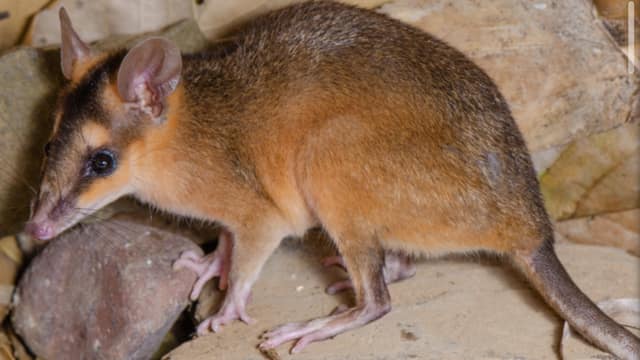
Gustavo Nicolas Paez Salamanca tested OpenAI's GPT-5.2 on 10,000 research-grade iNaturalist photographs of vertebrates recorded in Colombia (2,000 each of amphibians, birds, fishes, mammals and reptiles). The model was told only that the animal was seen in Colombia and had to name a family, genus and species for every image, with no option to decline. It matched the species in 9.5% of images: about 17–19% for mammals and reptiles, under 5% for amphibians, birds and fishes. Species with more public photographs were identified more accurately; recently described species were harder. Field cases from camera traps included a marsupial, Metachirus myosuros, named as a species whose range does not include Colombia. The study proposes AI as a first step, checked against current taxonomy and known ranges, with specialists for uncertain records.
Photo: Martínez-Fonseca et al. 2024 · Wikimedia Commons (CC BY 4.0) · Metachirus myosuros, illustrative
One email a day. 4 science stories, 5 quick results, 1 idea. 3 minutes.
Plus a daily quiz: Answer & Learn. Free, unsubscribe anytime.
AI · Fairness
AI-Written Resumes Carry Gender Stereotypes
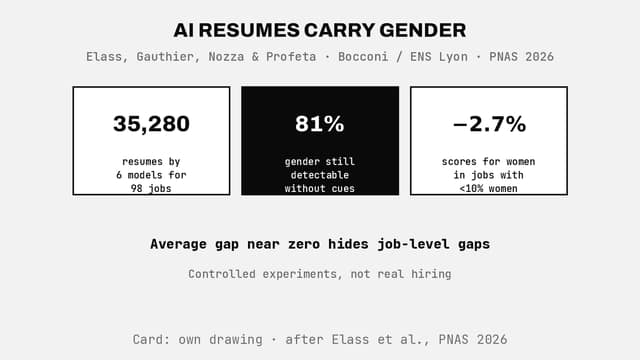
Kenza Elass (ENS de Lyon), Germain Gauthier, Paola Profeta and Debora Nozza (Bocconi) ran controlled experiments on six language models (GPT 5.4, Claude Opus 4.6, DeepSeek 3.2, Mistral Large 3, Grok 4.1, Llama 3.3 70B) across 98 occupations, generating 35,280 resumes with randomly assigned gender, then asking the models for salaries and employability scores. Resumes written for women stressed helping others and low-promotion tasks; even with explicit gender references removed, a classifier recognised the intended gender in 81% of cases. Average screening gaps were near zero, but in occupations with under 10% women female candidates scored about 2.7% lower (and gained a similar advantage where women are over 80%). With gender stated explicitly, salary suggestions for women were about 1.6% lower on average. Experiments in English and in the US context, not real hiring.
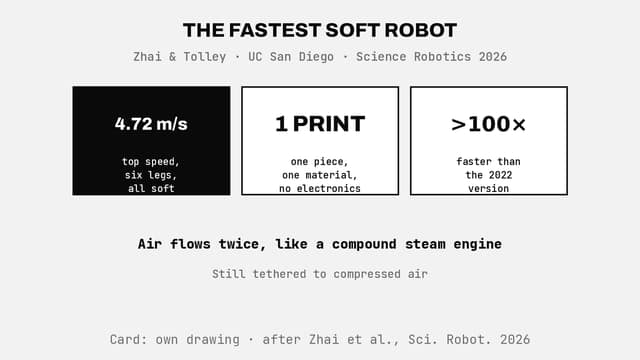
Yichen Zhai and Michael Tolley (Bioinspired Robotics and Design Lab, UC San Diego) built a six-legged, air-powered robot 3D-printed in one go from one material, with no electronics. Internal chambers, valves and tubes drive the legs. Borrowing the compound steam engine, pressurised air circulates twice: first through small high-pressure chambers that power the valves, then through larger low-pressure chambers that move the legs. It reached up to 4.72 m/s, more than 100 times faster than the team's 2022 version, ran on concrete, gravel, lawn, mulch and sand, went down stairs, swam and worked underwater. It still needs a tether to a compressed-air source.
Card: own drawing · after Zhai et al., Sci. Robot. 2026
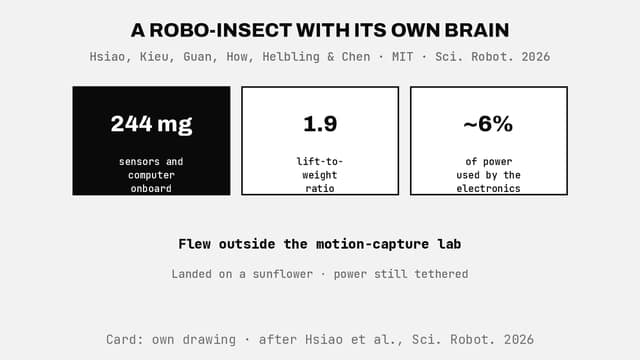
Yi-Hsuan Hsiao, Quang Phuc Kieu, Zhongtao Guan, Jonathan How, Elizabeth Farrell Helbling, Kevin Chen and colleagues (MIT, Cornell) enlarged the soft artificial muscles of their four-winged insect-scale robot by 50%, raising net lift by 46% and reaching a lift-to-weight ratio of 1.9. That let it carry a 244 mg electronics package with an inertial unit, an optical-flow sensor, a time-of-flight height sensor and a microcontroller running a fast, simplified state estimator. It hovered and followed trajectories with errors of a few centimetres outside a motion-capture system, and, steered by high-level joystick setpoints, landed on a sunflower. Electronics use about 6% of the power; the robot is still powered through a tether.
Card: own drawing · after Hsiao et al., Sci. Robot. 2026
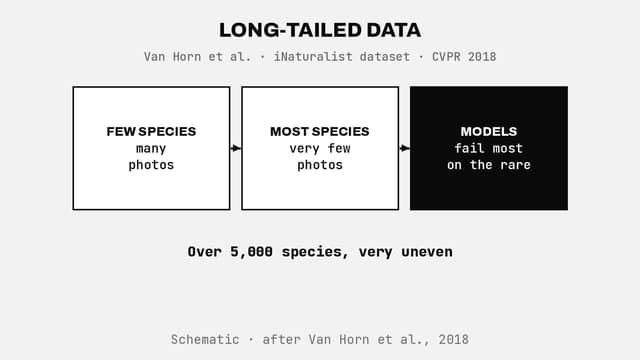
Van Horn et al. (CVPR 2018) introduced the iNaturalist species classification and detection dataset, over 5,000 species photographed by citizen scientists, with a highly imbalanced, long-tailed distribution of images per species. Baseline models performed well on species with many training images but poorly on those with few. The same imbalance shows up in the Colombian test, where species with fewer public photos were identified less accurately.
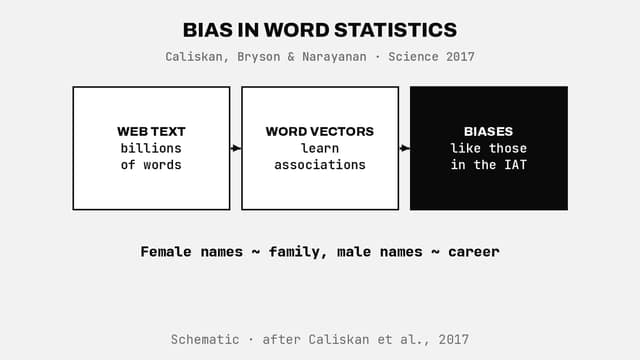
Caliskan, Bryson and Narayanan (Science, 2017) adapted the Implicit Association Test to word embeddings trained on a large web corpus and found that the embeddings reproduce a range of human-like associations, from neutral ones (flowers–pleasant) to stereotypes such as female names with family and male names with career. Models that learn from text inherit the statistics of that text, which helps explain stereotyped wording in AI-written resumes.
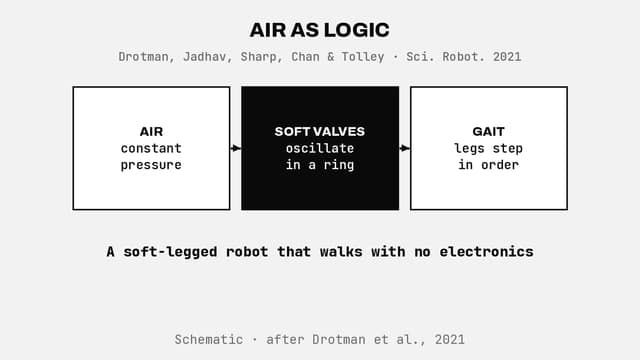
Drotman, Jadhav, Sharp, Chan and Tolley (Science Robotics, 2021) built pneumatic logic from soft valves and combined them into a ring oscillator that converts a constant pressure supply into a timed sequence that drives a soft-legged robot's gait, with no electronic components. The same lab's new runner builds on this electronics-free approach.