News & Ideas is a daily letter for anyone who wants the day's science in one place, not a feed. Each day is 4 news items and 3 ideas across AI & Tech, Physics & Engineering, Biology & Nature, and Mind & Society, and every story names a primary source you can check. The Shorts use a declared synthetic voice.
One email a day. 4 science stories, 5 quick results, 1 idea. 3 minutes.
Plus a daily quiz: Answer & Learn. Free, unsubscribe anytime.
Issue
19 November 2026
3 min read · 1 Short
Mind & Society: portraits of women turned less curvy long before magazines, Britain's first Roman capital drew people from afar, what young men think others think, a scent that carries a skill. Then waist-to-hip ratio, pluralistic ignorance, context-dependent memory.
One email a day. 4 science stories, 5 quick results, 1 idea. 3 minutes.
Plus a daily quiz: Answer & Learn. Free, unsubscribe anytime.
Mind & Society
Portraits Turned Less Curvy Long Before Magazines
Mind & Society: portraits of women turned less curvy long before magazines, Britain's first Roman capital drew people from afar, what young men think others think, a scent that carries a skill. Then waist-to-hip ratio, pluralistic ignorance, context-dependent memory.
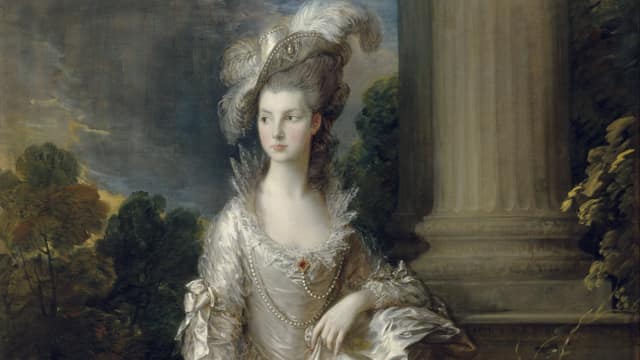
Jeanne Bovet (Northumbria University) and colleagues had more than 1,500 participants, in three groups, rate 606 depictions of upper-class women in 486 portraits painted between 1650 and 1950, drawn from three online art collections. One group matched body shapes to nine silhouettes varying in weight and waist-to-hip ratio; others rated attractiveness and likely past childbirth, or estimated age from faces. Later portraits showed straighter, less curvaceous figures (higher waist-to-hip ratios), a trend that held after accounting for perceived age and weight; perceived weight did not change significantly. The study measures representation (clothing, pose, artistic choice), not real bodies.
Painting: Thomas Gainsborough, The Honourable Mrs Graham · Wikimedia Commons (public domain) · illustrative
One email a day. 4 science stories, 5 quick results, 1 idea. 3 minutes.
Plus a daily quiz: Answer & Learn. Free, unsubscribe anytime.
Archaeology · Migration
Roman Colchester Drew People From Afar
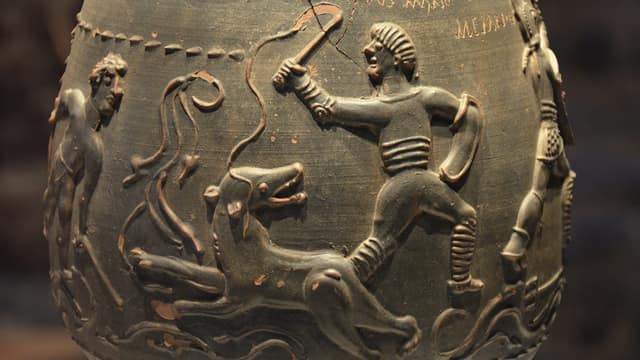
Joanna Moore, Janet Montgomery, Geoff Nowell and colleagues (Durham University, University of Reading, York Museums Trust) combined strontium and lead isotope analysis on Romano-British cremated remains for the first time, studying 22 burials from Roman Colchester (Camulodunum), the first capital of Britannia after the invasion of AD 43. Several individuals had grown up outside Britain; three had signatures suggesting Mediterranean childhoods, in regions such as Italy, Spain or Lebanon. Remains buried inside the Colchester Vase, decorated with gladiatorial combat and animal hunts, pointed to a man of Mediterranean origin, possibly a trainer of gladiators or a wealthy patron.
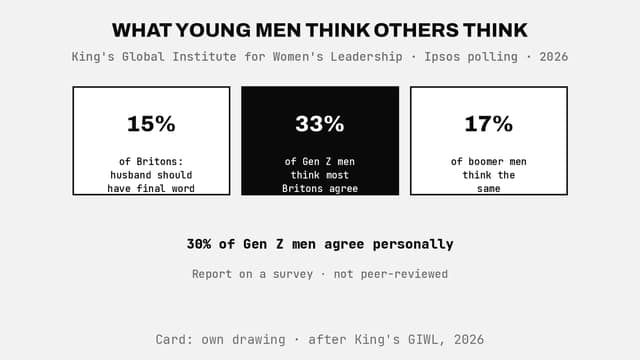
A 'Beyond the Backlash' report from the King's Global Institute for Women's Leadership analysed Ipsos polling (December 2025–January 2026) across generations in Britain. 15% of Britons agree that 'a husband should have the final word in important decisions at home', but 33% of Gen Z men believed more Britons agreed than disagreed, versus 17% of baby-boomer men and 7.5% of baby-boomer women. 30% of Gen Z men personally agreed, more than any other group (13% of young women). Only one in ten young men think caring makes men less masculine, but over a quarter think society will say so. A snapshot survey; some respondents agreed with statements on both sides. Report, not peer-reviewed.
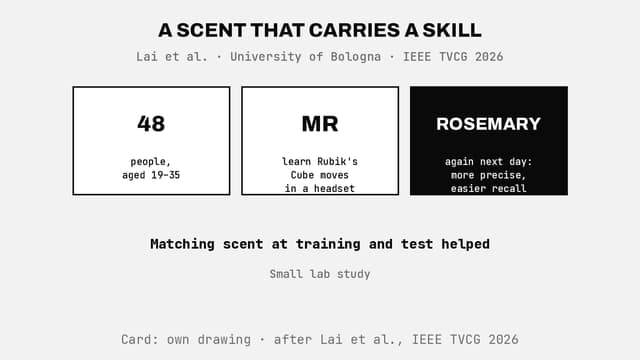
Mengting Lai, Xiaoxuan Zhao, Wen Li, Shirin Hajahmadi, Pasquale Cascarano and Gustavo Marfia (University of Bologna) trained 48 participants aged 19–35 to execute Rubik's Cube move sequences with a headset showing a synchronised digital replica, then tested them the next day on the physical cube without the headset. A rosemary scent was present on both days, on neither, or on only one. Rosemary during training boosted motivation and immersion; among those trained with rosemary, smelling it again at test was associated with greater precision, lower mental workload and less difficulty recalling, compared with no scent. Matching olfactory conditions improved accuracy and reduced cognitive load versus mismatched ones.
Card: own drawing · after Lai et al., IEEE TVCG 2026
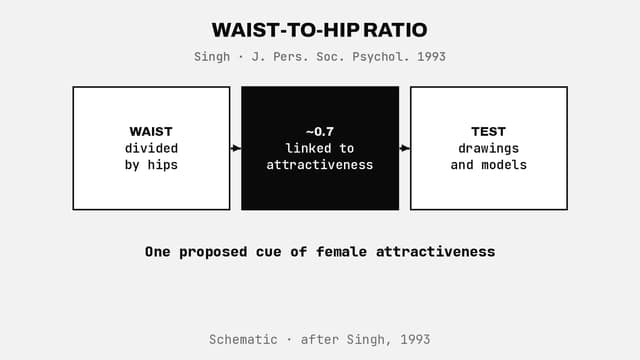
Singh (Journal of Personality and Social Psychology, 1993) argued that the waist-to-hip ratio (WHR) signals youthfulness and health and is a key cue of female attractiveness. Across decades, Miss America winners and Playboy centrefolds became slimmer relative to ideal weight, but their WHR stayed within 0.68–0.72; in drawings, men rated low-WHR figures as more attractive. The portrait study tracks the same ratio in paintings over three centuries.
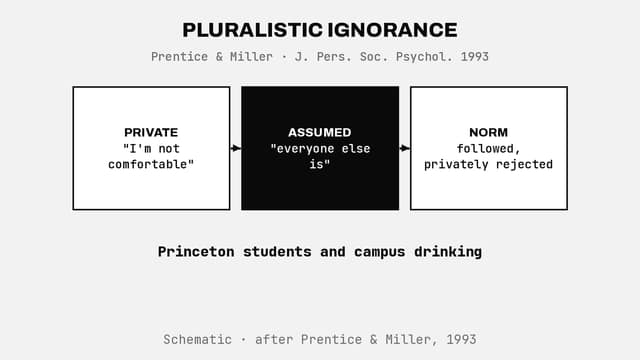
Prentice and Miller (Journal of Personality and Social Psychology, 1993) showed that Princeton students believed the average student was more comfortable with campus alcohol practices than they themselves were, a case of pluralistic ignorance, and that such misperceived norms can shape behaviour. Gen Z men overestimating support for male authority at home fits the same pattern.
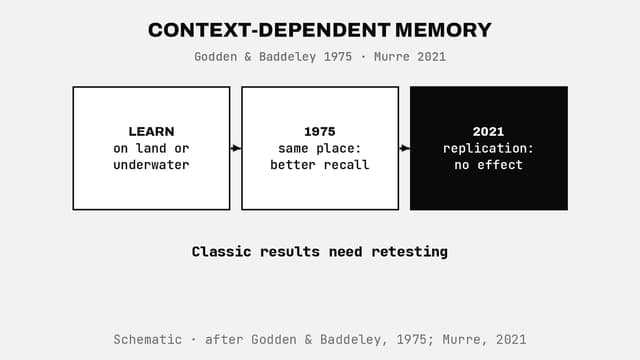
Godden and Baddeley (British Journal of Psychology, 1975) had divers learn word lists on dry land or underwater; lists learned underwater were best recalled underwater, and vice versa. Murre (Royal Society Open Science, 2021) replicated the design with 16 divers and did not find better recall in the learning context. The rosemary study tests a related idea: matching cues at learning and test.
Godden & Baddeley 1975 · Murre 2021
Schematic · after Godden & Baddeley, 1975; Murre, 2021