News & Ideas is a daily letter for anyone who wants the day's science in one place, not a feed. Each day is 4 news items and 3 ideas across AI & Tech, Physics & Engineering, Biology & Nature, and Mind & Society, and every story names a primary source you can check. The Shorts use a declared synthetic voice.
One email a day. 4 science stories, 5 quick results, 1 idea. 3 minutes.
Plus a daily quiz: Answer & Learn. Free, unsubscribe anytime.
Issue
26 November 2026
2 min read · 1 Short
Mind & Society: Ireland’s first hunters, friendship mistakes that forecast, who calls themselves a prepper, clickbait that hurts the truth. Then triadic closure, the information gap, perception of risk.
One email a day. 4 science stories, 5 quick results, 1 idea. 3 minutes.
Plus a daily quiz: Answer & Learn. Free, unsubscribe anytime.
Mind & Society
Were There Hunters in Ireland 1,000 Years Earlier?
Mind & Society: Ireland’s first hunters, friendship mistakes that forecast, who calls themselves a prepper, clickbait that hurts the truth. Then triadic closure, the information gap, perception of risk.
Were There Hunters in Ireland 1,000 Years Earlier?
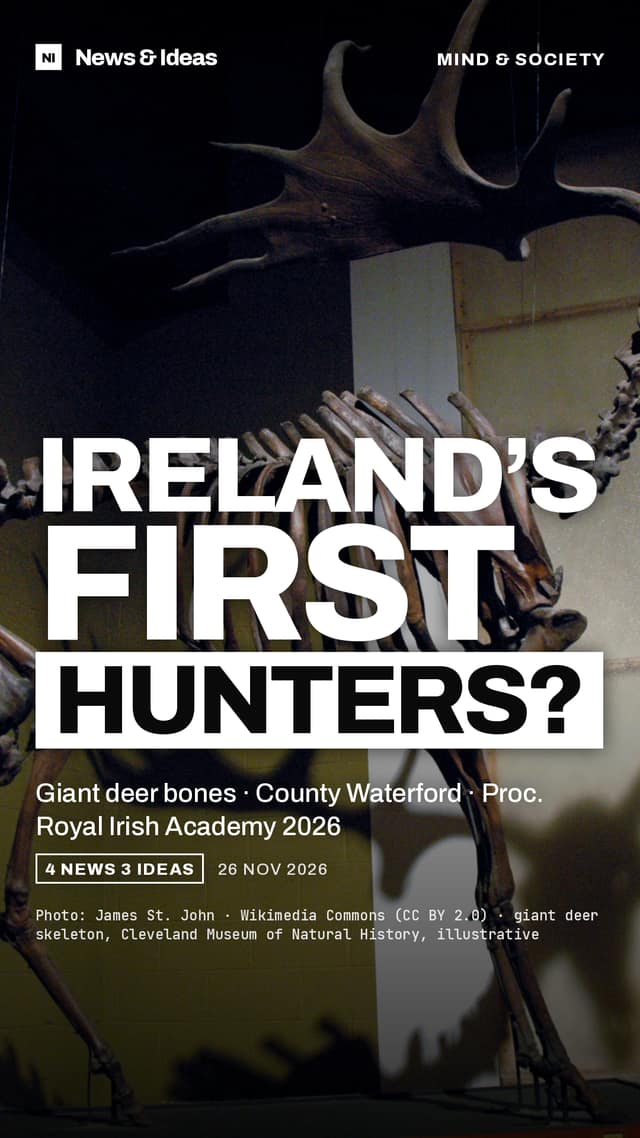
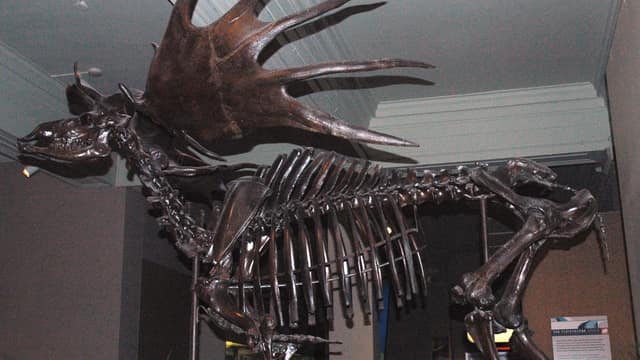
Archaeologists re-examined bones dug from a County Waterford cave in the late 1800s. Two giant deer bones show possible butchery marks, and one dates to about 13,500 years ago. The earliest firm evidence for people in Ireland is roughly 12,700 years old. More finds are needed.
Photo: James St. John · Wikimedia Commons (CC BY 2.0) · giant deer skeleton from an Irish bog, Carnegie Museum, illustrative
One email a day. 4 science stories, 5 quick results, 1 idea. 3 minutes.
Plus a daily quiz: Answer & Learn. Free, unsubscribe anytime.
Psychology · Social networks
Friendship Mistakes Forecast
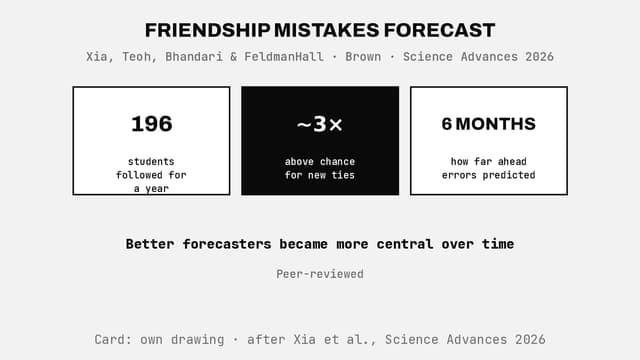
Brown University researchers followed 196 students for a year, asking who was friends with whom. People's mistakes weren't random: friendships they wrongly reported often formed later, up to six months on, nearly three times above chance. And the best forecasters became more central in the network.
Card: own drawing · after Xia et al., Science Advances 2026
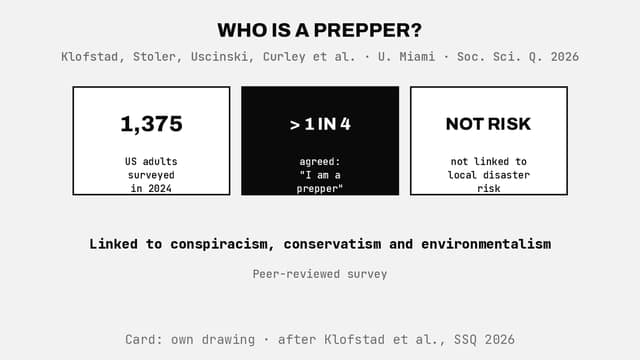
In a national survey of 1,375 US adults, more than a quarter agreed: I am a prepper. The identity was linked to conspiracy thinking, conservatism and, surprisingly, environmentalism, but not to the actual disaster risk where people live.
Card: own drawing · after Klofstad et al., SSQ 2026
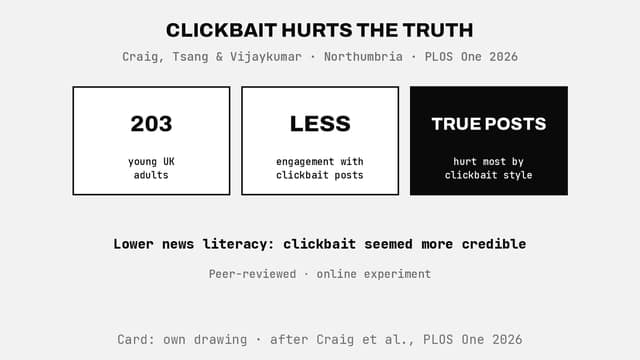
Does clickbait backfire? Northumbria University researchers showed 203 young UK adults mock posts, true and false, in plain or clickbait style. Clickbait cut engagement and credibility, and the damage was biggest for posts that were actually true.
Card: own drawing · after Craig et al., PLOS One 2026
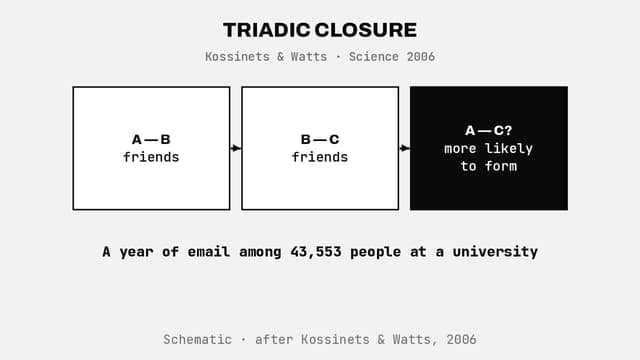
Triadic closure. If two people share a friend, they're more likely to become friends. In 2006, Gueorgi Kossinets and Duncan Watts tracked a year of email among 43,553 people at a university and saw new ties form through shared contacts and classes.
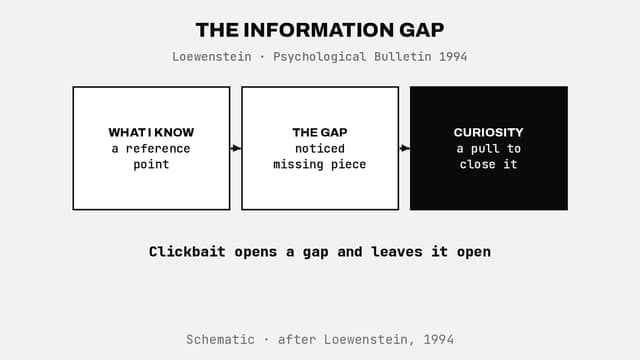
The information gap. In 1994, George Loewenstein argued that curiosity is a kind of deprivation we feel when we notice a gap in our knowledge. A headline that opens a gap and doesn't fill it pulls on exactly that. Clickbait is built on that itch.
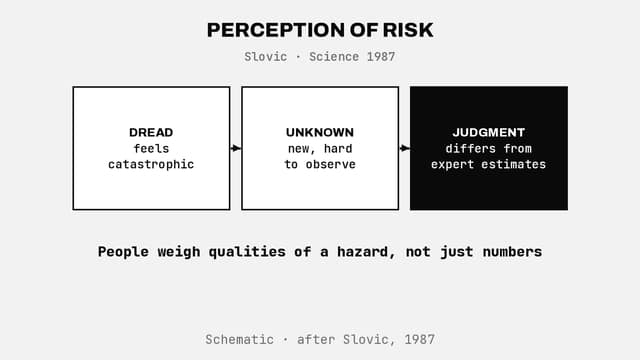
Perception of risk. In 1987, Paul Slovic reviewed how people judge hazards. Their judgments track qualities like dread and how unknown a risk feels, not only the numbers experts use. That helps explain why prepping follows outlook more than local danger.