News & Ideas is a daily letter for anyone who wants the day's science in one place, not a feed. Each day is 4 news items and 3 ideas across AI & Tech, Physics & Engineering, Biology & Nature, and Mind & Society, and every story names a primary source you can check. The Shorts use a declared synthetic voice.
One email a day. 4 science stories, 5 quick results, 1 idea. 3 minutes.
Plus a daily quiz: Answer & Learn. Free, unsubscribe anytime.
Issue
11 November 2026
3 min read · 1 Short
Mind & Society: Maya Lakes Held Toxic Mercury for Centuries, Chimpanzees Share a Signal Convention, A Motor Memory Tracked for 15 Weeks, Preschool Laws Linked to Gains for Women. Then Biomagnification: How Toxins Climb the Food Web, Conventions Emerge Without a Boss, Fast and Slow Motor Learning.
One email a day. 4 science stories, 5 quick results, 1 idea. 3 minutes.
Plus a daily quiz: Answer & Learn. Free, unsubscribe anytime.
Mind & Society
Maya Lakes Held Toxic Mercury for Centuries
Mind & Society: Maya Lakes Held Toxic Mercury for Centuries, Chimpanzees Share a Signal Convention, A Motor Memory Tracked for 15 Weeks, Preschool Laws Linked to Gains for Women. Then Biomagnification: How Toxins Climb the Food Web, Conventions Emerge Without a Boss, Fast and Slow Motor Learning.
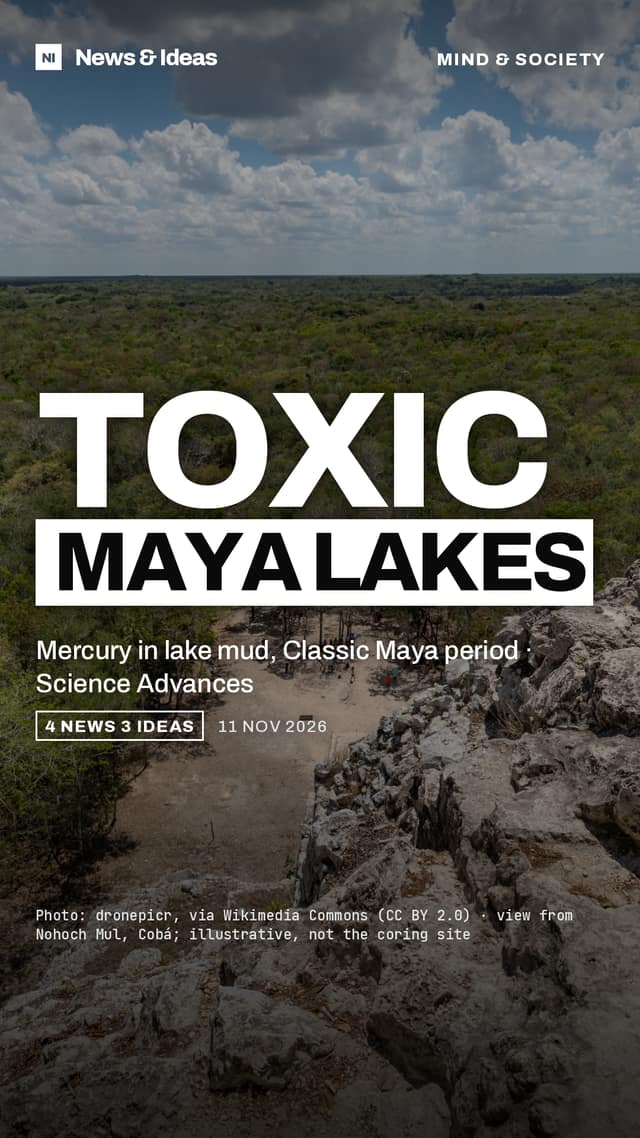
Waters, Wooten and colleagues (Auburn University) measured mercury in sediment cores from Lago Coba and Cenote Xcach in the Maya Lowlands. During the Classic period, Coba exceeded the probable-effect level for more than 200 years, including nearly a century above the severe-effect level; Xcach peaked at six times the severe-effect level for about 300 years, then dropped sharply around 850 CE. In the same layers algae, cyanobacteria and purple sulfur bacteria declined, ostracods were missing and dominant midge species declined; the communities recovered as mercury fell. The likely source is cinnabar, a red mercury mineral the Maya used on pottery, murals, temple walls and in burials, probably imported (a hypothesis). Waters does not claim mercury caused the Maya collapse, only that it was one more stressor (Science Advances, 6 Nov 2026).
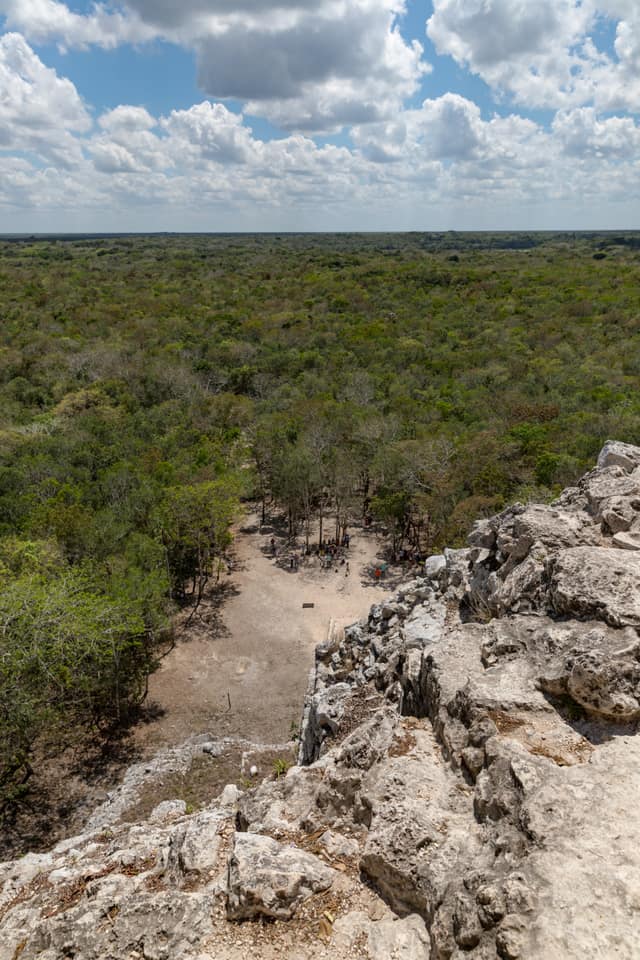
Photo: dronepicr, via Wikimedia Commons (CC BY 2.0) · view from Nohoch Mul, Cobá; illustrative, not the coring site
One email a day. 4 science stories, 5 quick results, 1 idea. 3 minutes.
Plus a daily quiz: Answer & Learn. Free, unsubscribe anytime.
Mind & Society
Chimpanzees Share a Signal Convention
Valet, Crockford, Wittig, Moore and colleagues recorded unvoiced calls such as "raspberries" from 91 chimpanzees in eight wild and sanctuary groups. Communities with adult role models used them in one dominant, stable context; groups without role models used them variably, evidence of a socially learned signal convention (PNAS, 9 Nov 2026).
Franklin, Nietschmann and Franklin trained 28 people over eight sessions on a reaching task with forces: compensation rose from about 80% to over 95%, about 60% was retained after 15 weeks, transfer to the other hand stayed at 5–10% and generalization narrowed with practice (Nature Human Behaviour, 9 Nov 2026).
Lou, Li and colleagues analysed 495 surveys (1990–2024) covering nearly 6.7 million women in 117 low- and middle-income countries: eligibility under preprimary-education laws was associated with higher female school enrolment and completion, more gender-egalitarian attitudes, more contraceptive use and lower adolescent childbearing and child marriage (Nature Human Behaviour, 4 Nov 2026). Associations from observational data; abstract free, full text paywalled.
Mercury turned into methylmercury by microbes accumulates in living tissue and concentrates at each step up the food web; at Minamata in Japan, industrial mercury reached people through fish and shellfish. Maya lake sediments show the base of that web collapsing.
In online experiments, people paired at random repeatedly converged on a shared name for a face with no central coordination: global conventions can emerge from local interactions. Chimpanzee groups with role models show a similar shared signal use.
Motor adaptation looks like two processes at once: a fast one that learns and forgets quickly, and a slow one that learns slowly and holds on. The model explains savings and spontaneous recovery, which the 15-week motor-memory study measured.