News & Ideas is a daily letter for anyone who wants the day's science in one place, not a feed. Each day is 4 news items and 3 ideas across AI & Tech, Physics & Engineering, Biology & Nature, and Mind & Society, and every story names a primary source you can check. The Shorts use a declared synthetic voice.
One email a day. 4 science stories, 5 quick results, 1 idea. 3 minutes.
Plus a daily quiz: Answer & Learn. Free, unsubscribe anytime.
Issue
18 November 2026
3 min read · 1 Short
Mind & Society: babies rarely see textbook emotion faces, why fake faces look more real, when scribes began writing as they spoke, kids expect girls to do costly chores. Then reading faces in context, the average face, diglossia.
One email a day. 4 science stories, 5 quick results, 1 idea. 3 minutes.
Plus a daily quiz: Answer & Learn. Free, unsubscribe anytime.
Mind & Society
Babies Rarely See the Emotion Faces Used to Test Them
Mind & Society: babies rarely see textbook emotion faces, why fake faces look more real, when scribes began writing as they spoke, kids expect girls to do costly chores. Then reading faces in context, the average face, diglossia.
Babies Rarely See the Emotion Faces Used to Test Them
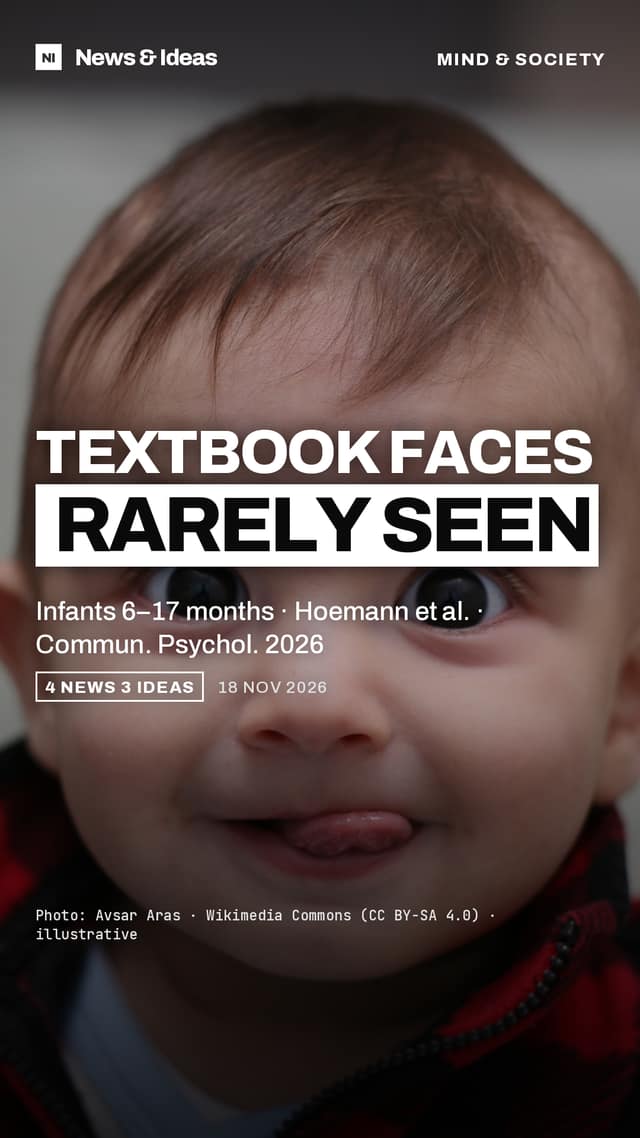
Katie Hoemann, Jeffrey Girard (University of Kansas) and colleagues at Rutgers, Northeastern and UC Davis analysed an existing longitudinal corpus of monthly, hour-long home recordings of 6- to 17-month-old infants interacting with close others, coding the faces and facial movements infants could see. Infants were exposed to far more partial than full faces; full-face exposure was low but increased with age. Facial configurations hypothesised as prototypes of emotions such as happiness or anger were extremely rare and, when they occurred, often appeared in unexpected contexts. Infants' input was dominated by a few mostly simple configurations that did not map fully or uniquely onto the prototypes. Communications Psychology (2026), open access.
One email a day. 4 science stories, 5 quick results, 1 idea. 3 minutes.
Plus a daily quiz: Answer & Learn. Free, unsubscribe anytime.
Psychology · Deepfakes
Why Fake Faces Look More Real
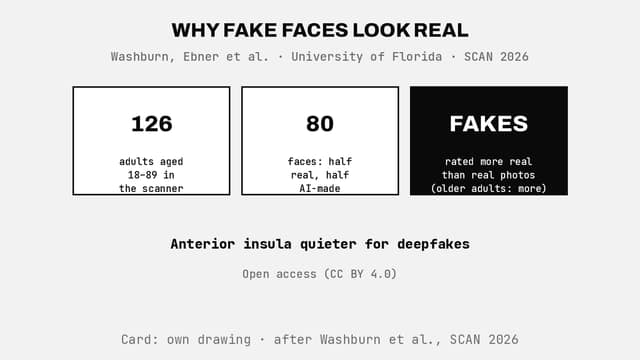
Stephanie Washburn, Natalie Ebner and colleagues (University of Florida) showed 80 face images, half real and half AI-generated, to 126 participants aged 18–89 who rated how real each looked during fMRI. Both younger and older adults rated deepfake faces as more real than real photographs ('deepfake hyperrealism'), and older adults showed a stronger bias. Activity in the anterior insula, a hub for detecting salient or suspicious information, was lower for deepfakes and tracked perceived realness, but did not differ between age groups. Social Cognitive and Affective Neuroscience (2026), open access.
Card: own drawing · after Washburn, Ebner et al., SCAN 2026
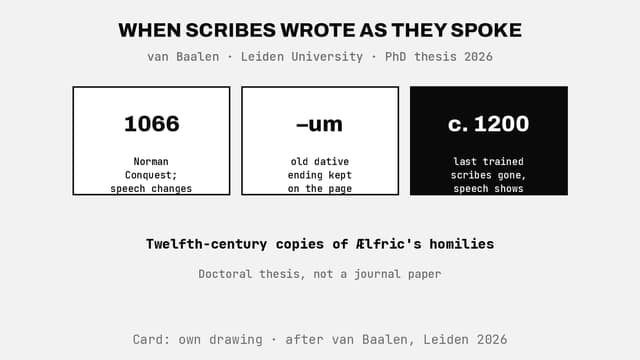
In his Leiden PhD thesis, Amos van Baalen traces how twelfth-century scribes updated late-eleventh- and twelfth-century copies of Ælfric of Eynsham's Catholic Homilies, using new transcriptions and automatic collation. He follows the plural dative ending -um (whether copyists still wrote a final nasal) and vocabulary changes. Scribes trained in the monastic Old English standard kept writing it long after the spoken language had moved on; the written standard disappeared only at the end of the twelfth century, when the last traditionally trained scribes had died, and copies increasingly show regional and spoken forms. Words were rarely replaced by French or Old Norse ones. Doctoral thesis (Leiden University, defended 17 Nov 2026), not a journal paper.
Card: own drawing · after van Baalen, Leiden University 2026
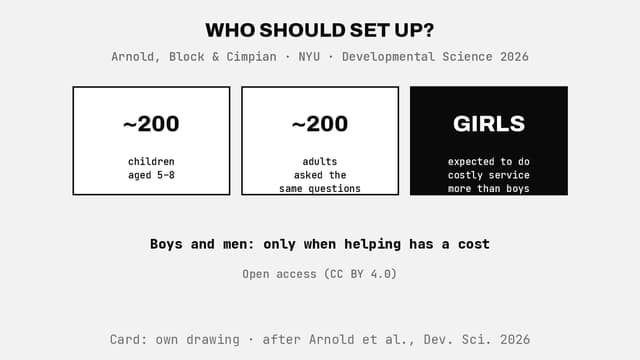
Sophie Arnold, Katharina Block and Andrei Cimpian (New York University) asked about 200 children aged 5–8 and about 200 adults whether one of the pictured boys or girls would help in classroom scenarios of three kinds: non-costly service to the group, costly service (e.g. setting up materials instead of playing outside at recess) and interpersonal helping. Both children and adults expected girls to do more costly service than boys. Girls and women expected girls to help more across all three kinds; boys and men did so only for costly service. Developmental Science (2026), open access.
Card: own drawing · after Arnold, Block & Cimpian, Dev. Sci. 2026
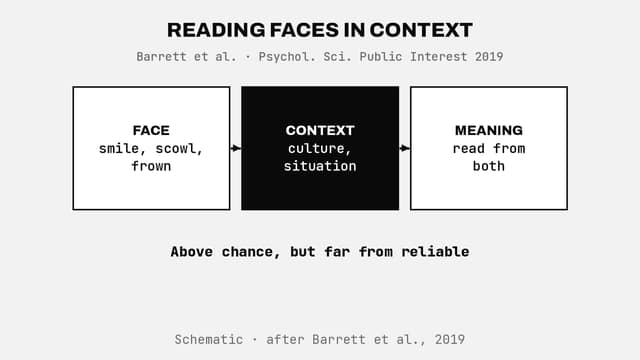
Barrett, Adolphs, Marsella, Martinez and Pollak (Psychological Science in the Public Interest, 2019) examined the common view that emotional states can be read from facial movements, for anger, disgust, fear, happiness, sadness and surprise. People do sometimes smile when happy, frown when sad or scowl when angry more than chance, but how emotions are communicated varies substantially across cultures, situations and people, and similar configurations can express more than one emotion. Perceivers rely on context.
Barrett et al. · Psychol. Sci. Public Interest 2019
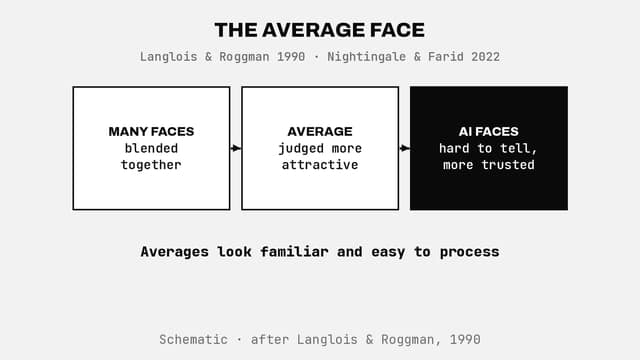
Langlois and Roggman (Psychological Science, 1990) showed that computer-averaged composite faces are judged more attractive than most of the individual faces that compose them. Nightingale and Farid (PNAS, 2022) found that faces synthesised by a modern generator were indistinguishable from real faces for human observers and were rated slightly more trustworthy. The Florida deepfake study links this hyperrealism to reduced anterior insula activity.
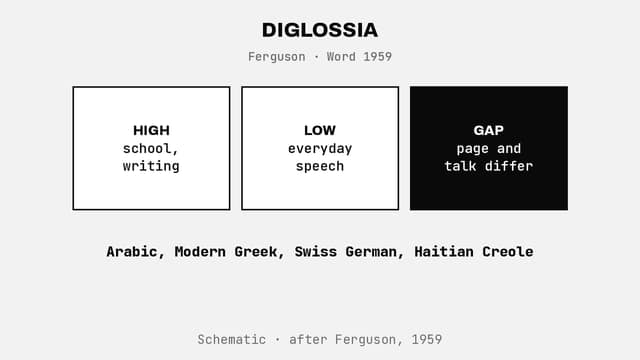
Charles Ferguson's 'Diglossia' (Word, 1959) describes speech communities where two varieties of a language coexist with distinct functions: a 'high' variety learned through formal education and used for writing and formal speech, and a 'low' variety used in everyday conversation. His defining cases were Arabic, Modern Greek, Swiss German and Haitian Creole. The persistence of written standard Old English while speech changed is a comparable gap between written and spoken language.