News & Ideas is a daily letter for anyone who wants the day's science in one place, not a feed. Each day is 4 news items and 3 ideas across AI & Tech, Physics & Engineering, Biology & Nature, and Mind & Society, and every story names a primary source you can check. The Shorts use a declared synthetic voice.
One email a day. 4 science stories, 5 quick results, 1 idea. 3 minutes.
Plus a daily quiz: Answer & Learn. Free, unsubscribe anytime.
Issue
14 November 2026
3 min read · 1 Short
Mind & Society: China Brewed Red Rice Drinks 5,000 Years Ago, How Promotion Rules Drove China's One-Child Policy, An Atlas of the Brain's Basal Ganglia, The Rhine Was No Barrier 5,000 Years Ago. Then Reading Ancient Starch Grains, The Principal-Agent Problem, Habits Live in the Basal Ganglia.
One email a day. 4 science stories, 5 quick results, 1 idea. 3 minutes.
Plus a daily quiz: Answer & Learn. Free, unsubscribe anytime.
Mind & Society
China's 5,000-Year-Old Red Rice Brew
Mind & Society: China Brewed Red Rice Drinks 5,000 Years Ago, How Promotion Rules Drove China's One-Child Policy, An Atlas of the Brain's Basal Ganglia, The Rhine Was No Barrier 5,000 Years Ago. Then Reading Ancient Starch Grains, The Principal-Agent Problem, Habits Live in the Basal Ganglia.
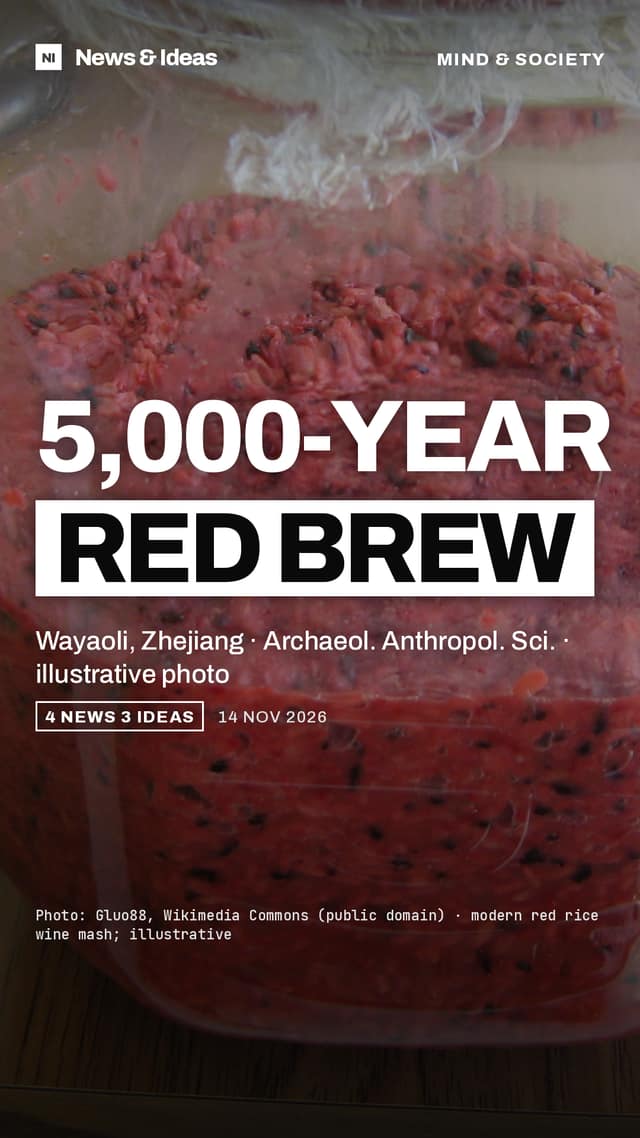
At Wayaoli, in Zhejiang, Ran Chen (University of Arizona) and colleagues analysed residues from 16 pottery vessels dated to about 5,000 to 5,300 years ago. All five double-bowl filters held rice residues and Monascus, the red mold used in traditional red rice brewing, so the drinks were probably reddish; foxnut starch was also present. Bast fibres on four filters suggest a woven cloth lining for straining, though no intact cloth survives and the lining is a reconstruction. Control samples were negative. Filters were found in about 71% of excavated burials, suggesting brewing mattered in social and ritual life.
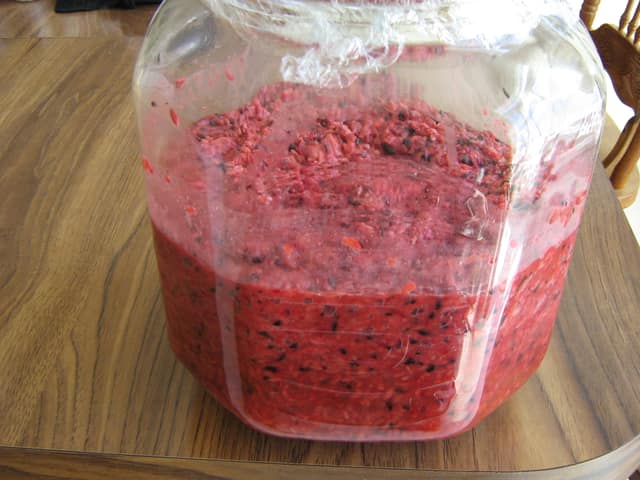
Photo: Gluo88, Wikimedia Commons (public domain) · modern red rice wine mash; illustrative
One email a day. 4 science stories, 5 quick results, 1 idea. 3 minutes.
Plus a daily quiz: Answer & Learn. Free, unsubscribe anytime.
Mind & Society
How Promotion Rules Drove China's One-Child Policy
Meng, Yang, Miller, Li and colleagues (Stanford, Renmin University) studied the one-vote veto, which barred local officials from promotion if they missed birth targets. They estimate it accounted for nearly half of China's fertility decline in the 1990s, when births per woman fell from about 2.5 to 1.6. IUD use rose first, and abortions rose later. Open access in Nature.
The BRAIN Initiative Cell Atlas Network published a cell-by-cell atlas of the basal ganglia, the deep brain circuits involved in movement, habits and reward, from 25.5 million cells in humans, macaques and marmosets, in a package of papers in Cell Press journals. Findings include a newly described neuron type, STR D2 SMYD2-HTR7, linked to genetic risk for schizophrenia and bipolar disorder, and an ageing clock based on cell changes. More than 50 institutions in 9 countries took part.
Archaeologist Sebastian Schultrich (ROOTS, Kiel University) links three kinds of late Neolithic finds on both sides of the Rhine: plain coarse-ware pottery, prestigious double axes and large collective graves. He argues they show a network of shared ideas from France to Scandinavia in the late fourth and early third millennia BC, with strong regional differences, rather than a river border between cultures. Published in Germania.
Starch grains and other microscopic plant remains can survive for thousands of years on pots, tools and even teeth, and many can be identified by shape. Henry, Brooks and Piperno used them to show that Neanderthals cooked and ate plants. The Wayaoli filters were read the same way.
When one party (the principal) relies on another (the agent) to act, incentives decide what the agent really does. Jensen and Meckling formalised the costs of this gap. Tying officials' promotions to birth targets is a stark example of an incentive at work.
Repeat an action enough and it becomes automatic. Ann Graybiel reviewed how circuits in the basal ganglia help turn actions into habits and chunk them into sequences. The new basal ganglia atlas lists the cell types that make up those circuits.