News & Ideas is a daily letter for anyone who wants the day's science in one place, not a feed. Each day is 4 news items and 3 ideas across AI & Tech, Physics & Engineering, Biology & Nature, and Mind & Society, and every story names a primary source you can check. The Shorts use a declared synthetic voice.
One email a day. 4 science stories, 5 quick results, 1 idea. 3 minutes.
Plus a daily quiz: Answer & Learn. Free, unsubscribe anytime.
Issue
2 November 2026
3 min read · 1 Short
Mind & Society: fingerprints on the Terracotta Army point to women and children, a sealed Pompeii cupboard with childhood amulets, gambling among young Americans, a fluent chatbot that makes things up. Then corvée labour, anagnorisis, processing fluency.
One email a day. 4 science stories, 5 quick results, 1 idea. 3 minutes.
Plus a daily quiz: Answer & Learn. Free, unsubscribe anytime.
Mind & Society
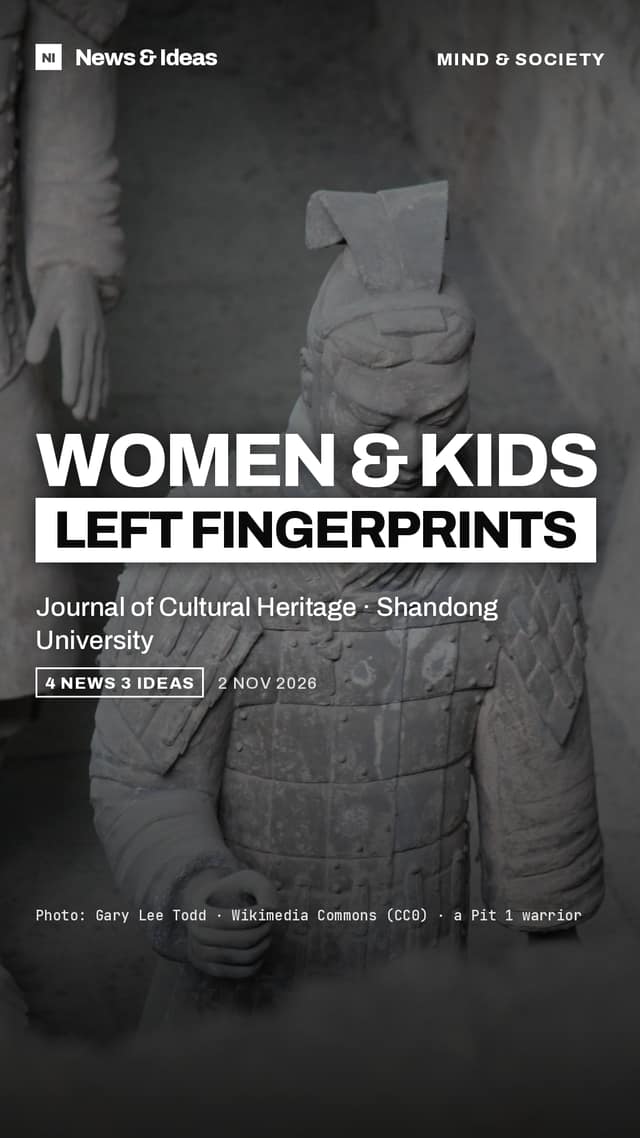
Terracotta Army fingerprints point to women and child makers
Mind & Society: fingerprints on the Terracotta Army point to women and children, a sealed Pompeii cupboard with childhood amulets, gambling among young Americans, a fluent chatbot that makes things up. Then corvée labour, anagnorisis, processing fluency.
Terracotta Army fingerprints point to women and child makers
Terracotta Army fingerprints point to women and child makers
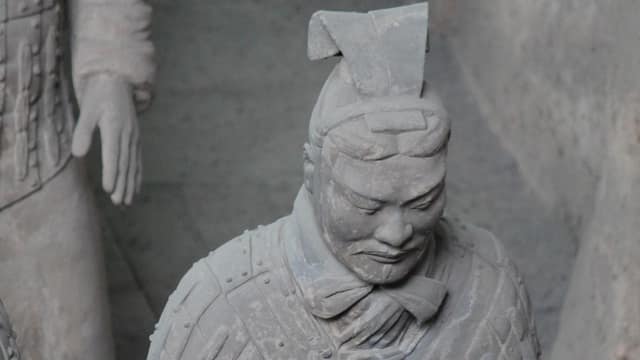
A Shandong University team imaged 23 warriors in Pit 1 of the Terracotta Army in 3D and isolated 79 distinct fingerprints. A statistical model of ridge density estimated about 45 percent adult men, 33 percent adult women and 22 percent children under 15. Most prints sit on heads and armour. The authors caution that these are group estimates: a share of prints is not a share of workers, and one person can leave many. Published in the Journal of Cultural Heritage.
Photo: Gary Lee Todd · Wikimedia Commons (CC0) · a Pit 1 warrior, not necessarily one of the 23 studied
One email a day. 4 science stories, 5 quick results, 1 idea. 3 minutes.
Plus a daily quiz: Answer & Learn. Free, unsubscribe anytime.
History · Pompeii
A sealed Pompeii cupboard: 24 childhood amulets and 38 coins
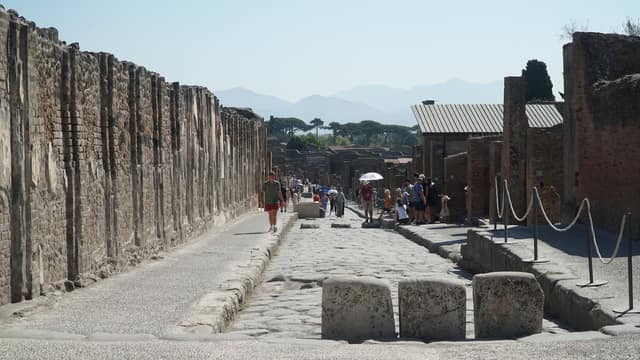
In the House of Cornelius Maximus on Via dell'Abbondanza, Pompeii's archaeologists rebuilt a lost wooden cupboard from its imprint in the ash. Inside were 24 small pendants, the crepundia worn as childhood amulets, plus a bronze lamp, pots, lead weights and 38 bronze coins in a woven basket. The authors say it cannot be known whether the owners fled or died.
Photo: Adam Harangozó · Wikimedia Commons (CC BY-SA 4.0) · Via dell'Abbondanza, not the find
More than half of young Americans gambled in the past year
Rutgers' Center for Gambling Studies surveyed 1,677 Americans aged 13 to 27, the first national study of its kind in nearly 20 years. 52.5 percent had gambled in the past year, including 42.7 percent of 13 to 17 year olds. Among those who gambled, 10.3 percent were at high risk of problem gambling. A research centre report, not yet peer-reviewed.
A fluent chatbot that makes things up is trusted like a correct one
Radboud University researchers showed people one of four chatbot conversations about The Lord of the Rings: fluent or curt, correct or with invented facts. A fluent chatbot that got facts wrong was rated as intelligent and pleasant as a curt one that was right. About 80 percent of participants did not notice the errors. Published in Computers in Human Behavior: Artificial Humans.
Users’ perception of chatbot language fluency and hallucinationComputers in Human Behavior: Artificial Humans · 21 Oct 2026 · Primary · de Sá Siqueira, Bosse & Müller, Computers in Human Behavior: Artificial Humans 10, 100412 (2026); open access; one scenario
Corvée is unpaid labour a state demands for a number of days a year, a tax paid in effort rather than money or crops. It built roads, canals and great works in many societies, from ancient Egypt to France before the Revolution. In Qin China, people entered the labour rolls at about 15, the age threshold the Terracotta study uses to read its 22 percent of prints from under-15s.
In the Poetics, Aristotle calls recognition a change from ignorance to knowledge: the moment a character discovers who someone really is, often through an object or a sign. In Plautus' comedy Rudens, the young Palaestra finds her family thanks to the crepundia she kept in a little box, the same kind of amulets found in the Pompeii cupboard.
What we read or process easily feels truer, more familiar and more competent, even when ease has nothing to do with truth. Reber and Schwarz showed in 1999 that statements made easier to read just by colour contrast were judged true more often. Alter and Oppenheimer later gathered dozens of similar effects under one idea. The fluent chatbot that makes things up is a case in point.
Photo: Gary Lee Todd · Wikimedia Commons (CC0) · a Pit 1 warrior, not necessarily one of the 23 studied
Photo: Adam Harangozó · Wikimedia Commons (CC BY-SA 4.0) · Via dell'Abbondanza, not the find
Voice: synthetic (neural text-to-speech).
Scripts written from the linked sources.
4 News 3 IdeasNews and IdeasMind & SocietyTerracotta Armyarchaeologyfingerprintsancient ChinaQin dynastyhistoryJournal of Cultural Heritagelabour history
Mind & Society
Question of the day
How many bronze coins lay in a woven basket inside the sealed Pompeii cupboard?
12
38
138
380
The ballot is in the email. Each choice there is counted once.