News & Ideas is a daily letter for anyone who wants the day's science in one place, not a feed. Each day is 4 news items and 3 ideas across AI & Tech, Physics & Engineering, Biology & Nature, and Mind & Society, and every story names a primary source you can check. The Shorts use a declared synthetic voice.
One email a day. 4 science stories, 5 quick results, 1 idea. 3 minutes.
Plus a daily quiz: Answer & Learn. Free, unsubscribe anytime.
Issue
20 November 2026
3 min read · 1 Short
Mind & Society: pupils that betray a secret card, numbers tell but words sell, how the brain tells speech from music, dark traits on a first date. Then pupils and mental effort, words with numbers, the cocktail party problem.
One email a day. 4 science stories, 5 quick results, 1 idea. 3 minutes.
Plus a daily quiz: Answer & Learn. Free, unsubscribe anytime.
Mind & Society
Your Pupils Can Betray a Secret Card
Mind & Society: pupils that betray a secret card, numbers tell but words sell, how the brain tells speech from music, dark traits on a first date. Then pupils and mental effort, words with numbers, the cocktail party problem.
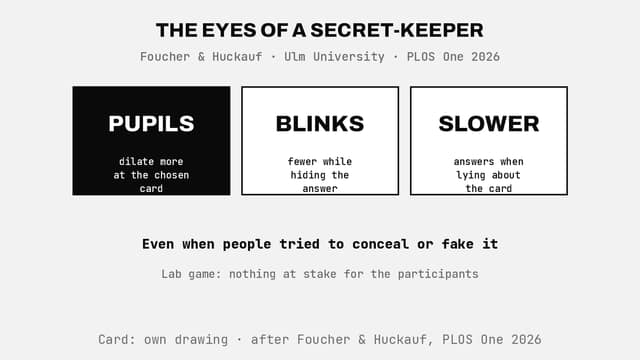
Valentin Foucher and Anke Huckauf (Ulm University) ran a social, interactive concealed information test: adult volunteers sat opposite a confederate posing as a mentalist, chose one of six numbered cards and then, depending on instructions, revealed it, kept it secret or tried to mislead him while the cards were shown again one at a time. Eye-tracking glasses recorded pupil size, blinks and fixations; response times were measured. Pupils briefly dilated more for the chosen card whether participants were honest or deceptive; when concealing, participants blinked less and fixated longer; lying answers were slower. The authors note deception carried no consequences, unlike real investigations.
Card: own drawing · after Foucher & Huckauf, PLOS One 2026
One email a day. 4 science stories, 5 quick results, 1 idea. 3 minutes.
Plus a daily quiz: Answer & Learn. Free, unsubscribe anytime.
Economics · Persuasion
Numbers Tell, Words Sell
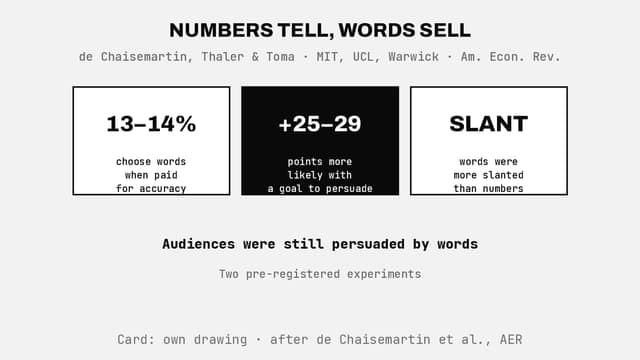
Victor de Chaisemartin (MIT), Michael Thaler (UCL) and Mattie Toma (Warwick) ran two pre-registered sender-receiver experiments: 1,000 Prolific participants communicating probabilities, and 146 academic researchers communicating research findings to policymakers from five countries. With incentives for accuracy, senders chose language over numbers only 13–14% of the time; with incentives to persuade, the likelihood of choosing language rose by 25–29 percentage points. Language messages were more slanted than numeric ones, and receivers were persuaded even when told the sender had an agenda. Accepted for publication in the American Economic Review.
Card: own drawing · after de Chaisemartin et al., AER
Numbers Tell, Words SellAmerican Economic Review (forthcoming) · 2026 · Primary · de Chaisemartin, Thaler & Toma, American Economic Review (forthcoming)
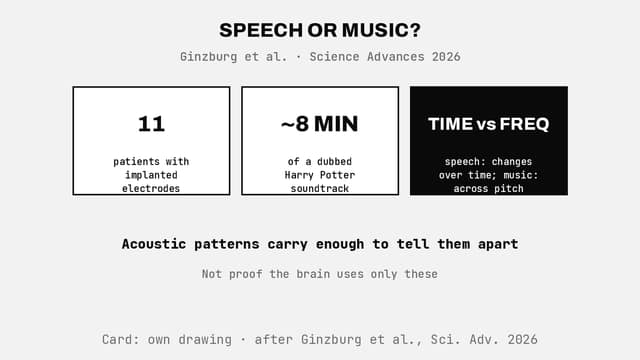
Jérémie Ginzburg and colleagues recorded intracranial activity in 11 epilepsy patients while they listened to nearly eight minutes of the French-dubbed soundtrack of 'Harry Potter and the Philosopher's Stone'; 19 healthy adults separately reported speech, music or both. From 39 auditory recording sites in both hemispheres, models reconstructed spectrotemporal modulations, which predicted listeners' judgements above chance (54–60% for speech, 54–71% for music per site; 97–100% from the soundtrack's acoustics directly). Speech depended mainly on temporal modulations, music on spectral ones; gamma activity tracked timing, alpha tracked frequency patterns; left-hemisphere agreement was stronger for speech, right for music. Acoustic coding is sufficient, the authors say, but not necessarily the only mechanism.
Card: own drawing · after Ginzburg et al., Sci. Adv. 2026
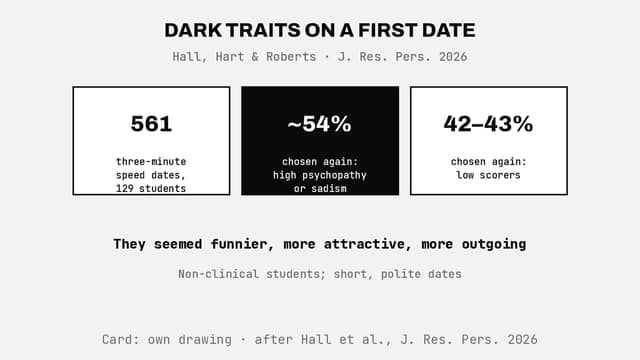
Braden Hall and colleagues ran eight speed-dating events with 129 heterosexual college students (68 men, 61 women) who completed psychopathy (SRP-SF) and sadism (ASP) questionnaires beforehand; 561 three-minute dates followed, with scorecards after each. Higher psychopathy raised the odds of a second-date 'yes' by nearly 25% and higher sadism by 28%: low scorers had a 42–43% chance, high scorers nearly 54%, about one extra second date per event. They were seen as more attractive, funnier and more extraverted, and not as less kind or agreeable. Traits were measured in non-clinical students; the study cannot say whether they hid antagonistic tendencies on purpose.
Card: own drawing · after Hall et al., J. Res. Pers. 2026
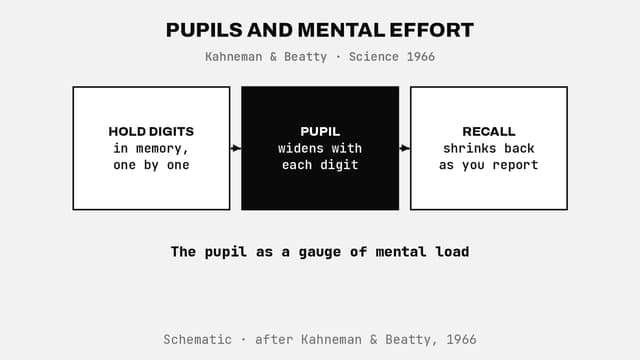
Kahneman & Beatty (Science, 1966) recorded pupil diameter while participants listened to and then repeated strings of digits: the pupil dilated with each digit presented and constricted with each digit reported, with larger changes for heavier memory loads. Pupillometry has since been used to track cognitive load and, as in the Ulm study, recognition of significant items.
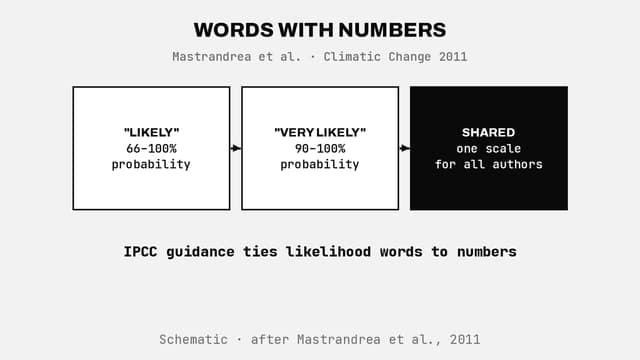
Mastrandrea et al. (Climatic Change, 2011) describe the IPCC AR5 guidance note on consistent treatment of uncertainties, which calibrates likelihood terms to probability ranges (e.g. 'likely' 66–100%, 'very likely' 90–100%) and separates them from confidence levels. The AER authors point to such shared standards as one response to strategic use of vague language.
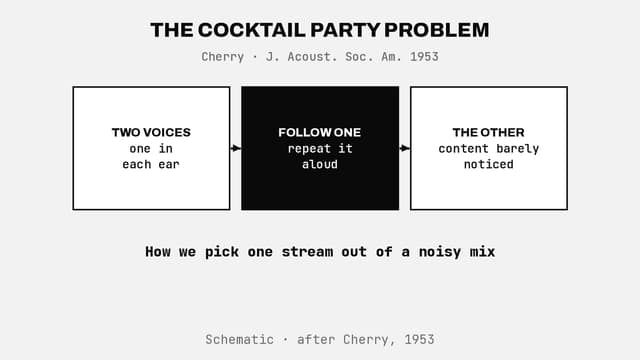
Cherry (Journal of the Acoustical Society of America, 1953) studied how we recognise one speaker among others. In dichotic experiments, listeners shadowed the message in one ear and could report almost nothing of the content in the other, though they noticed gross changes such as a switch to a tone. Separating and categorising overlapping sounds, like speech over film music, remains an active research question.