News & Ideas is a daily letter for anyone who wants the day's science in one place, not a feed. Each day is 4 news items and 3 ideas across AI & Tech, Physics & Engineering, Biology & Nature, and Mind & Society, and every story names a primary source you can check. The Shorts use a declared synthetic voice.
One email a day. 4 science stories, 5 quick results, 1 idea. 3 minutes.
Plus a daily quiz: Answer & Learn. Free, unsubscribe anytime.
Issue
16 November 2026
3 min read · 1 Short
Mind & Society: milk and wine left for the dead on Menorca, career incentives behind China's birth decline, sound that feels like a current, how designs evolve without culling. Then residue analysis, Campbell's law, pseudo-haptics.
One email a day. 4 science stories, 5 quick results, 1 idea. 3 minutes.
Plus a daily quiz: Answer & Learn. Free, unsubscribe anytime.
Mind & Society
Milk and Wine for the Dead in Iron Age Menorca
Mind & Society: milk and wine left for the dead on Menorca, career incentives behind China's birth decline, sound that feels like a current, how designs evolve without culling. Then residue analysis, Campbell's law, pseudo-haptics.
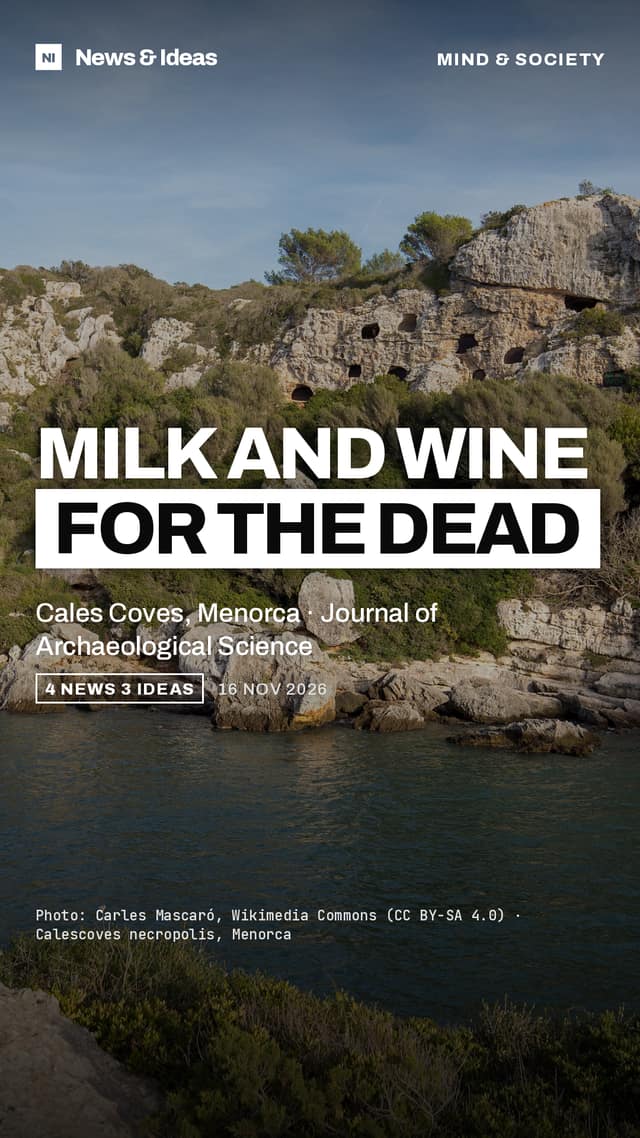
Sònia Carbonell (BSC-CNS), Margalida Coll (UPF) and Adrià Breu (UAB) analysed organic residues in 34 ceramic vessels from Cave 45 of the Calescoves burial complex (Alaior, Menorca), dating to the Late Iron Age (post-Talayotic period), over 2,000 years ago. The small, high-bottomed vessels typical of the island mainly held dairy products; wine appeared only in a few local pieces of 'foreign-inspired' style, linked to Punic forms, the first evidence of wine in a Menorcan funerary ritual. A small spouted vessel was confirmed as a likely infant feeding bottle. Animal fats and plant oils were also found. The lab combined dairy and wine tests into one procedure to halve sample size. Journal of Archaeological Science (2026).
One email a day. 4 science stories, 5 quick results, 1 idea. 3 minutes.
Plus a daily quiz: Answer & Learn. Free, unsubscribe anytime.
Society · Policy
Career Rules Drove China's Birth Decline
Lingsheng Meng, Hanmo Yang, Grant Miller and Hongbin Li (Stanford, Renmin University) studied why China's fertility barely moved after the one-child policy of 1979-1980 but fell by more than a third in the early 1990s. Using provincial differences in when the 'one vote veto' was adopted, a rule that blocked career advancement for officials who failed birth-control targets, they estimate it explains nearly half of the 1990s decline in the total fertility rate, pushing it below replacement. IUD use recommended by local officials rose; induced abortions increased later. Observational design based on timing differences. Nature, 11 Nov 2026 (open access, CC BY-NC-ND 4.0).
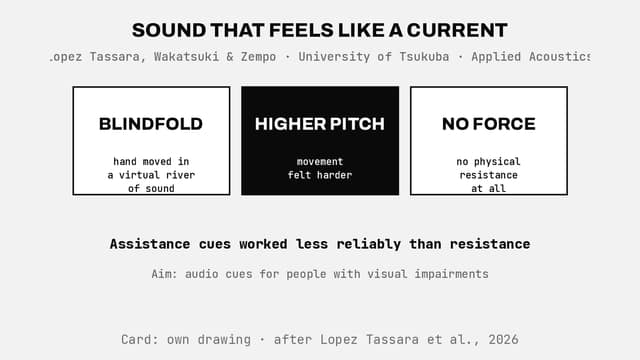
Researchers at the University of Tsukuba asked blindfolded participants wearing headphones to move a hand side to side in a simulated 'hand-in-river' scene, tracked by a smartphone camera, while the pitch and apparent location of sounds changed. With no physical force, higher pitch increased perceived resistance, more so when combined with sound shifted away from the hand. Lower pitch or sound shifted in the direction of movement did not reliably create a sense of assistance. The aim is sound-based cues for people with visual impairments in virtual spaces. Applied Acoustics (2027 issue, online 2026).
Card: own drawing · after Lopez Tassara et al., Applied Acoustics
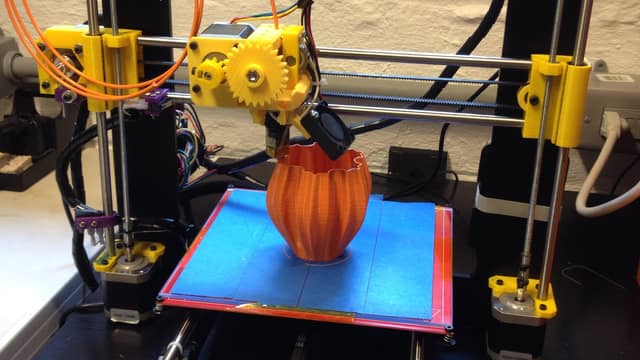
A Charles University team with the University of Buea ran transmission-chain experiments with 600 participants in Czechia and Cameroon, who modified 3D objects on a tablet, each generation building on the previous one; objects were 3D-printed and tested. In the engineering task (roll down a ramp fast), objects improved across generations; in the aesthetic task, new objects were not rated higher than their models. Chains without selection (no discarding of the worst artefact) improved at the same rate as chains with selection, as far as the sample size allows, pointing to 'guided variation': people improving designs in their heads. Cultural background shaped how much people deviated from models. Evolution and Human Behavior (2027 issue).
Photo: John Abella · Wikimedia Commons (CC BY 2.0) · 3D printer; illustrative
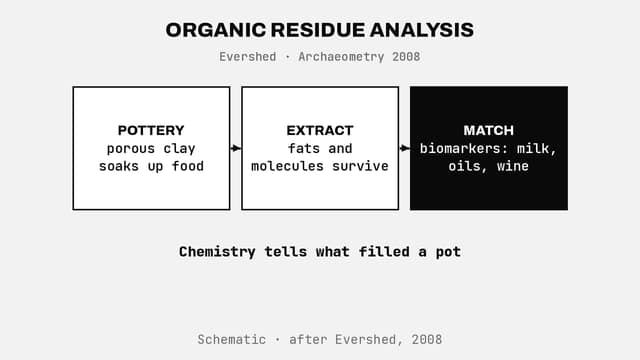
Unglazed pottery absorbs lipids and other organic compounds from what it held, and these can survive for millennia protected in the clay. Evershed's review describes how chemists extract the residues and identify 'biomarkers' and isotope signatures that point to dairy fats, animal fats, plant oils, beeswax or wine. The Menorca study used this approach, combining dairy and wine tests in one procedure.
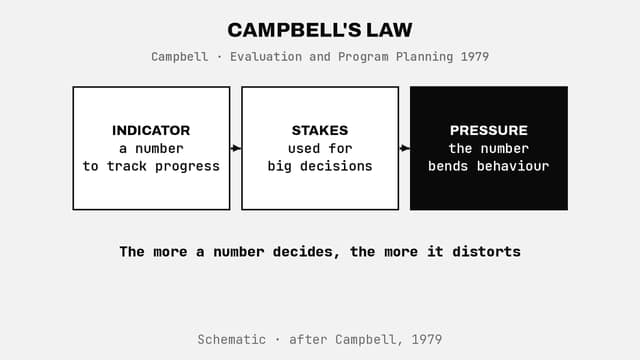
Donald Campbell's 1979 paper on evaluating social programmes states that the more any quantitative social indicator is used for social decision-making, the more subject it is to corruption pressures and the more apt it is to distort the social processes it is meant to monitor. It is a close cousin of Goodhart's law. China's 'one vote veto', which tied officials' promotion to birth targets, is a case where an indicator carried very high stakes.
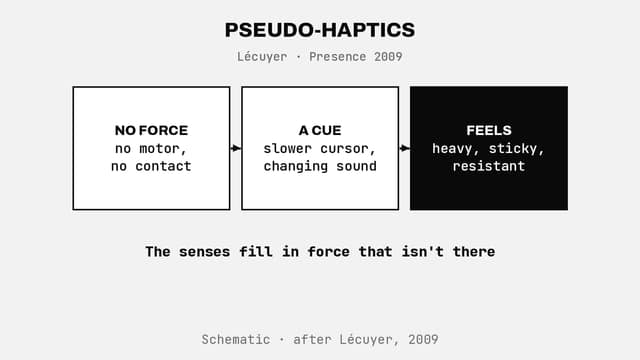
Pseudo-haptic feedback simulates touch and force sensations without force-feedback hardware, by exploiting how the brain combines senses. Lécuyer's survey describes classic effects: changing the speed of a cursor as it moves over an area makes people perceive bumps, holes, stiffness or friction. Most work has used vision; the Tsukuba 'hand-in-river' study tests sound alone.