News & Ideas is a daily letter for anyone who wants the day's science in one place, not a feed. Each day is 4 news items and 3 ideas across AI & Tech, Physics & Engineering, Biology & Nature, and Mind & Society, and every story names a primary source you can check. The Shorts use a declared synthetic voice.
One email a day. 4 science stories, 5 quick results, 1 idea. 3 minutes.
Plus a daily quiz: Answer & Learn. Free, unsubscribe anytime.
Issue
31 October 2026
2 min read · 1 Short
Mind & Society: children who fear spiders but still love nature, cunning folk on trial in Exeter, emotion regulation without one brain signature, heritability from 500,000 sibling pairs. Then biophilia, the ideomotor effect, the jingle-jangle fallacy.
One email a day. 4 science stories, 5 quick results, 1 idea. 3 minutes.
Plus a daily quiz: Answer & Learn. Free, unsubscribe anytime.
Mind & Society
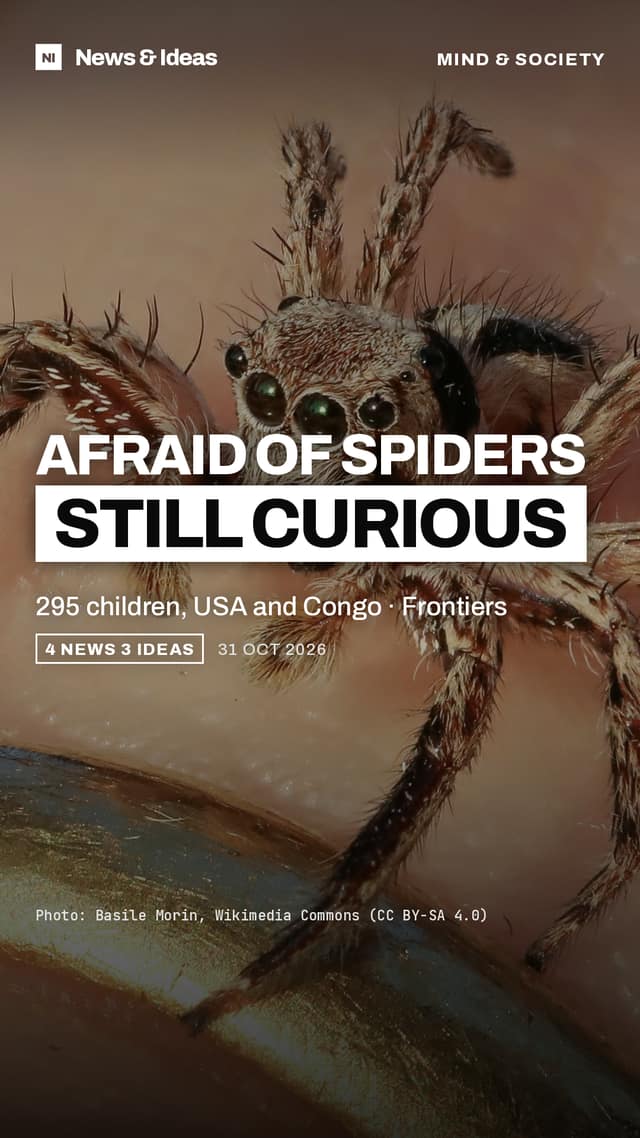
Afraid of spiders, still curious
Mind & Society: children who fear spiders but still love nature, cunning folk on trial in Exeter, emotion regulation without one brain signature, heritability from 500,000 sibling pairs. Then biophilia, the ideomotor effect, the jingle-jangle fallacy.
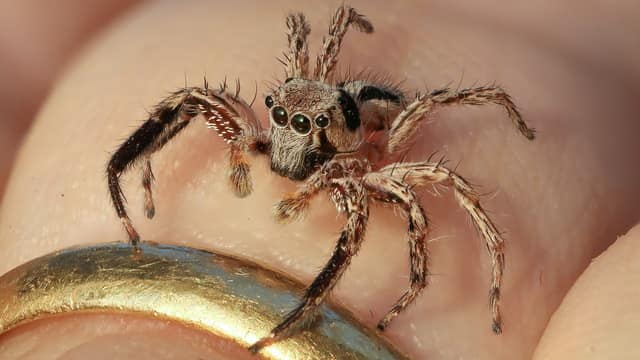
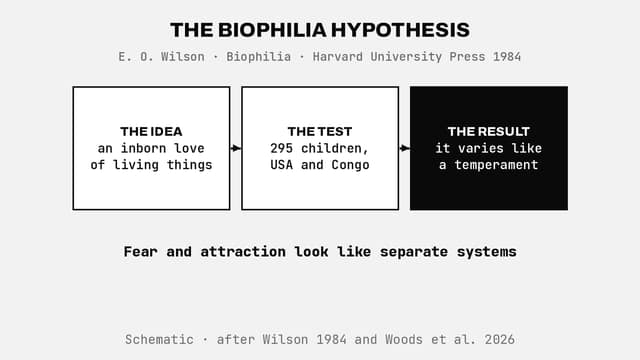
Duke and NC State researchers asked 295 children, at a North Carolina zoo and a bonobo sanctuary in Congo, about animals. In both groups, fear of animals did not correlate with attraction to nature. Answers were self-reported. Published in Frontiers in Psychology.
One email a day. 4 science stories, 5 quick results, 1 idea. 3 minutes.
Plus a daily quiz: Answer & Learn. Free, unsubscribe anytime.
Society · History
Cunning folk on trial in Exeter
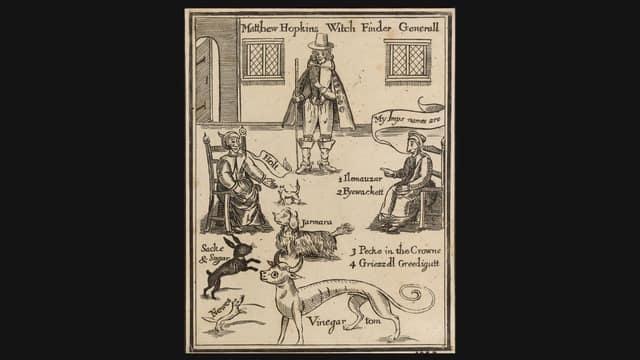
Southampton historian Mark Stoyle reread Exeter court records. Cunning folk, paid to find lost spoons or purses, were mostly tolerated elsewhere in England, but Exeter prosecuted them, in 1629, 1642 and 1666. The 1647 print shows a different witch hunt. From a new book edition, not a paper.
Print: British Museum 1868,0808.3233 · Wikimedia Commons (public domain) · 1647, not Exeter
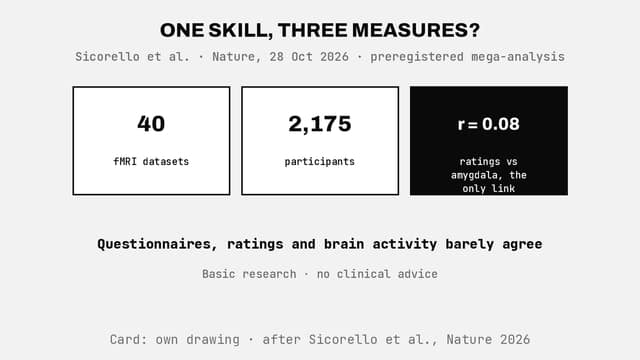
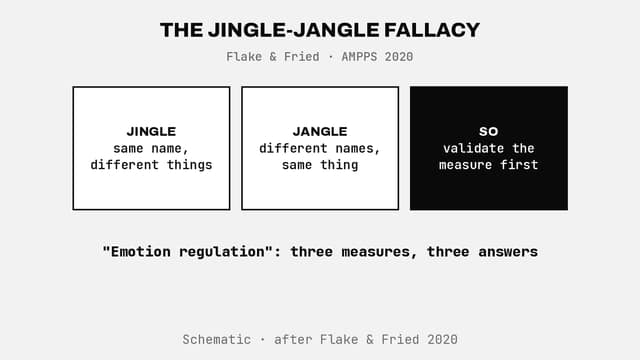
In a preregistered mega-analysis of 40 brain-scan datasets and 2,175 people, three measures of rethinking emotions barely agreed: questionnaires, task ratings, and amygdala activity. The only link, ratings with amygdala, was r equals 0.08. Basic research, published in Nature.
Card: own drawing · after Sicorello et al., Nature 2026
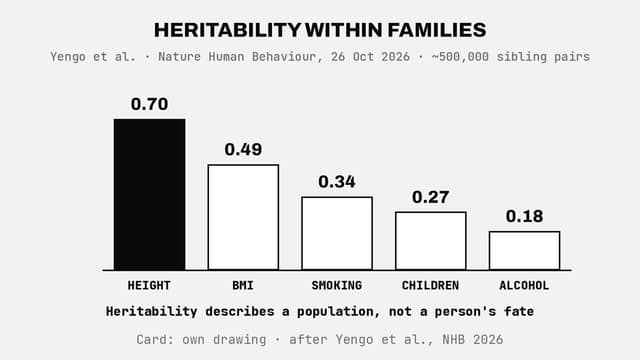
Using about 500,000 sibling pairs from 23andMe data, researchers estimated heritability within families. Height came out highest, at 0.70; alcohol use at 0.18. Estimates agreed across ancestries and were lower than in twin studies. Heritability describes populations, not individual fate. Published in Nature Human Behaviour.
Card: own drawing · after Yengo et al., Nat. Hum. Behav. 2026
The biophilia hypothesis. In 1984, E. O. Wilson proposed humans have an innate, universal affinity for living things. Today's study suggests it varies between people, like temperament, and fear does not erase it.
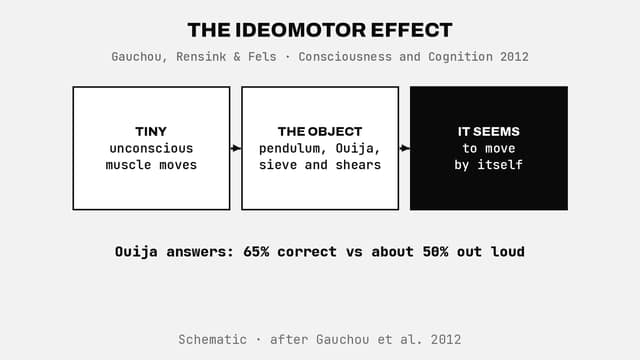
The ideomotor effect. Tiny unconscious muscle movements make pendulums, Ouija boards or a sieve seem to move by themselves. In one study, people who thought they were guessing answered yes-no questions correctly 65 percent of the time via a Ouija board, against about 50 percent aloud.
The jingle-jangle fallacy. Two tests with the same name can measure different things, and two names can hide the same thing. Without validation, a label does not guarantee that measures agree, as today's emotion study shows.