News & Ideas is a daily letter for anyone who wants the day's science in one place, not a feed. Each day is 4 news items and 3 ideas across AI & Tech, Physics & Engineering, Biology & Nature, and Mind & Society, and every story names a primary source you can check. The Shorts use a declared synthetic voice.
One email a day. 4 science stories, 5 quick results, 1 idea. 3 minutes.
Plus a daily quiz: Answer & Learn. Free, unsubscribe anytime.
Issue
21 November 2026
4 min read · 1 Short
Mind & Society: a sugary drink makes its logo pull harder, late-night phones and teen sleep, three days on Instagram and prejudice, the networking paradox. Then wanting is not liking, the contact hypothesis, structural holes.
One email a day. 4 science stories, 5 quick results, 1 idea. 3 minutes.
Plus a daily quiz: Answer & Learn. Free, unsubscribe anytime.
Mind & Society
How a Sugary Drink Makes Its Logo Pull Harder
Mind & Society: a sugary drink makes its logo pull harder, late-night phones and teen sleep, three days on Instagram and prejudice, the networking paradox. Then wanting is not liking, the contact hypothesis, structural holes.
Kyle Burger (Monell Chemical Senses Center) and colleagues ran a randomized controlled trial (NCT03490734) with 160 young adults at the University of North Carolina at Chapel Hill. For three weeks, 85 participants drank a sugar-sweetened beverage (27 grams of sugar, 111 calories) paired with a distinct visual symbol, while 75 drank a flavour-matched, unsweetened, non-caloric control paired with a different symbol. Before and after, the team measured behaviour and brain responses with functional MRI (122 people in the imaging subsample). The sugar group showed faster approach toward its beverage cue, associated with differences in ventral striatal response to the cue, without detectable changes in how much they valued or liked the drink, body mass, blood glucose or diet. The authors read this as a signature of incentive sensitization; whether it changes real-world drink choices is the next question.
One email a day. 4 science stories, 5 quick results, 1 idea. 3 minutes.
Plus a daily quiz: Answer & Learn. Free, unsubscribe anytime.
Society · Sleep
Late-Night Phones and Teen Sleep
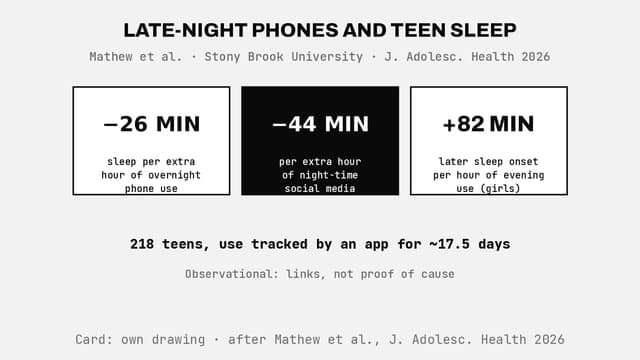
Gina Marie Mathew and colleagues (Stony Brook University MEDiA Study) installed the RealityMeter app on the personal smartphones of 218 US adolescents aged 13–18, recording app use, categories and timing for an average of 17.5 days, rather than relying on self-reported screen time. More daily smartphone use went with later bedtimes, shorter and more irregular sleep and more weekend catch-up sleep. Each additional hour of overnight use was associated with about 26 minutes less sleep, and an extra hour of night-time social media with 44.4 fewer minutes. Among girls, each additional hour of evening use was linked to falling asleep 82.2 minutes later and 70.8 minutes less sleep; the association was not statistically significant in boys. The study is observational, so it shows associations, not cause and effect.
Card: own drawing · after Mathew et al., J. Adolesc. Health 2026
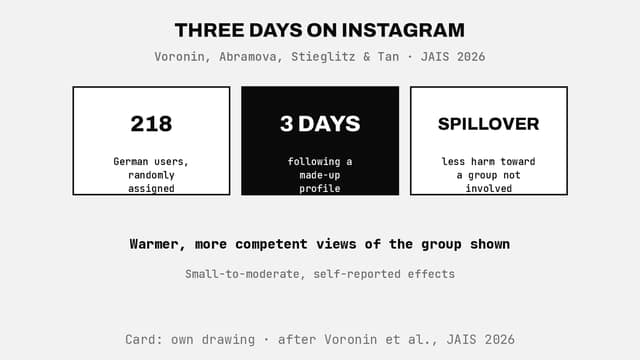
Georg Voronin and Stefan Stieglitz (University of Potsdam), Olga Abramova (Leuphana University Lüneburg) and Chee-Wee Tan (Hong Kong Polytechnic University) created four fictional Instagram profiles, two with German-sounding and two with Arabic- or Turkish-sounding names, posting neutral everyday photos such as building facades and parks. In a three-day randomized field experiment, 218 German Instagram users each followed one profile. Afterwards, participants perceived people of Turkish or Arab background in Germany as warmer and more competent, and reported less willingness to harm and more willingness to support them. The effect spilled over to a group not involved in the contact: participants also reported less willingness to engage in negative behaviour toward LGBTQIA+ people. Effects were small to moderate, comparable to face-to-face contact, based on questionnaire answers rather than behaviour, and their persistence beyond three days is unknown. Published in the Journal of the Association for Information Systems.
Card: own drawing · after Voronin et al., JAIS 2026
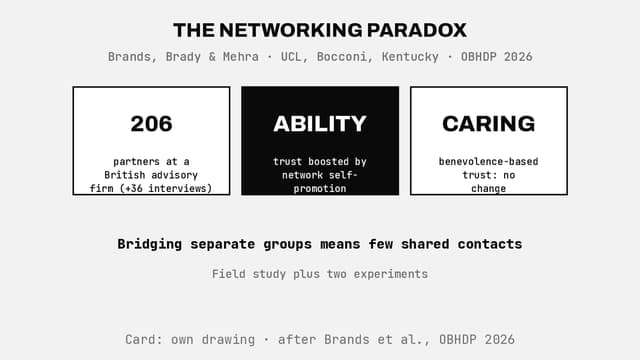
Raina Brands (University College London), Garrett Brady (Bocconi University) and Ajay Mehra (University of Kentucky) studied brokers, people whose networks span structural holes between disconnected groups. Those networks help spot valuable referrals but lack the mutual contacts that let others check a broker's reputation. In a field study at a British accounting and business advisory firm (36 interviews, survey responses from 206 partners), brokers with more disconnected networks had more referrals accepted, especially those who practised network self-promotion, highlighting their network quality and matchmaking competence. Two experiments showed asymmetric effects across facets of trust: self-promotion substituted for missing reputational cues about ability, amplified integrity-based trust where shared ties existed, and did not change the role of benevolence-based trust. Exaggerated self-promotion can backfire, the authors note.
Card: own drawing · after Brands, Brady & Mehra, OBHDP 2026
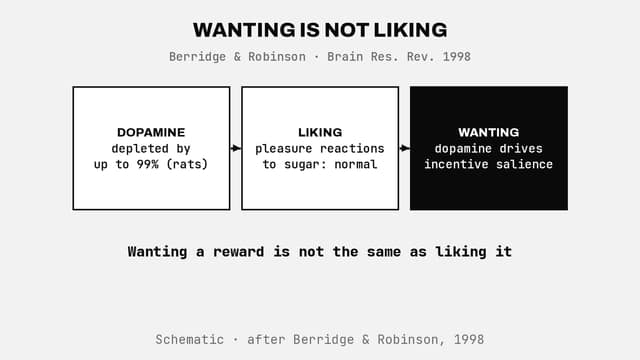
Berridge and Robinson (Brain Research Reviews, 1998) depleted dopamine in the nucleus accumbens and neostriatum of rats by up to 99% with 6-hydroxydopamine and measured taste reactivity. The rats showed normal hedonic reactions to sucrose versus quinine, normal learning of new hedonic values and normal pharmacological enhancement of palatability. They concluded that dopamine is needed for 'wanting' incentives, incentive salience, but not for 'liking' them. Today's Cell Metabolism trial explicitly tests a prediction of this incentive-sensitization view in humans.
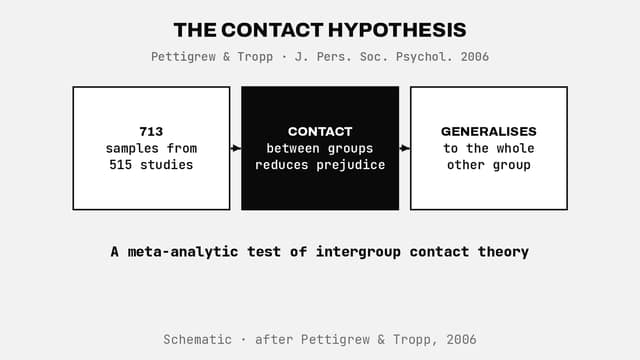
Pettigrew and Tropp (Journal of Personality and Social Psychology, 2006) ran a meta-analysis of 713 independent samples from 515 studies and found that intergroup contact typically reduces intergroup prejudice. The result did not appear to stem from participant selection or publication bias, more rigorous studies showed larger effects, and contact effects typically generalised to the entire outgroup, across many kinds of groups and settings. Allport's optimal conditions strengthened the effect but were not essential. The Instagram experiment tests the same idea online.
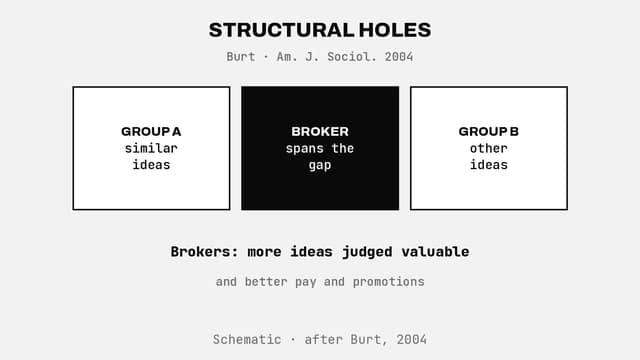
Burt (American Journal of Sociology, 2004) argued that opinion and behaviour are more homogeneous within than between groups, so people connected across groups see alternative ways of thinking. Studying managers' networks in a large American electronics company, he found that compensation, positive evaluations, promotions and good ideas were disproportionately held by people whose networks spanned structural holes; these brokers were more likely to express ideas, less likely to have them dismissed and more likely to have them evaluated as valuable. Today's study looks at the trust cost of that position.