News & Ideas is a daily letter for anyone who wants the day's science in one place, not a feed. Each day is 4 news items and 3 ideas across AI & Tech, Physics & Engineering, Biology & Nature, and Mind & Society, and every story names a primary source you can check. The Shorts use a declared synthetic voice.
One email a day. 4 science stories, 5 quick results, 1 idea. 3 minutes.
Plus a daily quiz: Answer & Learn. Free, unsubscribe anytime.
Issue
29 October 2026
2 min read · 1 Short
Mind & Society: a global survey of trust in science, a fake AI paper caught by its ghost citations, seen and unseen faces in the brain, where language came from. Then trust, binocular rivalry, gossip.
One email a day. 4 science stories, 5 quick results, 1 idea. 3 minutes.
Plus a daily quiz: Answer & Learn. Free, unsubscribe anytime.
Mind & Society
Trust in science, a fake AI paper, unseen faces
Mind & Society: a global survey of trust in science, a fake AI paper caught by its ghost citations, seen and unseen faces in the brain, where language came from. Then trust, binocular rivalry, gossip.
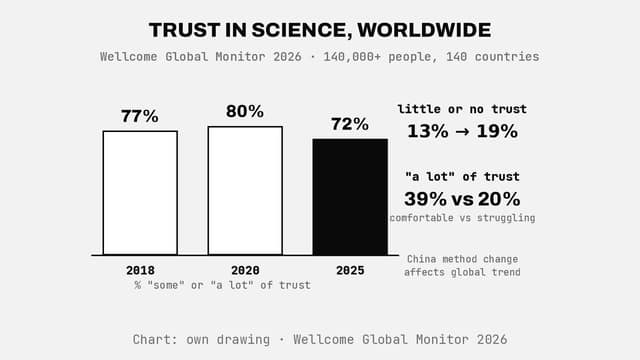
The Wellcome Global Monitor surveyed more than 140,000 people in 140 countries. In 2025, 72 percent trusted science some or a lot, down from 80 percent in 2020. Low or no trust rose from 13 to 19 percent. People living comfortably were about twice as likely to trust science a lot. A survey change in China affects the global trend.
One email a day. 4 science stories, 5 quick results, 1 idea. 3 minutes.
Plus a daily quiz: Answer & Learn. Free, unsubscribe anytime.
Society · Publishing
A fake AI paper, caught by its ghost citations
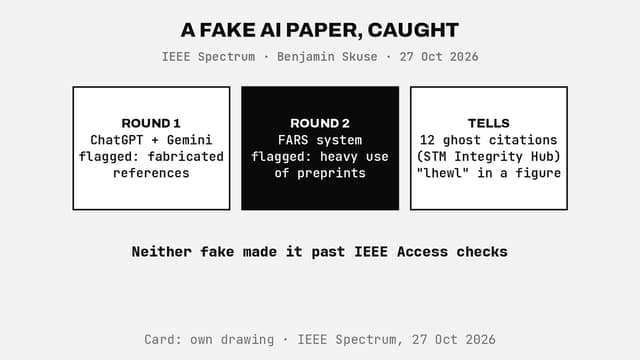
For IEEE Spectrum, Benjamin Skuse used AI tools to fake research papers and submitted them to IEEE Access. The first, from ChatGPT and Gemini, was caught for invented references: one checker found 12 ghost citations. The second, from an automated system, was flagged for relying on preprints. Neither got through.
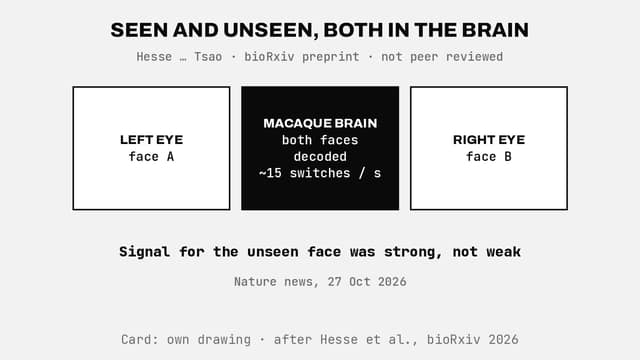
Doris Tsao's team showed monkeys a different face to each eye. From neural activity alone, they decoded both the face the animal was seeing and the one it was not, with activity flipping about 15 times per second. The unseen signal was surprisingly strong. This is a preprint, not yet peer reviewed.
Card: own drawing · after Hesse et al., bioRxiv 2026
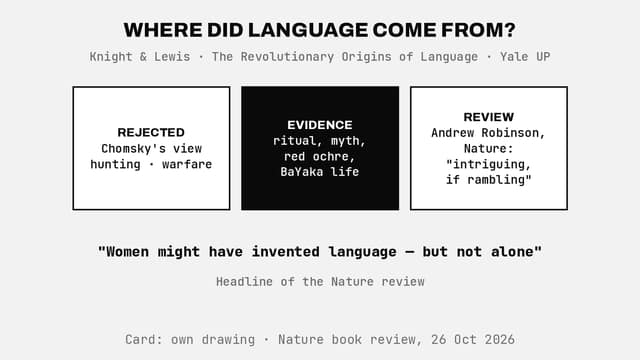
In The Revolutionary Origins of Language, anthropologists Chris Knight and Jerome Lewis reject Chomsky's account and theories based on hunting or war. They draw on ritual, myth, red ochre and decades among the BaYaka of Central Africa. Reviewing it for Nature, Andrew Robinson calls the book intriguing, if rambling.
Card: own drawing · Nature book review, 26 Oct 2026
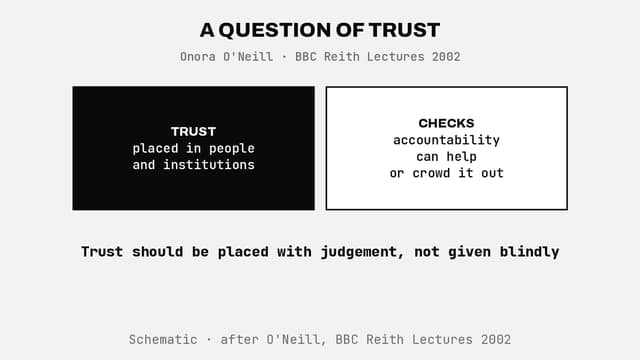
A question of trust. In her 2002 Reith Lectures, philosopher Onora O'Neill questioned whether more accountability builds trust. Her point: what matters is trusting those who are trustworthy, and having ways to check. Citation checks are one such way.
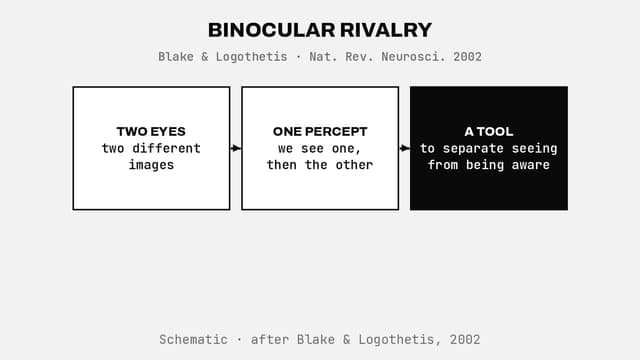
Binocular rivalry. Show each eye a different image and you do not see a blend. You see one, then the other, while the input stays the same. That lets scientists separate what reaches the brain from what we are aware of.
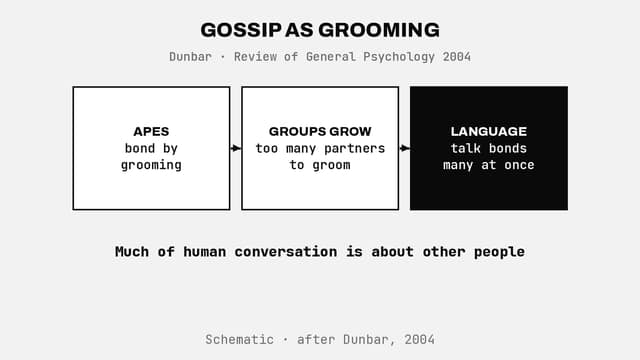
Gossip as grooming. Primates bond by grooming, one partner at a time. Robin Dunbar argues that as human groups grew, talk took over, bonding several people at once. Much of our conversation is still about other people.