News & Ideas is a daily letter for anyone who wants the day's science in one place, not a feed. Each day is 4 news items and 3 ideas across AI & Tech, Physics & Engineering, Biology & Nature, and Mind & Society, and every story names a primary source you can check. The Shorts use a declared synthetic voice.
One email a day. 4 science stories, 5 quick results, 1 idea. 3 minutes.
Plus a daily quiz: Answer & Learn. Free, unsubscribe anytime.
Issue
12 November 2026
3 min read · 1 Short
Mind & Society: Jurassic Park Predicts Which Dinosaurs We Read About, Stone Age Children's Fingerprints on Clay Figurines, Some of Iberia's Last Megalith Builders, Repeat Thieves Learn Less From Rewards. Then Cumulative Advantage: Popularity Feeds Itself, Learning by Doing Alongside Adults, Explore or Exploit?.
One email a day. 4 science stories, 5 quick results, 1 idea. 3 minutes.
Plus a daily quiz: Answer & Learn. Free, unsubscribe anytime.
Mind & Society
Jurassic Park Predicts Dinosaur Fame Better Than Size
Mind & Society: Jurassic Park Predicts Which Dinosaurs We Read About, Stone Age Children's Fingerprints on Clay Figurines, Some of Iberia's Last Megalith Builders, Repeat Thieves Learn Less From Rewards. Then Cumulative Advantage: Popularity Feeds Itself, Learning by Doing Alongside Adults, Explore or Exploit?.
Jurassic Park Predicts Dinosaur Fame Better Than Size
Jurassic Park Predicts Which Dinosaurs We Read About
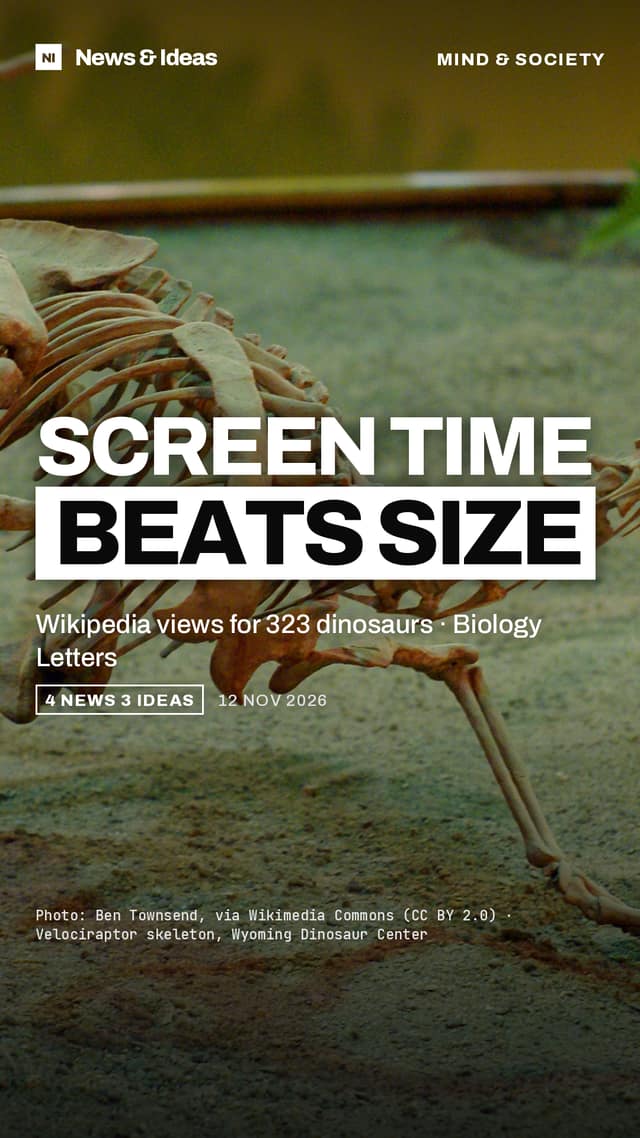
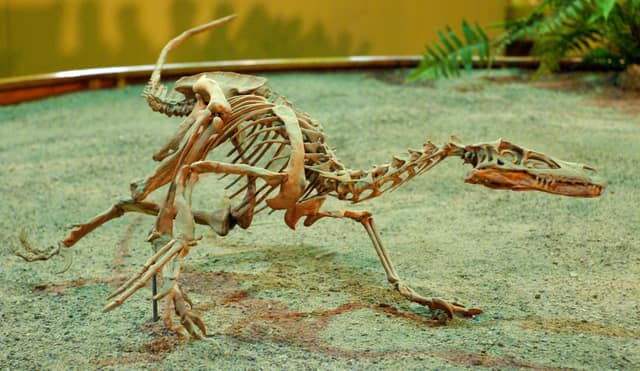
An international team led by Pâmela Lima analysed more than 3.5 billion Wikipedia page views for 323 dinosaur genera from 2015 to 2025. Larger, meat-eating genera and those described earlier drew more attention; plant eaters, omnivores and Middle Jurassic genera drew less. But appearing in the Jurassic Park franchise was the strongest predictor of public interest, stronger than size or diet. The authors call it a 'blockbuster effect' and suggest narrative media could raise the profile of less charismatic species. Peer-reviewed, open access (CC BY).
Photo: Ben Townsend, via Wikimedia Commons (CC BY 2.0) · Velociraptor skeleton, Wyoming Dinosaur Center
One email a day. 4 science stories, 5 quick results, 1 idea. 3 minutes.
Plus a daily quiz: Answer & Learn. Free, unsubscribe anytime.
Mind & Society
Stone Age Children's Fingerprints on Clay Figurines
At three Natufian sites in Israel (15,000 to 11,650 years ago), Laurent Davin and colleagues found 154 figurative clay artefacts, the earliest clay figurative tradition in Southwest Asia, in about 40 kg of clay lumps. Fingerprint ridge measurements show that both children and adults made them, before farming began in the region. Peer-reviewed, open access.
Radiocarbon dates from two megalithic tombs on the Trafalgar tombolo in Cádiz, Spain, put most burials between about 1850 and 1650 BC, in the Bronze Age, long after collective tombs went out of fashion elsewhere. Grave goods include gold, silver and ivory. The authors suggest the tombs may even have been built then, which would make them among the latest megaliths in Iberia; that part is still a hypothesis. Peer-reviewed, open access.
Kyoto University researchers gave a four-arm bandit choice task to theft recidivists with and without kleptomania and to people with no criminal record, while recording prefrontal activity with fNIRS. Repeat thieves without kleptomania made fewer optimal choices and showed a lower learning rate, updating less after feedback. Results for the kleptomania group were inconclusive. Small, peer-reviewed study; association, not cause.
When people can see what others chose, early popularity snowballs. In the MusicLab experiment, 14,000 people downloaded unknown songs; where they could see download counts, hits became bigger and less predictable than where they could not. A film role works like a huge early download count for a dinosaur.
In hunter-gatherer societies children learn skills mostly by watching and joining in with adults and older children, with little formal teaching. A review of ethnographies finds play and participation central. Clay figurines carrying both adult and child fingerprints are a rare archaeological trace of that kind of shared making.
Every repeated choice balances exploiting the option that paid before against exploring others that might pay more. The brain tracks rewards and uncertainty to strike that balance, and learning rate sets how fast feedback changes behaviour. A low learning rate means bad outcomes barely shift future choices, as reported in repeat thieves.