News & Ideas is a daily letter for anyone who wants the day's science in one place, not a feed. Each day is 4 news items and 3 ideas across AI & Tech, Physics & Engineering, Biology & Nature, and Mind & Society, and every story names a primary source you can check. The Shorts use a declared synthetic voice.
One email a day. 4 science stories, 5 quick results, 1 idea. 3 minutes.
Plus a daily quiz: Answer & Learn. Free, unsubscribe anytime.
Issue
12 November 2026
3 min read · 1 Short
Physics & Engineering: First Black Hole Image Survives an Independent Check, Artemis II Rippled Earth's Ionosphere Three Times, A Metal That Carries Heat Two Ways, Quantum Turbulence Caught Untangling in 3D. Then Closure Phases: Signals That Ignore Bad Calibration, Electrons and Phonons: Two Ways to Carry Heat, Quantized Vortices and Quantum Turbulence.
One email a day. 4 science stories, 5 quick results, 1 idea. 3 minutes.
Plus a daily quiz: Answer & Learn. Free, unsubscribe anytime.
Physics & Engineering
First Black Hole Image Survives an Independent Check
Physics & Engineering: First Black Hole Image Survives an Independent Check, Artemis II Rippled Earth's Ionosphere Three Times, A Metal That Carries Heat Two Ways, Quantum Turbulence Caught Untangling in 3D. Then Closure Phases: Signals That Ignore Bad Calibration, Electrons and Phonons: Two Ways to Carry Heat, Quantized Vortices and Quantum Turbulence.
First Black Hole Image Survives an Independent Check
First Black Hole Image Survives an Independent Check
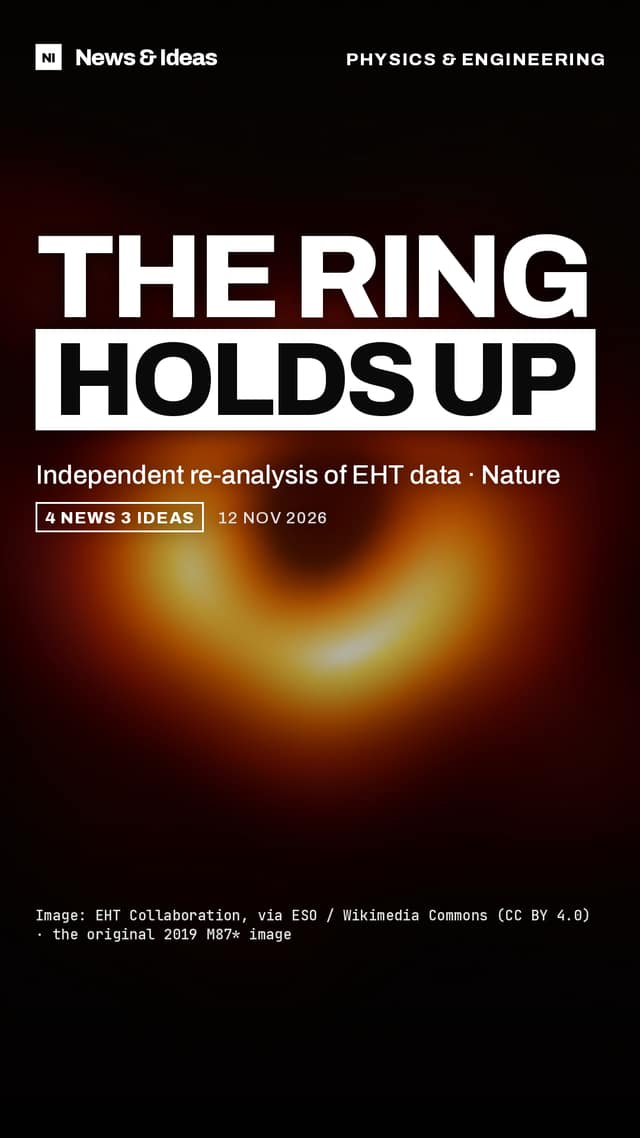
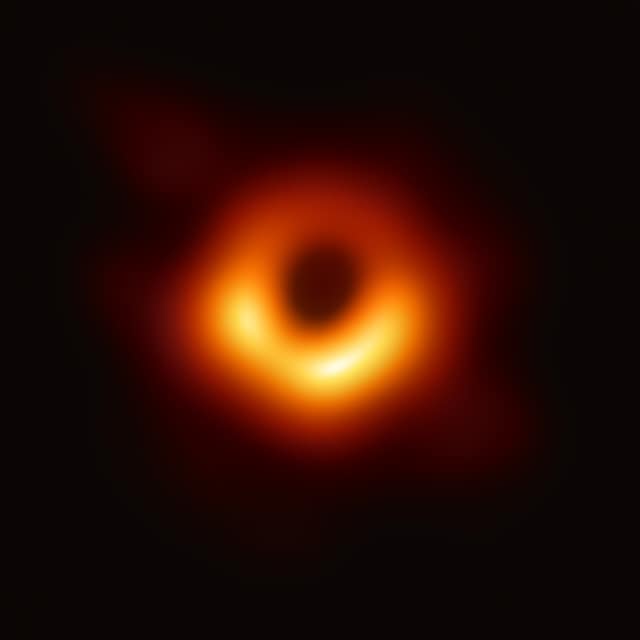
In 2019 the Event Horizon Telescope released the first image of a black hole, a ring around M87*; some later analyses argued the ring was an artefact of the imaging method. Samuel Lai and colleagues in Australia re-imaged the public EHT data from 2017, 2018 and 2021 with their own algorithm, GenDIReCT, which uses only closure invariants (signal combinations unaffected by telescope calibration errors) and a generative AI model trained on images unrelated to astronomy. Every epoch gave a compact ring, 42.2 ± 1.5 micro-arcseconds across, which implies about 6.5 billion solar masses, viewed about 20 degrees from the approaching jet. Peer-reviewed, open access in Nature.
Image: EHT Collaboration, via ESO / Wikimedia Commons (CC BY 4.0) · the original 2019 M87* image
One email a day. 4 science stories, 5 quick results, 1 idea. 3 minutes.
Plus a daily quiz: Answer & Learn. Free, unsubscribe anytime.
Physics & Engineering
Artemis II Rippled Earth's Ionosphere Three Times
GPS-based total electron content data show that the Artemis II mission disturbed the ionosphere on three separate occasions: at launch on 1 April 2026, at the apogee raise burn about two hours later, which triggered large-scale disturbances stretching about 50 degrees of longitude across North America, and again, more weakly, at the trans-lunar injection burn about 25 hours after liftoff. The authors say it is the first time one mission did this three times over the same region; the two burns started at a perigee altitude of 185 km, dumping exhaust energy straight into the ionosphere. Preprint, not peer-reviewed.
Metals usually move heat with electrons and insulators with lattice vibrations (phonons); having both is rare. A University of Texas at Austin team led by Feliciano Giustino screened metals and semimetals and predicted that a crystal form of tantalum nitride, epsilon-TaN, should conduct about 273 W/m·K at room temperature, between aluminium and gold, with about 20% carried by electrons and 80% by phonons. They then grew the material and confirmed both large contributions in heat-transport experiments. Peer-reviewed.
Cambridge physicists imaged a random tangle of quantized vortex lines decaying in a homogeneous 3D gas of ultracold potassium atoms, using a matter-wave magnifier and thin slices of the cloud. The decay matched predictions for Vinen, or ultraquantum, turbulence, did not depend on how strongly the atoms interact, and resembled superfluid helium, pointing to universal behaviour across superfluids. Peer-reviewed, open access.
Closure Phases: Signals That Ignore Bad Calibration
In a radio interferometer each antenna adds its own phase error. Add the measured phases around a triangle of three antennas and those errors cancel, leaving a 'closure phase' that depends only on the source. Jennison proposed it in 1958; it is why imaging a black hole with dishes on different continents is possible at all, and the M87* re-analysis builds on its generalisation, closure invariants.
Heat in a solid travels with free electrons, which dominate in metals, or with phonons, quantised lattice vibrations, which dominate in insulators like diamond. The two usually compete: what helps electrons often scatters phonons. Epsilon-TaN is notable because both channels stay large, with phonons carrying about four fifths of the heat in a metal.
Electrons and PhononsOxford University Press · 1960 · Primary · Ziman, Electrons and Phonons (Oxford, 1960)
Idea · Physics & Engineering
Quantized Vortices and Quantum Turbulence
In a superfluid, rotation can only exist as thin vortex lines carrying a fixed quantum of circulation. Stir hard and these lines tangle into quantum turbulence. In 'Vinen' turbulence the tangle has no large-scale swirl and decays in its own simple way; the Cambridge experiment watched exactly that in a gas of ultracold atoms.
Quantum TurbulenceJournal of Low Temperature Physics · 2002 · Primary · Vinen & Niemela, J. Low Temp. Phys. 128, 167 (2002)
Credits
Image: EHT Collaboration, via ESO / Wikimedia Commons (CC BY 4.0) · the original 2019 M87* image