News & Ideas is a daily letter for anyone who wants the day's science in one place, not a feed. Each day is 4 news items and 3 ideas across AI & Tech, Physics & Engineering, Biology & Nature, and Mind & Society, and every story names a primary source you can check. The Shorts use a declared synthetic voice.
One email a day. 4 science stories, 5 quick results, 1 idea. 3 minutes.
Plus a daily quiz: Answer & Learn. Free, unsubscribe anytime.
Issue
26 October 2026
2 min read · 1 Short
Physics & Engineering: Lumina, the Milky Way disk, colliding grains, X-ray plasma imaging. Then Gunn-Peterson, contact charging, Bragg.
One email a day. 4 science stories, 5 quick results, 1 idea. 3 minutes.
Plus a daily quiz: Answer & Learn. Free, unsubscribe anytime.
Physics & Engineering
Lumina, the Milky Way disk, charged grains
Physics & Engineering: Lumina, the Milky Way disk, colliding grains, X-ray plasma imaging. Then Gunn-Peterson, contact charging, Bragg.
Lumina: watching the universe switch on its lights
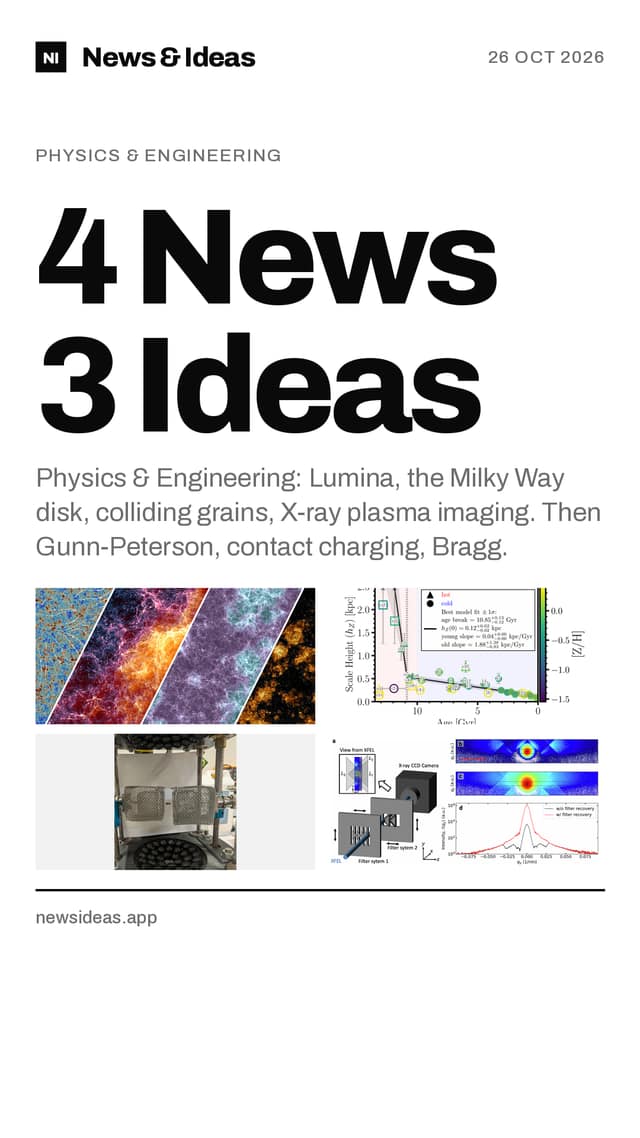
Researchers including MIT built Lumina, a simulation of a cube of the universe 1.6 billion light years wide, starting about 45 million years after the Big Bang. It is the first to capture both hydrogen reionization, driven by galaxies, and helium reionization, driven by supermassive black holes. Published in Monthly Notices.
One email a day. 4 science stories, 5 quick results, 1 idea. 3 minutes.
Plus a daily quiz: Answer & Learn. Free, unsubscribe anytime.
Physics · Galaxies
The Milky Way's disk settled in two stages
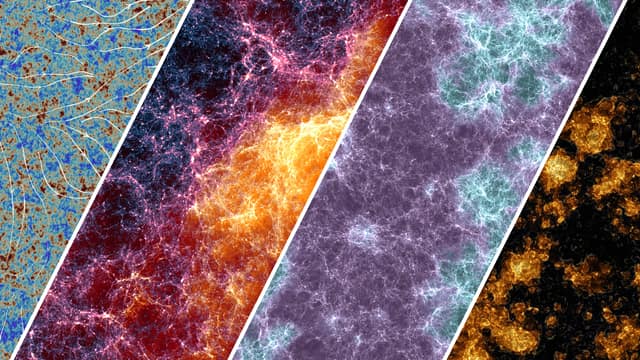
How did the Milky Way's disk settle? Using Gaia data and precise stellar ages, a team at the Canary Islands Astrophysics Institute found two stages: the disk thinned fast, with a break about 10.85 billion years ago, then slowly. Thick-disk stars were mostly born thick. Published in The Astrophysical Journal Letters.
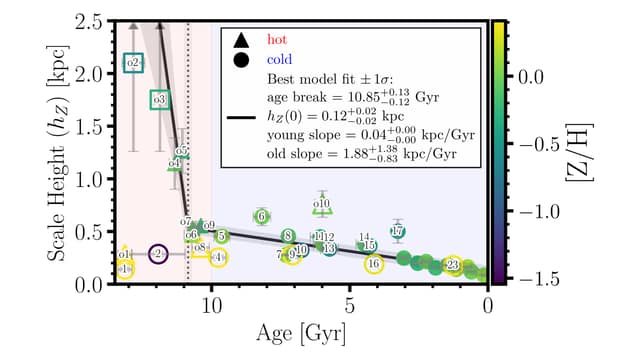
Bristol physicists levitated two plastic grains with sound and let them collide again and again. The charge exchanged was random from pair to pair, but steady for the same pair. It grew linearly for about fifteen collisions, then slowed, as capacitor theory predicts. Published in Physical Review E.
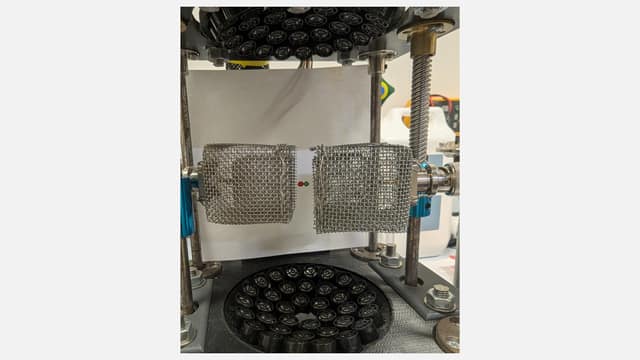
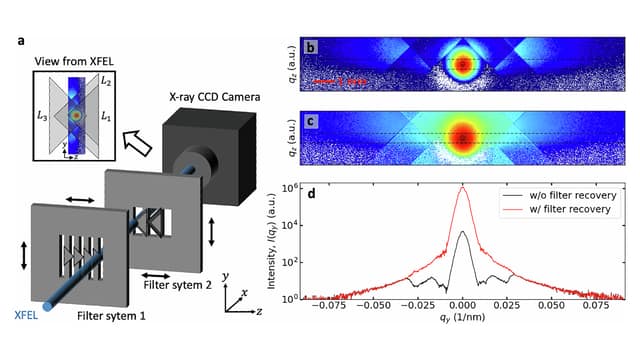
Japanese researchers imaged a laser-made plasma with a single X-ray laser pulse at SACLA, without the usual beamstop. Stacked filters let them see structures from 10 to 500 nanometers, with sub-picosecond timing. A few nanometers of early plasma growth cut laser absorption to about a quarter. Published in Communications Physics.
Figure: Ota et al., Communications Physics 2026 · CC BY-NC-ND 4.0
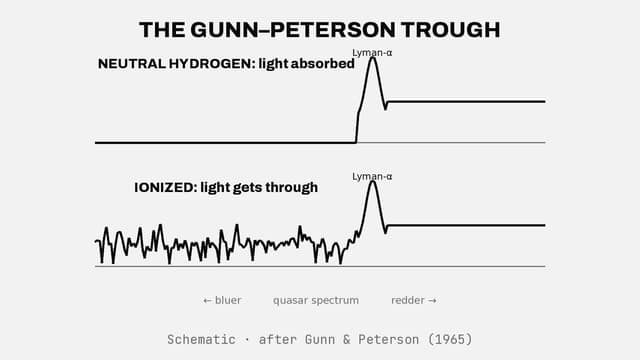
The Gunn-Peterson trough. Even a little neutral hydrogen between galaxies absorbs a distant quasar's light just bluer than the Lyman-alpha line. When that dark trough disappears, the gas has been ionized. It is one way astronomers date reionization, the era Lumina simulates.
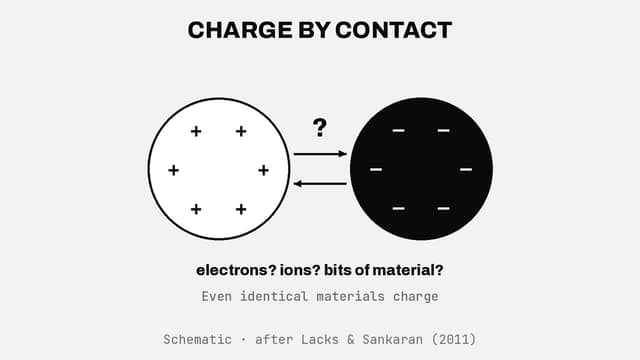
Contact electrification. When two insulators touch, they exchange charge, but whether electrons, ions or bits of material carry it is still debated. Even identical materials can charge each other. The Bristol grains are a clean way to watch it happen, collision by collision.
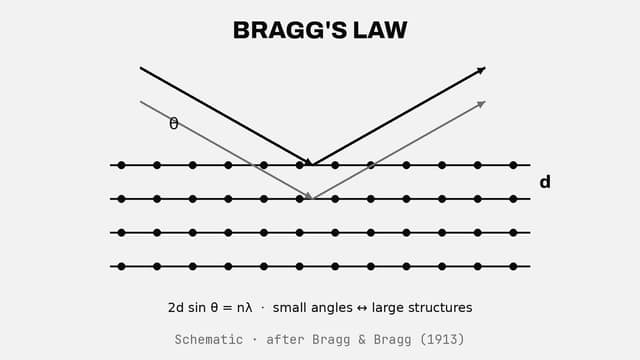
Bragg's law. Waves scattered by ordered layers interfere, and the angle where they reinforce reveals the spacing between the layers. Small angles correspond to large structures. Small-angle X-ray scattering, used on the laser plasma, reads nanometer structures this way.