News & Ideas is a daily letter for anyone who wants the day's science in one place, not a feed. Each day is 4 news items and 3 ideas across AI & Tech, Physics & Engineering, Biology & Nature, and Mind & Society, and every story names a primary source you can check. The Shorts use a declared synthetic voice.
One email a day. 4 science stories, 5 quick results, 1 idea. 3 minutes.
Plus a daily quiz: Answer & Learn. Free, unsubscribe anytime.
Issue
4 November 2026
4 min read · 1 Short
Physics & Engineering: LHCb finds evidence of a one-in-ten-billion decay, a chip that sorts mixed light into its coherence modes, an anode-free sodium battery that lasts 1,400 cycles, silicon springs that tune terahertz light. Then evidence versus discovery, coherence modes, anode-free cells.
One email a day. 4 science stories, 5 quick results, 1 idea. 3 minutes.
Plus a daily quiz: Answer & Learn. Free, unsubscribe anytime.
Physics & Engineering
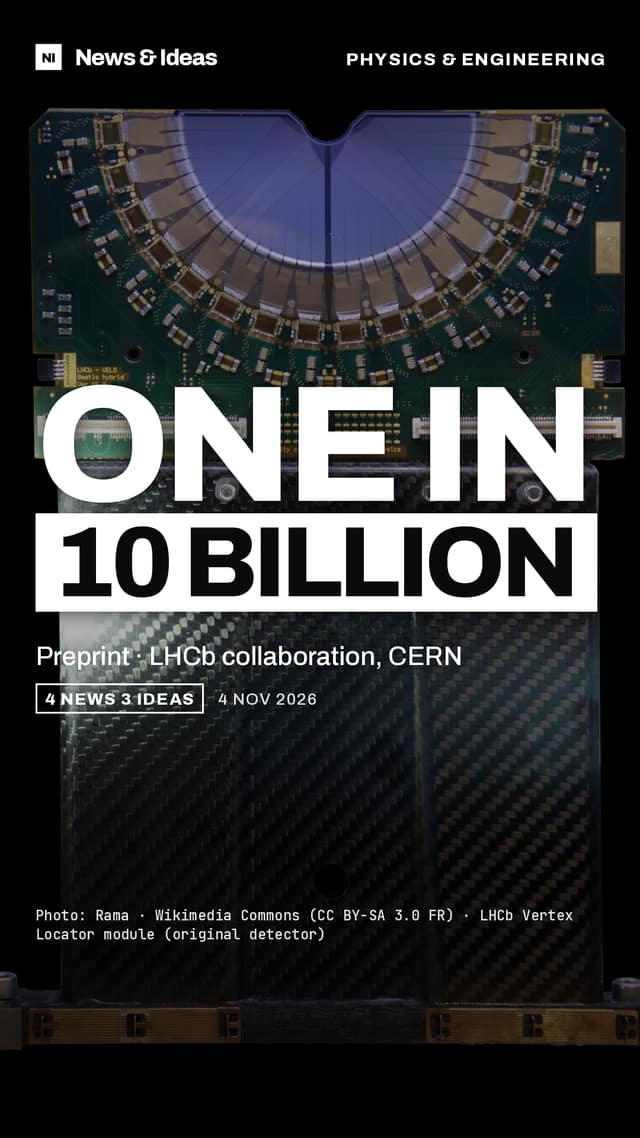
LHCb Finds Evidence of a One-in-Ten-Billion Decay
Physics & Engineering: LHCb finds evidence of a one-in-ten-billion decay, a chip that sorts mixed light into its coherence modes, an anode-free sodium battery that lasts 1,400 cycles, silicon springs that tune terahertz light. Then evidence versus discovery, coherence modes, anode-free cells.
LHCb finds evidence of a one-in-ten-billion particle decay (preprint)
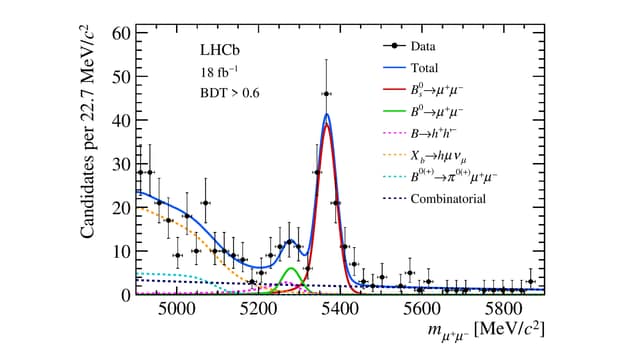
The LHCb collaboration at CERN reports the first evidence of the decay of the B0 meson, a beauty particle, into a muon and an antimuon. Using 18 inverse femtobarns of data recorded in 2024 and 2025 with the upgraded detector, the signal reaches 3.0 standard deviations; combined with the 2011 to 2018 data, 3.2. The combined branching fraction is 1.14 (+0.42, −0.39) × 10⁻¹⁰, about one in ten billion, against a Standard Model prediction of 1.03 ± 0.05 × 10⁻¹⁰. The sister decay of the Bs meson is measured more precisely than ever, at 3.25 × 10⁻⁹. Everything agrees with the Standard Model so far; heavy unknown particles could change these rates, which is why they are watched closely. A 2015 LHCb and CMS claim of first evidence was not confirmed by later updates. Preprint, submitted to Physical Review X.
Figure: LHCb collaboration, arXiv 2611.00230 (CC BY 4.0)
One email a day. 4 science stories, 5 quick results, 1 idea. 3 minutes.
Plus a daily quiz: Answer & Learn. Free, unsubscribe anytime.
Physics · Photonics
A chip that sorts mixed light into its coherence modes
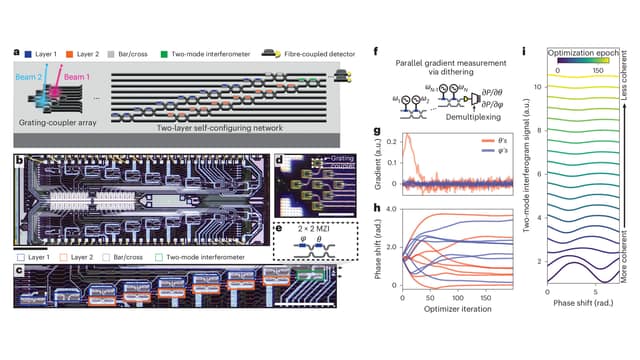
Partially coherent light, from scattering media, stars or biological tissue, is a mixture of components that ordinary optics cannot pull apart. Researchers at Stanford, ISTA, Politecnico di Milano and elsewhere built a programmable silicon-on-insulator photonic circuit, about the size of a fingernail, with nine inputs, that learns on its own to separate the orthogonal, mutually incoherent components of such light. It separated the two strongest coherence modes with fidelity of about 98% or better (97.8% and 99.9%), and a further experiment handled three modes on a nine-by-nine circuit. The authors point to microscopy and astronomy as uses. Peer-reviewed, open access.
Figure: Mor et al., Nature Photonics 2026 (CC BY 4.0)
An anode-free sodium battery keeps 80% capacity after 1,400 cycles
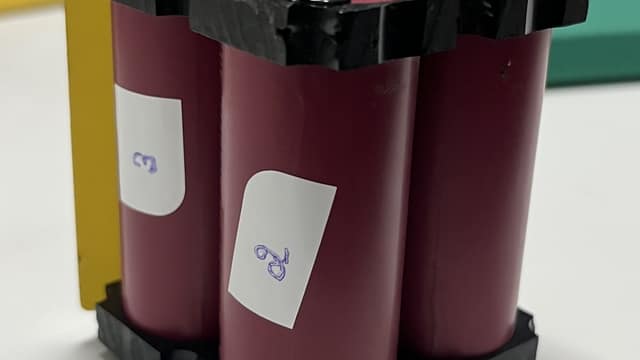
A team led by Xi'an Jiaotong University built anode-free sodium cells, in which sodium from the cathode plates onto the current collector during charging, saving weight and volume. Such cells have usually died quickly. Here an electrolyte based on the cyclic ether 1,3-dioxolane, DOX, oligomerises in a controlled way at the surface and forms a thin, robust interphase. Pouch cells of about 300 milliamp-hours kept about 80% of their capacity after 1,400 cycles at 1C, worked up to 3C and kept 88% at −40 °C. Peer-reviewed; the paper is behind a paywall, so these figures come from the abstract and the university's release.
Photo: Brihaspati · Wikimedia Commons (CC BY-SA 4.0) · Illustrative: commercial sodium-ion cells, not the XJTU anode-free pouch cell
Microscopic springs make silicon stretchable for terahertz light
Researchers from ORIST, Osaka University and Tohoku University etched spiral springs through a 200-micrometre silicon wafer, turning the rigid, brittle material into a stretchable terahertz metamaterial without any polymer or metal support. Stretched by 12.6%, its effective refractive index fell by about 6% for perpendicular polarisation and about 8% for parallel, so its birefringence can be tuned by pulling. The authors see mechanically tunable terahertz optics that integrate with MEMS technology. Peer-reviewed.
Photo: Rob Bulmahn · Wikimedia Commons (CC BY 2.0) · Illustrative: a generic silicon wafer, not the ORIST sample
Evidence or discovery? The sigmas of particle physics
Statistical significance says how unlikely it is that background noise alone would produce an excess this large. In particle physics, 3 sigma, about a 0.3% chance by CERN's description, is enough to speak of evidence; a discovery needs 5 sigma, about one in 3.5 million. The bar is strict because physicists run very many searches, and flukes happen. LHCb's B0 to two muons signal is at 3.2 sigma today, and a 2015 evidence claim for the same decay was not confirmed.
Wikipedia, Statistical significance · Particle Data Group, Statistics review
Coherence modes: mixed light is a sum of pure waves
Partially coherent light can always be decomposed into orthogonal, mutually incoherent components, each perfectly coherent and with its own weight. This is the mode decomposition of the light's coherence matrix. Usually it is reconstructed on a computer after measurement; the Stanford, ISTA and Politecnico di Milano chip separates the two strongest modes physically, with fidelity of about 98% or better.
Anode-free batteries: the anode forms on the first charge
An anode-free battery is built without active material at the anode. On the first charge, ions arriving from the cathode plate as metal onto the current collector. That saves weight and volume, but every ion lost during cycling is capacity lost for good, because there is no reserve. The Xi'an Jiaotong sodium cell limits those losses with a DOX-based electrolyte and keeps 80% of its capacity after 1,400 cycles.