News & Ideas is a daily letter for anyone who wants the day's science in one place, not a feed. Each day is 4 news items and 3 ideas across AI & Tech, Physics & Engineering, Biology & Nature, and Mind & Society, and every story names a primary source you can check. The Shorts use a declared synthetic voice.
One email a day. 4 science stories, 5 quick results, 1 idea. 3 minutes.
Plus a daily quiz: Answer & Learn. Free, unsubscribe anytime.
Issue
29 October 2026
2 min read · 1 Short
Physics & Engineering: NASA's Swift ends its mission, helicon waves drive tokamak current, NMR on a single atom, light that escapes disorder. Then satellite drag, Anderson localization, tokamak current.
One email a day. 4 science stories, 5 quick results, 1 idea. 3 minutes.
Plus a daily quiz: Answer & Learn. Free, unsubscribe anytime.
Physics & Engineering
Swift ends, helicon waves, single-atom NMR
Physics & Engineering: NASA's Swift ends its mission, helicon waves drive tokamak current, NMR on a single atom, light that escapes disorder. Then satellite drag, Anderson localization, tokamak current.
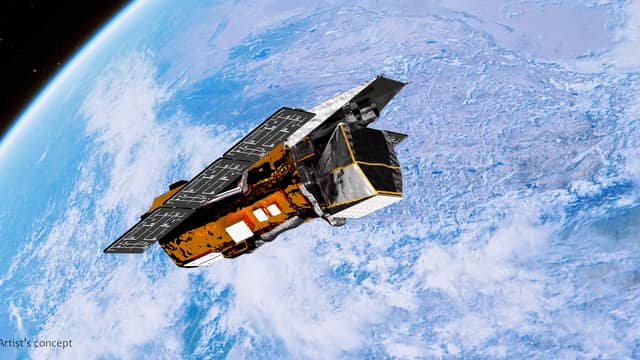
NASA's Neil Gehrels Swift Observatory has ended its science mission. Atmospheric drag pulled it below 275 kilometres, too low to point steadily, and it made its last observation on October 20. Launched in 2004 for a two-year mission, it observed more than 2,000 gamma-ray bursts. It should re-enter within weeks.
One email a day. 4 science stories, 5 quick results, 1 idea. 3 minutes.
Plus a daily quiz: Answer & Learn. Free, unsubscribe anytime.
Physics · Fusion
Helicon waves drive current in a tokamak
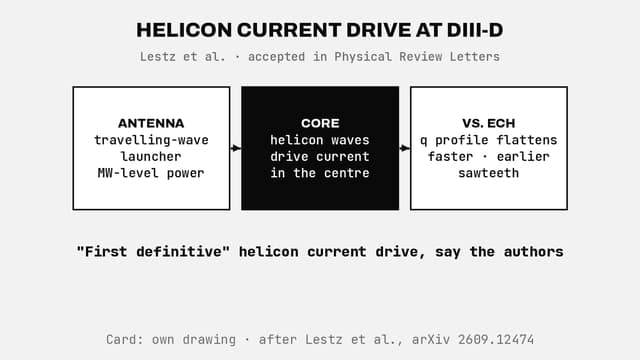
At the DIII-D tokamak, a megawatt-level antenna launched helicon waves into the plasma core. Compared with shots using electron cyclotron heating, the safety factor profile flattened faster and sawtooth oscillations started earlier. The authors call it the first definitive helicon current drive on any device. The paper is accepted in Physical Review Letters.
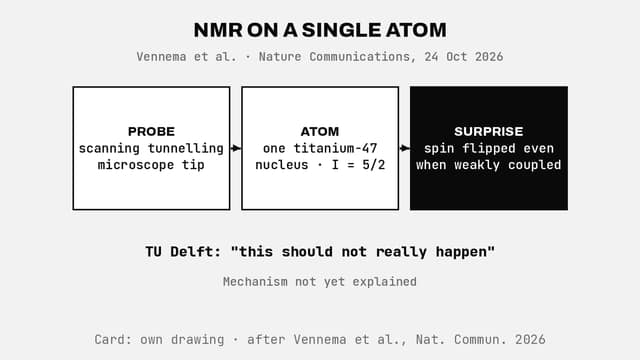
At TU Delft, researchers used a scanning tunnelling microscope to do magnetic resonance on the nucleus of a single titanium-47 atom. They could flip the nuclear spin even when it was only weakly coupled to the electron spin. The team says this was unexpected, and the mechanism is not yet explained.
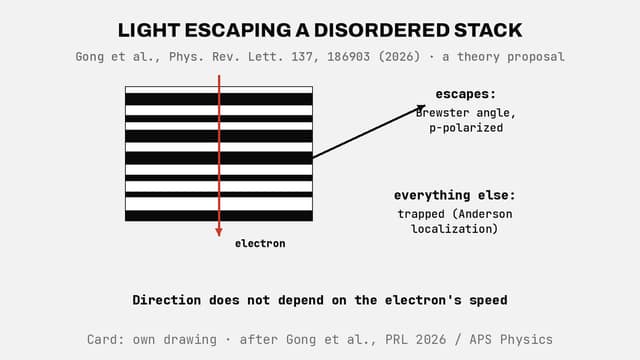
Disorder usually traps light. A new theory study models an electron crossing a stack of random layers. Most of the light it emits gets trapped. But light at the Brewster angle, polarized in that plane, escapes, and its direction does not depend on the electron's speed. Published in Physical Review Letters.
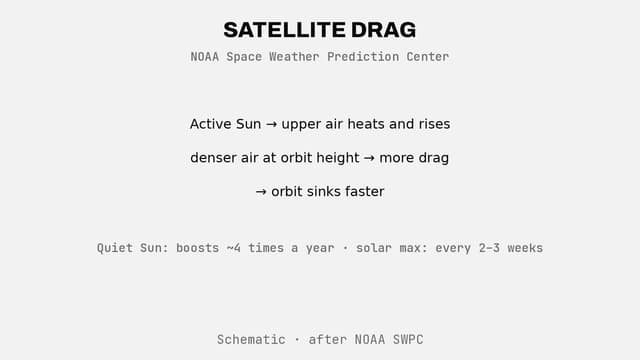
Satellite drag. Even in low orbit there is a little air. When the Sun is active, the upper atmosphere heats and swells, denser air rises to orbital height, and satellites slow down and sink. That is why missions in low orbit need boosts, or eventually fall.
NOAA SWPC · Satellite Drag
Schematic · after NOAA SWPC
Satellite DragNOAA Space Weather Prediction Center · Primary
Idea · Waves
Anderson localization
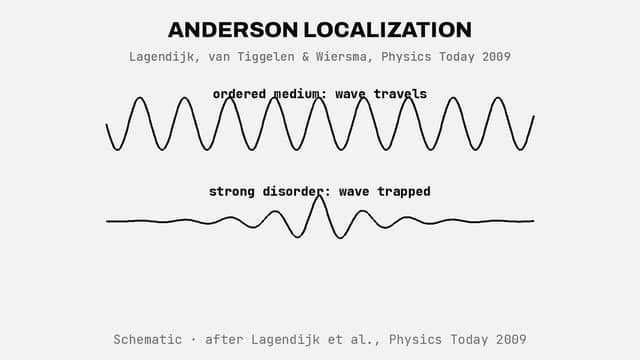
Anderson localization. In a strongly disordered material, waves scattered in all directions can interfere and cancel, until the wave stops spreading and stays trapped. First proposed for electrons in 1958, it also happens to light and sound.
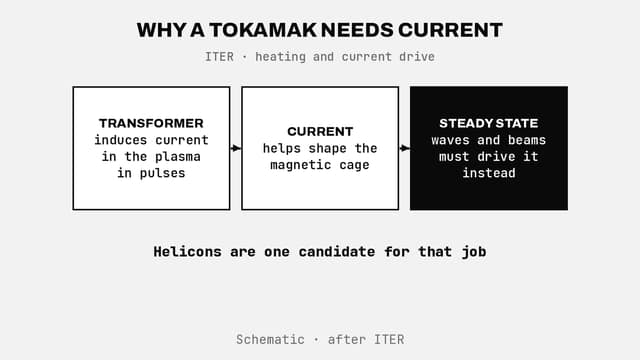
Why a tokamak needs current. A current flowing in the plasma helps make the magnetic field that holds it. A transformer can induce that current, but only in pulses. To run steadily, a reactor must drive the current with waves or beams.