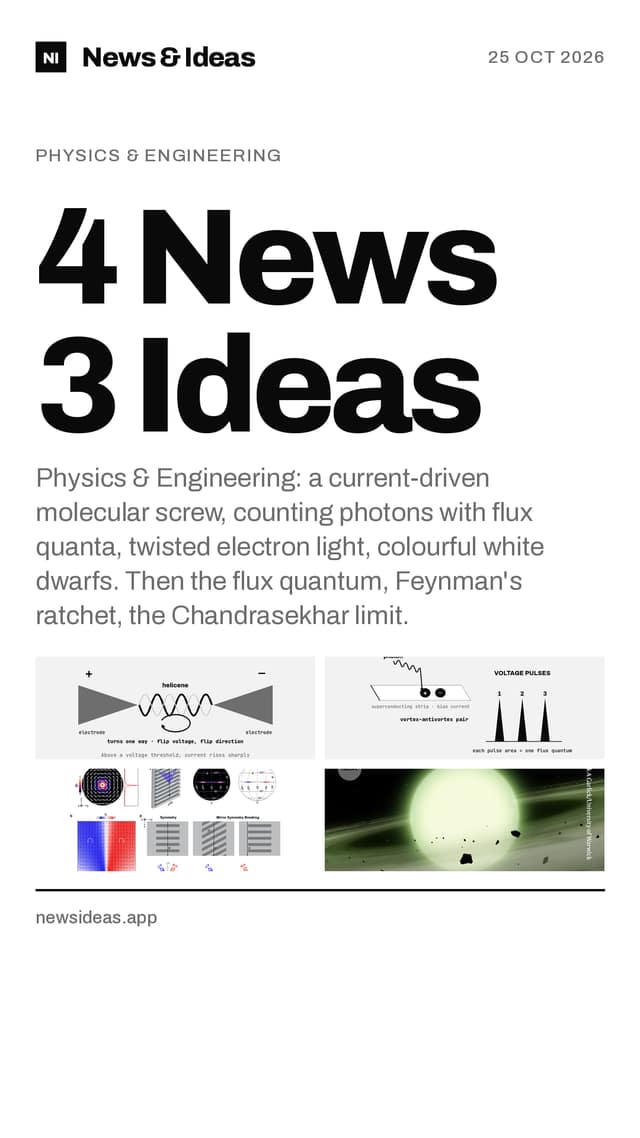
Physics & Engineering: a current-driven molecular screw, counting photons with flux quanta, twisted electron light, colourful white dwarfs. Then the flux quantum, Feynman's ratchet, the Chandrasekhar limit.
Physics & Engineering
Molecular screw, photon counts, white dwarfs
Physics & Engineering: a current-driven molecular screw, counting photons with flux quanta, twisted electron light, colourful white dwarfs. Then the flux quantum, Feynman's ratchet, the Chandrasekhar limit.
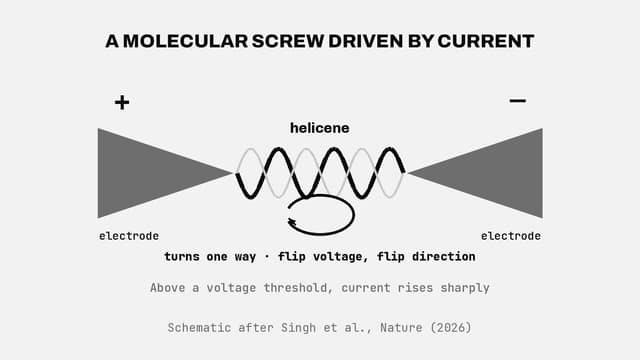
At the Weizmann Institute, researchers held a helix-shaped molecule between two electrode tips. Current made it rotate, always in the same direction, and flipping the voltage flipped the rotation. Above a threshold, the current rose sharply. Think of an Archimedes screw driven by electricity. Published in Nature.
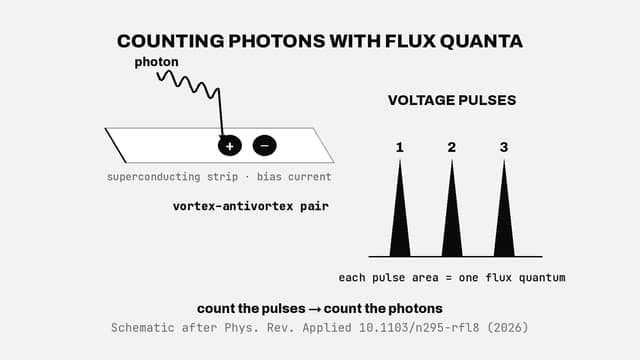
Japan's AIST counted photons in a new way. A photon absorbed in a superconducting film creates pairs of tiny magnetic vortices. Each gives a voltage pulse of fixed size, set by the flux quantum. Counting pulses counts photons, a first for this mechanism. In Physical Review Applied.
Diagram: own drawing · Jodoi et al., Phys. Rev. Applied 2026
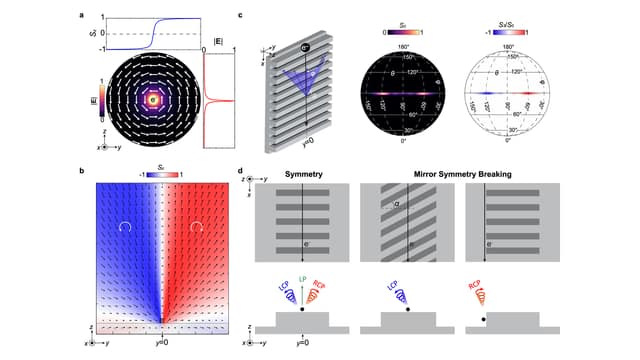
Electrons skimming past a grating emit Smith-Purcell light. A Singapore team shows this light is already chiral, but symmetry hides it. Twisting a plain silicon grating breaks the symmetry, reaching a degree of polarization of 0.87, the highest reported. In Nature Communications.
Figure: Zhu et al., Nat. Commun. 2026 · CC BY-NC-ND 4.0
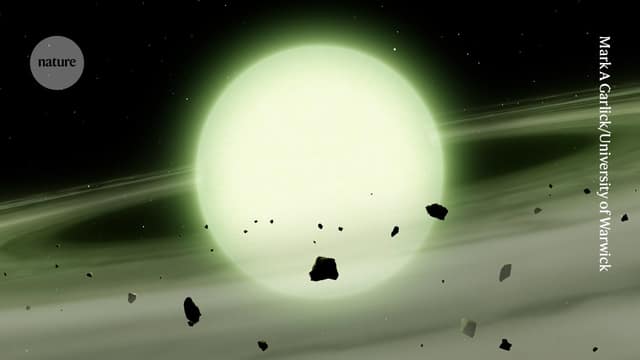
White dwarfs are the dense remnants of stars like the Sun, and most look white. But a new analysis finds that some come in a rainbow of colours, even green, a colour never seen before in a star. Nature highlighted the study, published in RAS Techniques and Instruments.
Illustration: Mark A Garlick / University of Warwick
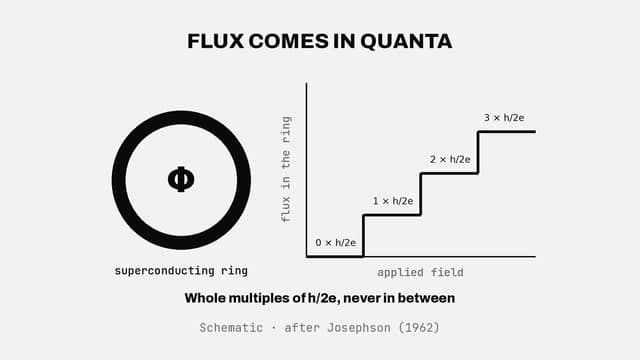
In a superconducting ring, magnetic flux comes only in whole multiples of a tiny unit, h over 2e. In 1962, Josephson showed that the voltage across a superconducting junction is tied to how fast its quantum phase turns. One full phase slip gives a pulse worth exactly one flux quantum, so today's detector can simply count.
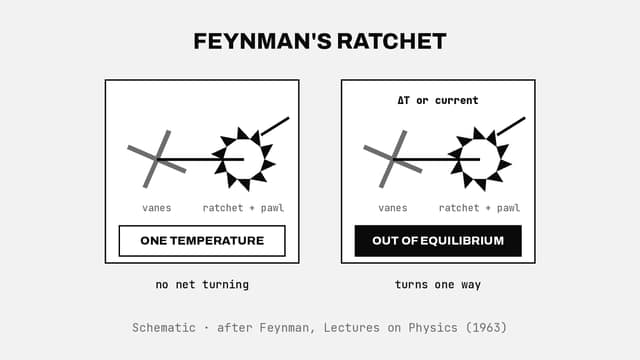
Feynman's ratchet: a tiny paddle wheel kicked by gas molecules, linked to a ratchet that turns only one way. Does it spin forever? No. At one temperature, the pawl jiggles too and slips back as often as it clicks forward. Directed motion needs a push out of equilibrium, like a current, as in today's molecular screw.
Feynman Lectures on Physics, I, ch. 46
Diagram: own drawing · Feynman Lectures, ch. 46
Ratchet and pawlThe Feynman Lectures on Physics, Vol. I, ch. 46 · Primary
Idea · Astrophysics
Why white dwarfs don't collapse
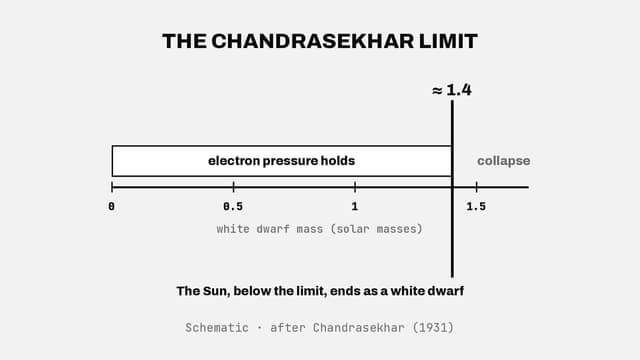
A white dwarf has no fusion left. What resists gravity is its electrons: the exclusion principle stops them crowding into the same states, creating pressure even without heat. In 1931 Chandrasekhar showed this support has a mass limit, now put at about 1.4 solar masses. The Sun, below it, will end as a white dwarf.