Biology & Nature: snakes that roll, the oldest flightless bird, malaria's molecular door, plastic and the seabird family tree. Then wheels in nature, related species, losing flight.
Biology & Nature
Rolling snakes, flightless bird, malaria, plastic
Biology & Nature: snakes that roll, the oldest flightless bird, malaria's molecular door, plastic and the seabird family tree. Then wheels in nature, related species, losing flight.
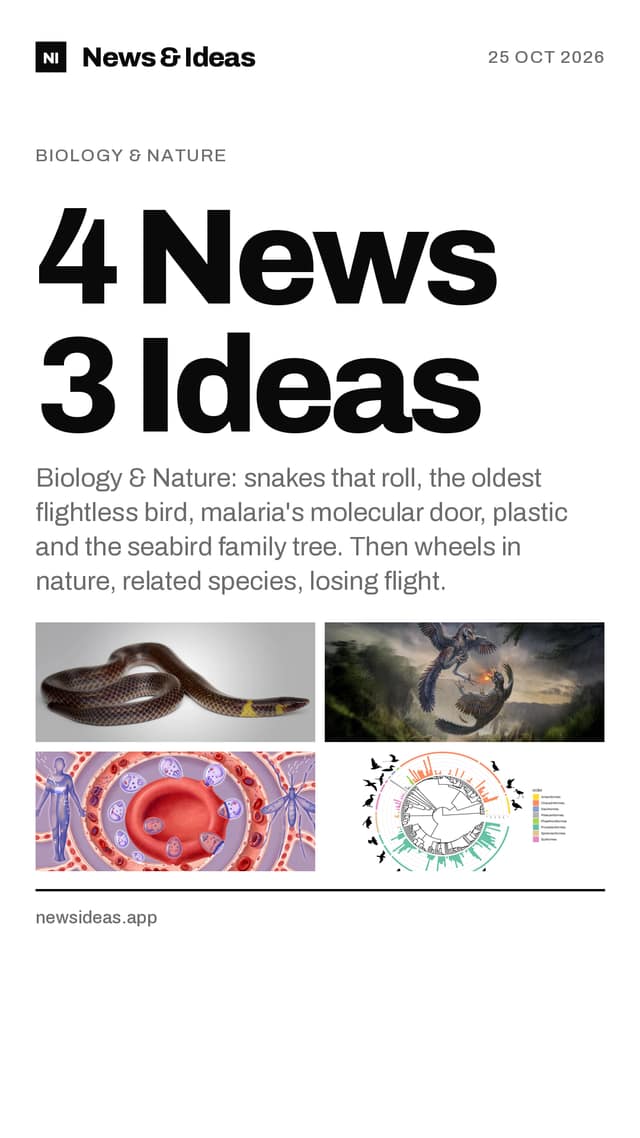
Dwarf reedsnakes in Southeast Asia escape by rolling. Filmed from several angles, they reached 1.7 to 3.7 metres per second, about four times their top slithering speed, on a track just 20 centimetres wide. The body spins while the head stays steady. Published in Current Biology.
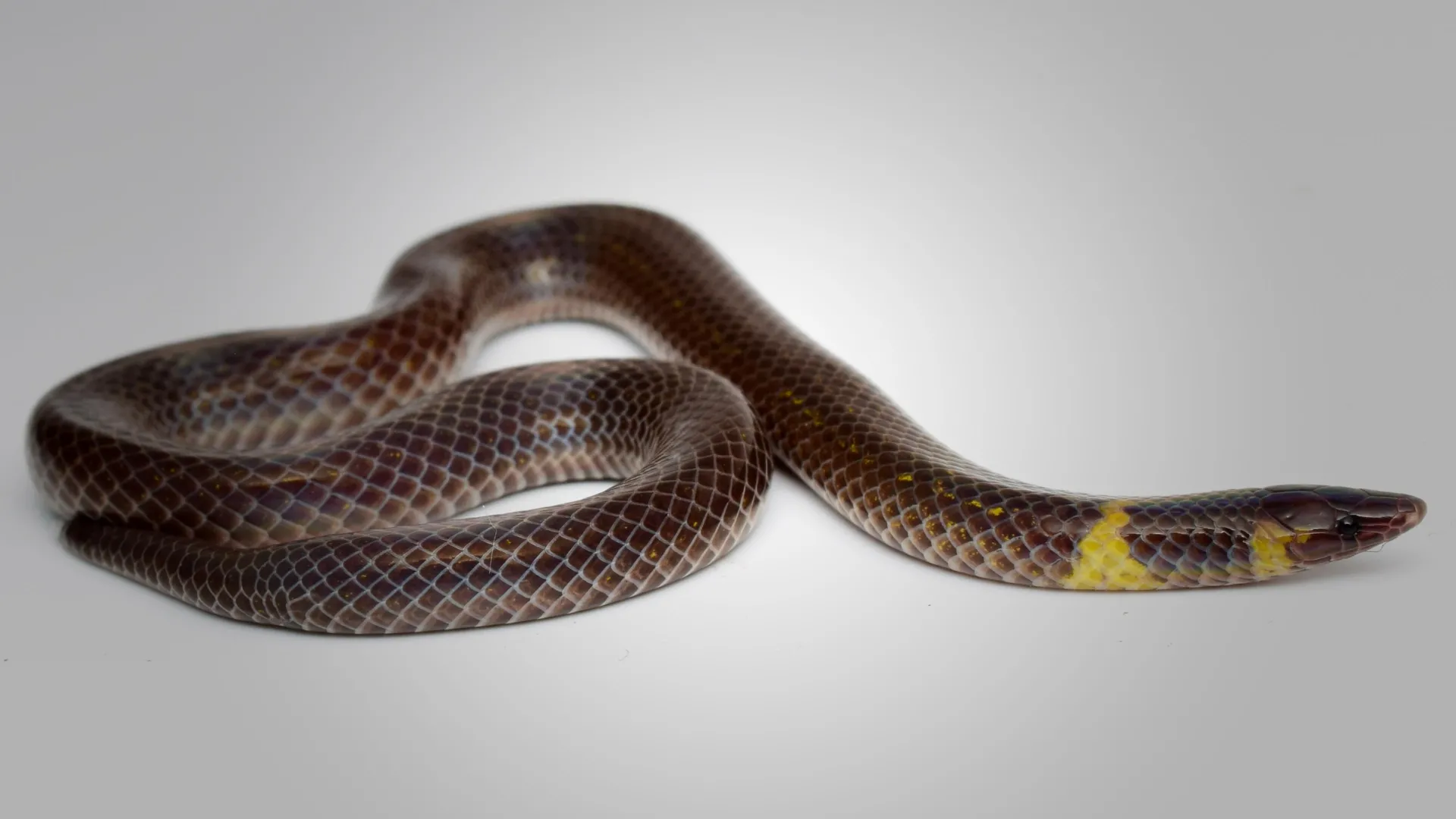
A 150-million-year-old fossil from Fujian, China, is the earliest known case of flight loss in birds. The crow-sized bird had serrated, dinosaur-like teeth, a sickle-shaped claw, and a body built for life on the ground. It lived in the Late Jurassic, around the time of Archaeopteryx. Published in Nature.
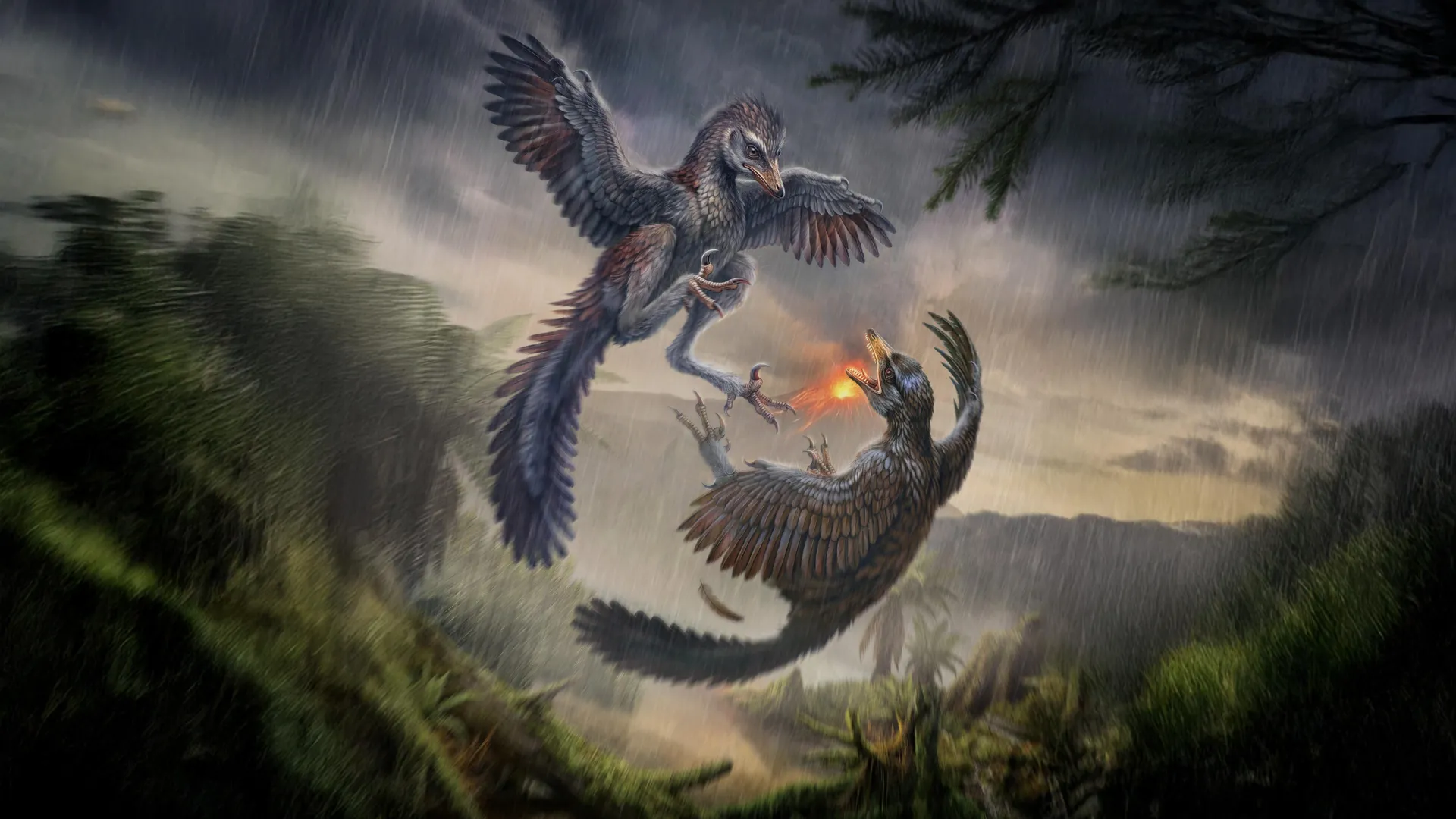
Using cryo-electron microscopy, Chi-Min Ho's lab imaged how the malaria parasite enters a red blood cell. It injects three proteins that form a dense wedge under the membrane; a fourth links them to the parasite. Their forces bend the membrane, which seals behind the invader. Basic research, in Cell.
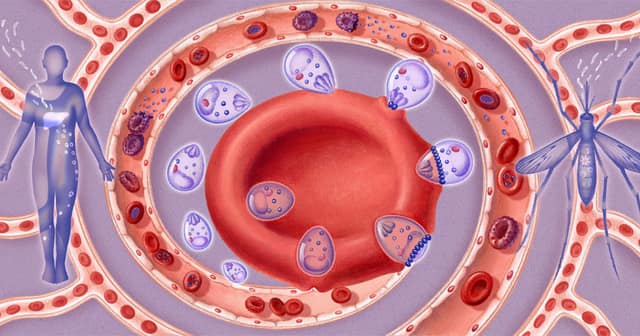
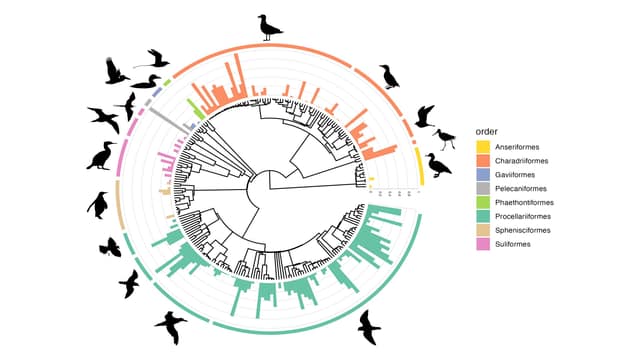
Researchers pooled 262 sources on 93,281 seabirds of 240 species, and plastic was recorded in 182 of them. The strongest predictor was not diet or feeding style, but the family tree: related species showed similar patterns. The records show presence, not amount or harm. Published in Biology Letters.
Figure: Avery-Gomm et al., Biology Letters 2026 · CC BY 4.0
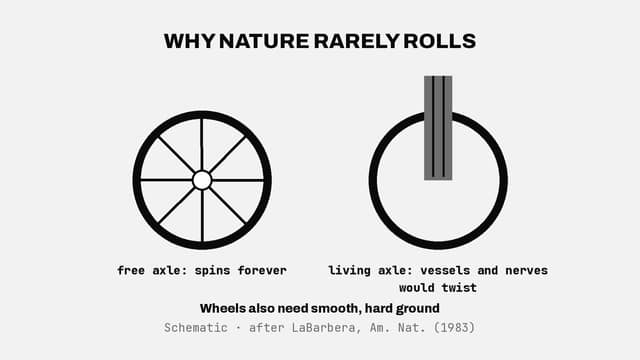
Why are wheels so rare in nature? A true wheel spins on a free axle, and a living axle would need blood vessels and nerves crossing a joint that turns forever. Wheels also need smooth, hard ground, which is rare in the wild. Today's reedsnakes get around this: the whole body rolls, with no axle at all.
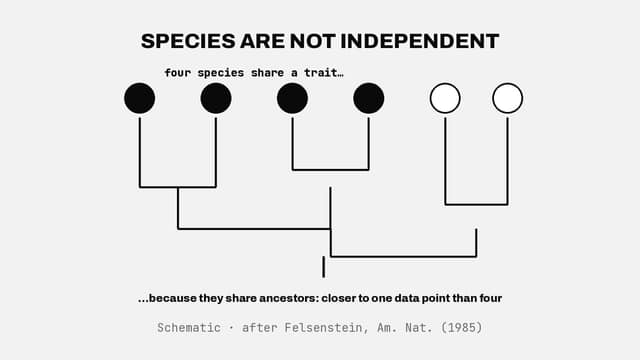
Close relatives resemble each other because they share ancestors, not because each adapted on its own. Count ten related species as ten independent data points, and you can find patterns that are just inheritance. In 1985, Joseph Felsenstein proposed correcting comparisons for the family tree, as today's seabird study does.
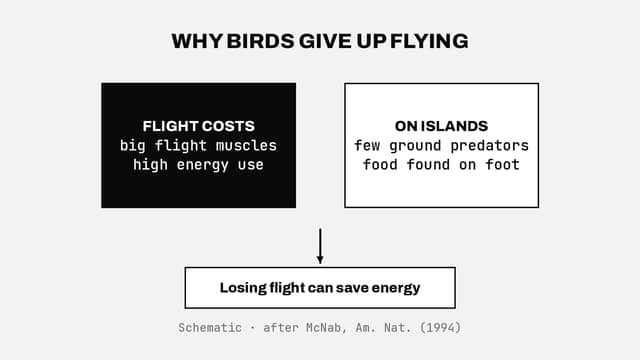
Flight is expensive: big muscles and high energy use. Where there are few ground predators and food can be found on foot, losing flight can save energy. Brian McNab linked flightlessness to energy conservation in birds on islands. Kiwis and the dodo are famous examples. Today's Jurassic bird shows that flight loss began very early.