News & Ideas is a daily letter for anyone who wants the day's science in one place, not a feed. Each day is 4 news items and 3 ideas across AI & Tech, Physics & Engineering, Biology & Nature, and Mind & Society, and every story names a primary source you can check. The Shorts use a declared synthetic voice.
One email a day. 4 science stories, 5 quick results, 1 idea. 3 minutes.
Plus a daily quiz: Answer & Learn. Free, unsubscribe anytime.
Issue
16 November 2026
3 min read · 1 Short
Physics & Engineering: Starship caught by its tower after orbit, quantum whirlpools untangling, 3D video at 150,000 frames per second, clogging as a phase transition. Then Kibble–Zurek, fringe projection, directed percolation.
One email a day. 4 science stories, 5 quick results, 1 idea. 3 minutes.
Plus a daily quiz: Answer & Learn. Free, unsubscribe anytime.
Physics & Engineering
Starship Caught by Its Tower After Orbit
Physics & Engineering: Starship caught by its tower after orbit, quantum whirlpools untangling, 3D video at 150,000 frames per second, clogging as a phase transition. Then Kibble–Zurek, fringe projection, directed percolation.
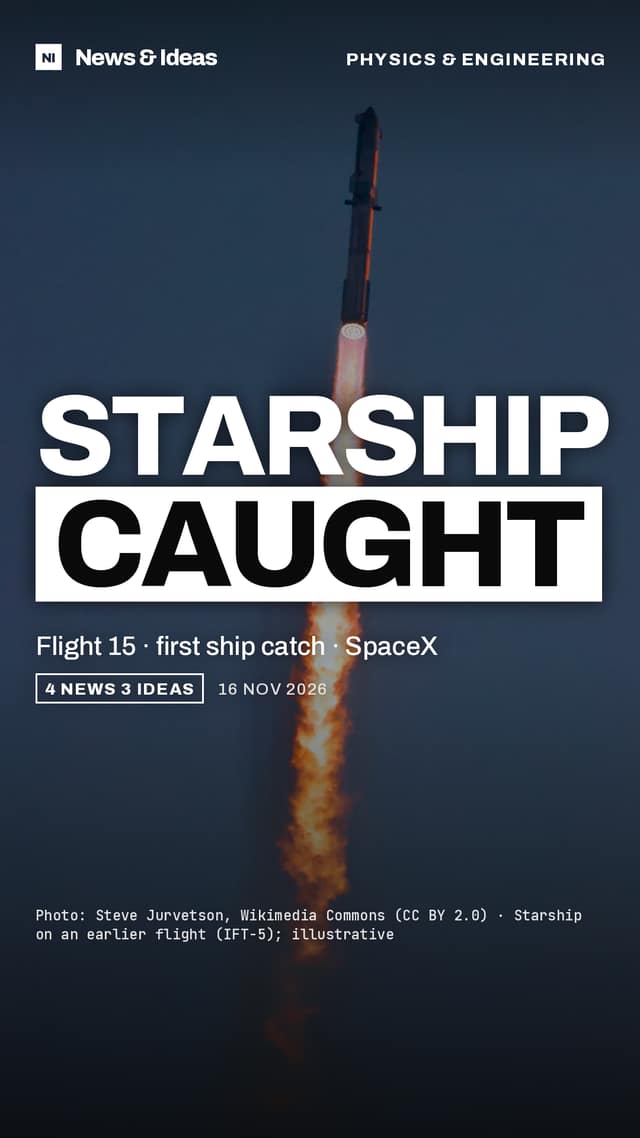
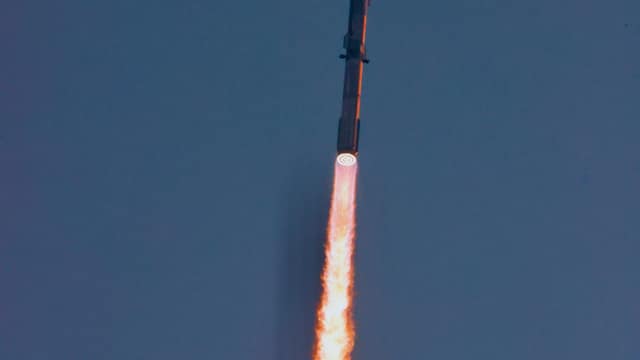
SpaceX's Starship Flight 15 lifted off from Starbase, Texas, on 13 November. The upper stage reached orbit, deployed 26 Starlink V3 satellites and, after more than 20 hours in space, relit a Raptor engine to deorbit. It returned to the same launch site about 22.5 hours after liftoff, flipped and descended into the tower's 'Mechazilla' arms, which caught Starship for the first time. The Super Heavy booster's boostback burn ended early due to low fuel mass; its guidance aborted the return, diverted offshore, and the flight termination system was triggered after its landing burn over the Gulf. Root cause under investigation. Company account; AP coverage reports 14 orbits.
Photo: Steve Jurvetson · Wikimedia Commons (CC BY 2.0) · Starship, earlier flight; illustrative
One email a day. 4 science stories, 5 quick results, 1 idea. 3 minutes.
Plus a daily quiz: Answer & Learn. Free, unsubscribe anytime.
Physics · Quantum fluids
Quantum Whirlpools Caught Untangling
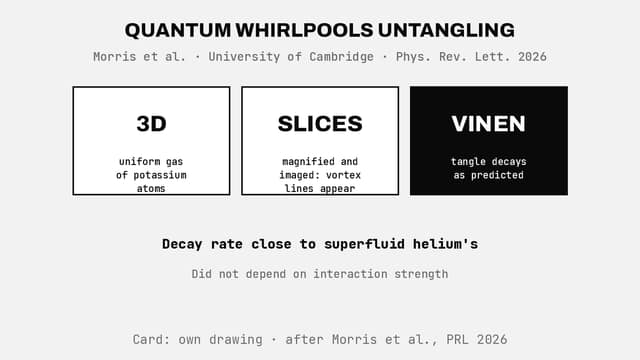
Sebastian Morris and colleagues at the University of Cambridge scrambled a uniform 3D Bose gas of potassium atoms in a cylindrical optical trap, then let it relax towards a Bose–Einstein condensate. Using matter-wave magnification (about 3.5x) and imaging a thin slice of the cloud, they saw imprints of randomly oriented vortex lines and measured the vortex-line length per unit volume. Its decay matched the prediction for Vinen 'ultraquantum' turbulence; later, vortices were lost at the trap walls. The decay did not depend on interaction strength and was similar to that in strongly interacting superfluid helium. Physical Review Letters, open access (CC BY 4.0).
Jinyang Liang's team at INRS (Canada) developed chromatically band-limited illumination profilometry (C-BLIP), a single-shot fringe-projection method: a digital micromirror device projects grayscale fringes at ultrahigh speed with incoherent light, and a colour camera captures spatially multiplexed fringe images for 3D reconstruction. They imaged a projectile-turbofan blade collision in colour 3D at 25,000 frames per second, the fall of a maple samara at 75,000 fps, and ultrasound encryption and recovery at 150,000 fps, which the institute calls a world record for profilometry. Nature Communications, open access (CC BY 4.0).
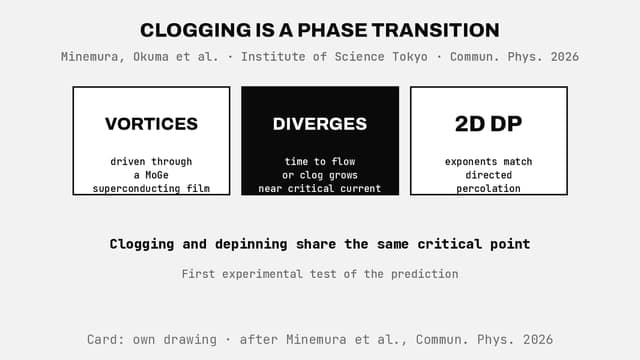
Takahide Minemura, Satoshi Okuma and colleagues at the Institute of Science Tokyo drove superconducting vortices with direct current through amorphous molybdenum-germanium films, where defects act as pinning sites and trapped vortices form bottlenecks. A two-step protocol separated the fast relaxation linked to clogging from the slower one linked to pinning. Both relaxation times diverged as power laws near a critical current that coincided with the depinning current, and the critical exponents agreed with the two-dimensional directed-percolation class, an absorbing-state nonequilibrium transition. The authors call it the first experimental demonstration of the predicted clogging transition. Communications Physics, 25 Sep 2026 (open access, CC BY-NC-ND 4.0).
Card: own drawing · after Minemura et al., Commun. Phys. 2026
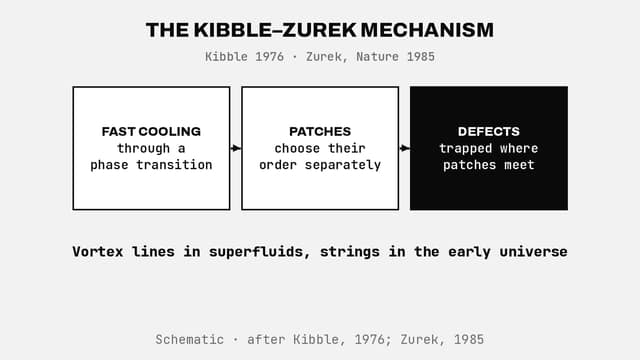
When a system is driven quickly through a symmetry-breaking phase transition, regions too far apart to communicate choose their ordered state independently; where they meet, topological defects such as vortex lines are frozen in. Tom Kibble (1976) proposed this for cosmic strings and domains in the early universe; Wojciech Zurek (1985) argued it could be tested in superfluid helium and estimated the defect density from the quench rate. Today's Cambridge experiment watches such a vortex tangle form and decay in an atomic gas.
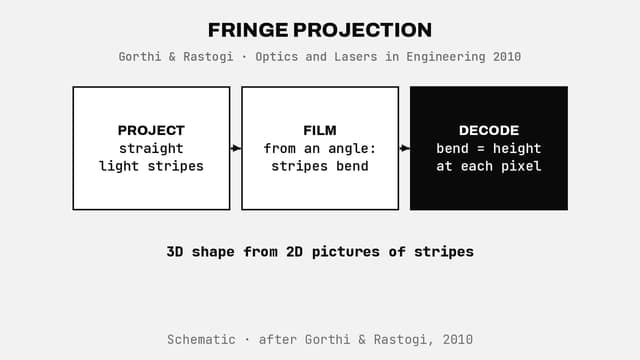
Fringe projection profilometry measures 3D shape by projecting a known stripe (fringe) pattern and imaging it from a different angle: surface height shifts the phase of the fringes, and phase is converted to height pixel by pixel. Gorthi and Rastogi review the methods, from multi-frame phase shifting to single-shot approaches used for fast dynamics, which C-BLIP pushes to 150,000 frames per second.
Gorthi & Rastogi · Optics and Lasers in Engineering 2010
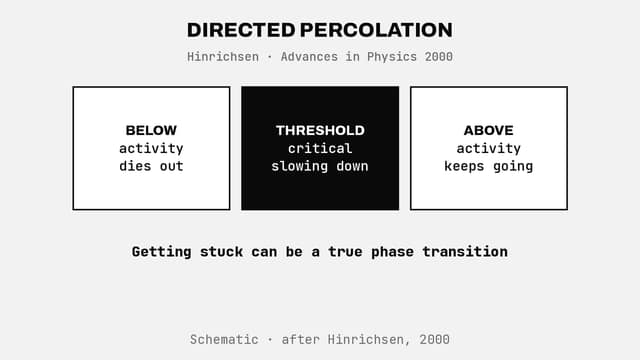
Directed percolation is the standard model of a nonequilibrium phase transition into an absorbing state, one the system can never leave, like an epidemic that has died out. Near the threshold, quantities follow power laws with universal exponents shared by many different systems. Hinrichsen's review covers the theory; the Science Tokyo vortices showed exponents consistent with the two-dimensional directed-percolation class.