News & Ideas is a daily letter for anyone who wants the day's science in one place, not a feed. Each day is 4 news items and 3 ideas across AI & Tech, Physics & Engineering, Biology & Nature, and Mind & Society, and every story names a primary source you can check. The Shorts use a declared synthetic voice.
One email a day. 4 science stories, 5 quick results, 1 idea. 3 minutes.
Plus a daily quiz: Answer & Learn. Free, unsubscribe anytime.
Issue
27 October 2026
2 min read · 1 Short
Physics & Engineering: one trapped positron, a topological hint, phase-space microscopes, a radio phoenix. Then the g-factor, CPT, joint measurements.
One email a day. 4 science stories, 5 quick results, 1 idea. 3 minutes.
Plus a daily quiz: Answer & Learn. Free, unsubscribe anytime.
Physics & Engineering
One positron, a plateau, a radio phoenix
Physics & Engineering: one trapped positron, a topological hint, phase-space microscopes, a radio phoenix. Then the g-factor, CPT, joint measurements.
Researchers at Northwestern realized the first one-positron quantum cyclotron: a single positron held in a trap, with its cyclotron and spin states quantized and controlled. It opens a path to a thirty-fold better measurement of the positron's magnetic moment, and a sharper test of CPT symmetry. Published in Physical Review Letters.
One email a day. 4 science stories, 5 quick results, 1 idea. 3 minutes.
Plus a daily quiz: Answer & Learn. Free, unsubscribe anytime.
Physics · Condensed matter
A conductance plateau in an iron-based superconductor
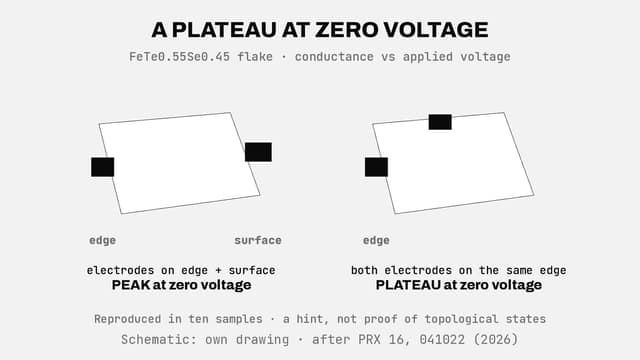
In the iron telluride selenide superconductor, a Boston College team saw a zero-voltage conductance peak flatten into a plateau when both electrodes touch the same edge. It was reproduced in ten samples, and suggests a nonlocal edge mode. It is not proof of a topological state: chirality measurements are still needed. Published in Physical Review X.
Schematic: own drawing · after PRX 16, 041022 (2026)
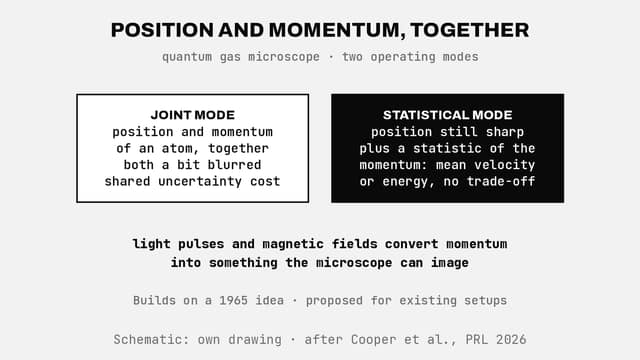
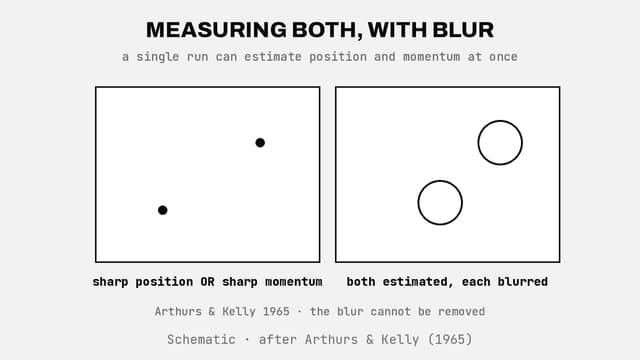
Quantum gas microscopes image atoms, but usually not their momentum. A Cambridge team proposes using light pulses and magnetic fields to measure position and momentum together, with a shared blur, or position plus a momentum statistic without that trade-off. It is a proposed method, not yet an experiment. Published in Physical Review Letters.
Schematic: own drawing · after Cooper et al., PRL 2026
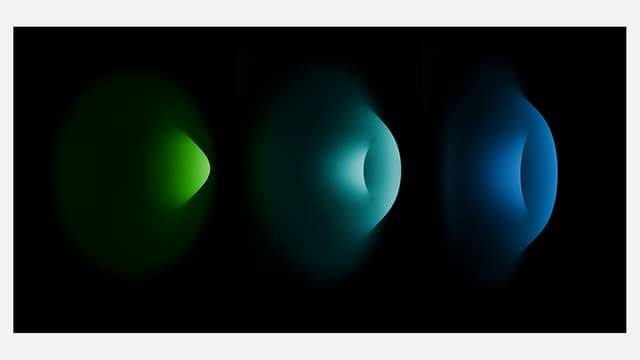
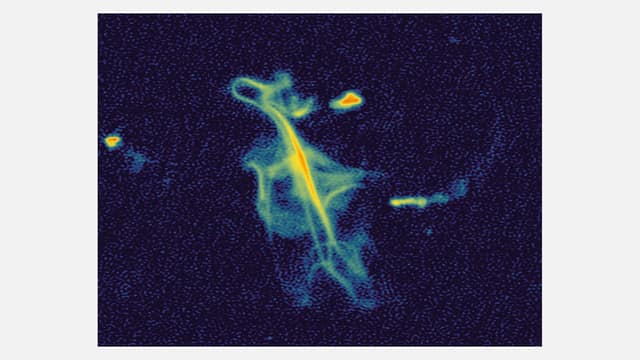
The Treble Clef is a galactic radio phoenix, imaged by the LOFAR telescope. Its filaments span about a million light years. The plasma was heated by a black-hole jet, would have faded, and was re-compressed by a collision between galaxy clusters. The study is by Botteon and colleagues.
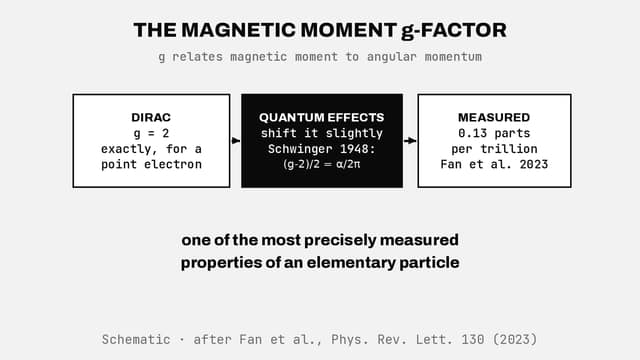
The g-factor. An electron behaves like a tiny magnet, and Dirac theory predicts a g-factor of exactly two. Quantum fluctuations shift it slightly, by about alpha over two pi, the result Schwinger found in 1948. Today the electron's value is measured to 0.13 parts per trillion.
Fan et al. 2023 · Phys. Rev. Lett. 130, 071801
Schematic · after Fan et al., Phys. Rev. Lett. 130 (2023)
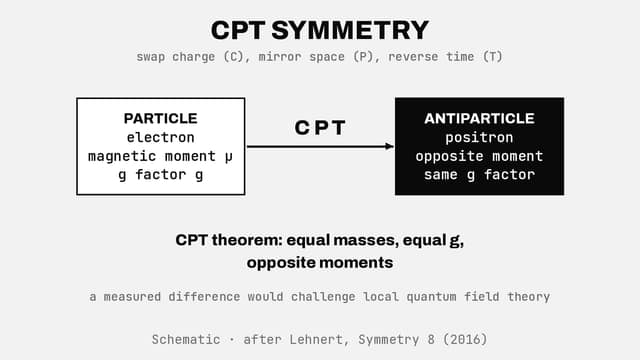
CPT symmetry. Swap charge, mirror space and reverse time, and the laws of physics should look the same. One consequence: a particle and its antiparticle have equal masses and opposite magnetic moments, so the same g-factor. A difference between electron and positron would challenge quantum field theory.
Position and momentum, together. Heisenberg's principle limits how precisely both can be known. But a 1965 analysis by Arthurs and Kelly showed that one experiment can still estimate both at once, approximately, with a shared blur. The Cambridge proposal turns that idea into a tool for atom microscopes.