News & Ideas is a daily letter for anyone who wants the day's science in one place, not a feed. Each day is 4 news items and 3 ideas across AI & Tech, Physics & Engineering, Biology & Nature, and Mind & Society, and every story names a primary source you can check. The Shorts use a declared synthetic voice.
One email a day. 4 science stories, 5 quick results, 1 idea. 3 minutes.
Plus a daily quiz: Answer & Learn. Free, unsubscribe anytime.
Issue
3 November 2026
4 min read · 1 Short
Physics & Engineering: Hubble and Webb image a cat-shaped pillar in Carina, pulsars set limits on giant black-hole binaries at cosmic dawn, a diamond laser magnetometer, a 15 kV silicon carbide switch. Then photoevaporation, pulsar timing arrays, NV centres.
One email a day. 4 science stories, 5 quick results, 1 idea. 3 minutes.
Plus a daily quiz: Answer & Learn. Free, unsubscribe anytime.
Physics & Engineering
Hubble and Webb Spot a Cat-Shaped Dust Pillar
Physics & Engineering: Hubble and Webb image a cat-shaped pillar in Carina, pulsars set limits on giant black-hole binaries at cosmic dawn, a diamond laser magnetometer, a 15 kV silicon carbide switch. Then photoevaporation, pulsar timing arrays, NV centres.
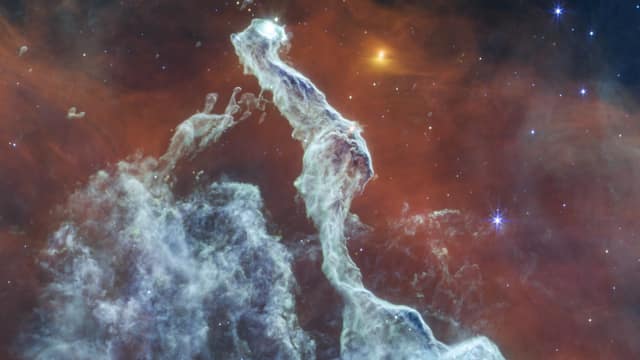
ESA/Webb released Hubble and Webb images of a small pillar of gas and dust in the Carina Nebula, about 7,500 light-years away, nicknamed the Cat's Head Nebula: it resembles a cat sitting with its back to us, head turned right, with a glowing eye. Ultraviolet radiation and winds from massive stars likely sculpted it; denser material resists erosion, at least for now, and the scene will eventually disperse. In Hubble's visible light the red eye may be a young star still partly embedded in dust. Webb's near-infrared view makes the pillar more transparent and reveals many stars and faint background galaxies; its mid-infrared view shows warm dust. Agency image release, no paper.
Image: NASA, ESA, CSA, STScI. Image Processing: J. DePasquale (STScI) · ESA/Webb (CC BY 4.0) · Webb MIRI view
One email a day. 4 science stories, 5 quick results, 1 idea. 3 minutes.
Plus a daily quiz: Answer & Learn. Free, unsubscribe anytime.
Physics · Gravitational waves
Pulsars set first limits on giant black-hole binaries at cosmic dawn
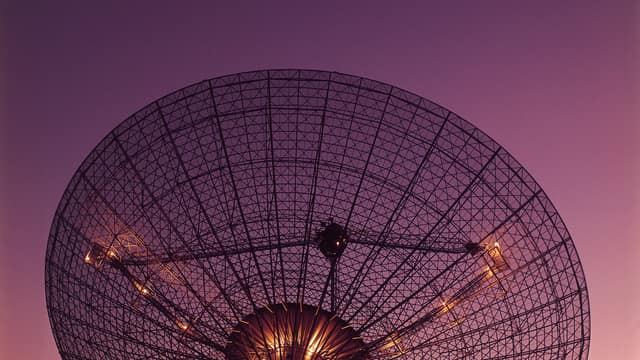
The Parkes Pulsar Timing Array used about 18 years of timing of 32 millisecond pulsars to set the first nanohertz gravitational-wave limits on supermassive black-hole binaries at cosmic dawn. By including redshift, which beyond z of about 2.6 makes distant binaries easier to see, they mapped sensitivity from z of 0.01 up to 20; earlier searches stayed below 0.4. Around the quasar J0100+2802 and the galaxy JADES-GS-z14-0, equal-mass binaries with chirp masses above about ten billion suns are ruled out. These are upper limits, not detections. Published in Physical Review Letters.
A diamond laser reads magnetic fields with 100% contrast
A team led by Fraunhofer IAF put a diamond with nitrogen-vacancy centres inside the cavity of a semiconductor laser. A microwave in resonance with the centres switches the laser off, so a magnetic field is read as laser on or off, with 100 percent optical contrast, where fluorescence methods reach a few percent. The calculated shot-noise limit is below 400 femtotesla per root hertz for every field component, 127 in the best orientation, over a range of plus or minus 280 microtesla, five times Earth's field. These are theoretical limits, not measured sensitivities. Published in Nature Communications.
Photo: Lillian B. Hughes et al. · Wikimedia Commons (CC BY 4.0) · NV-rich diamond from another lab
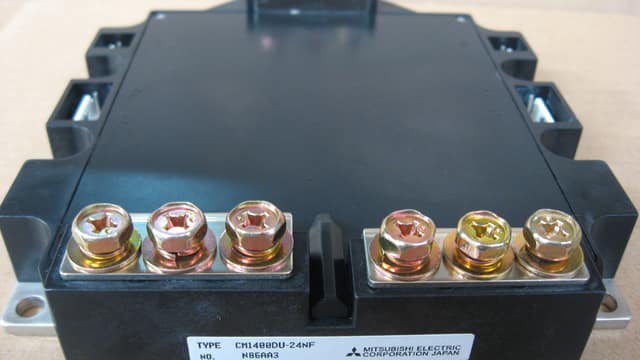
A university-built 15,000-volt silicon carbide switch (press release)
A University at Albany team led by Woongje Sung demonstrated a 15-kilovolt silicon carbide IGBT, a power switch for very high voltages, funded by the DEVCOM Army Research Laboratory. Most fabrication was done by GE Aerospace, and the spin-off NoMIS Power packaged it. UAlbany says one device can replace stacks of three or more silicon IGBTs, for uses from high-voltage DC lines and renewables to AI data centres, and calls it the second such demonstration in the US and the first by an academic institution. University press release; no paper cited.
Ultraviolet light from hot young stars ionises gas and drives it off a cloud. Denser parts erode more slowly and are left standing as columns, with a bright rim where gas is being stripped away, while inside them gas can still collapse into new stars. Webb's 2022 image of the Pillars of Creation in the Eagle Nebula, about 6,500 light-years away, is the famous example; the Carina cat, with its yellow rim of ionised gas, is a new one.
ESA/Webb weic2216 (2022) · Photoevaporation, Wikipedia
Millisecond pulsars are very precise natural clocks. A gravitational wave light-years long passing through the galaxy shifts their pulse arrival times in a way that is correlated between pulsars. Redshift also makes very distant binaries easier to see than expected: at a given observed frequency we see them in a tighter, louder stage of the orbit, as Rosado and colleagues showed in 2016. In 2023 NANOGrav, with 15 years of data on 68 pulsars, reported evidence for a nanohertz gravitational-wave background; today PPTA uses the redshift bias to reach towards cosmic dawn.
Rosado et al., PRL 116, 101102 (2016) · NANOGrav 15-year release (2023)
A nitrogen-vacancy centre is a nitrogen atom next to a missing carbon atom in the diamond lattice. Its spin levels split in a magnetic field, the Zeeman effect. Lit with green light it glows red, and the glow dims when a microwave is in resonance with the spin levels, so the frequency of the dip measures the field, even at room temperature. The Fraunhofer sensor replaces that small dip in fluorescence with a laser that switches off completely.