News & Ideas is a daily letter for anyone who wants the day's science in one place, not a feed. Each day is 4 news items and 3 ideas across AI & Tech, Physics & Engineering, Biology & Nature, and Mind & Society, and every story names a primary source you can check. The Shorts use a declared synthetic voice.
One email a day. 4 science stories, 5 quick results, 1 idea. 3 minutes.
Plus a daily quiz: Answer & Learn. Free, unsubscribe anytime.
Issue
19 November 2026
3 min read · 1 Short
Physics & Engineering: a supergiant engulfs a smaller star in Andromeda, a message sent with gravity, atoms that flash in rhythm, how long the Moon shakes. Then common envelopes, weighing gravity, superradiance.
One email a day. 4 science stories, 5 quick results, 1 idea. 3 minutes.
Plus a daily quiz: Answer & Learn. Free, unsubscribe anytime.
Physics & Engineering
Webb Sees a Supergiant Engulf a Sun-Like Star
Physics & Engineering: a supergiant engulfs a smaller star in Andromeda, a message sent with gravity, atoms that flash in rhythm, how long the Moon shakes. Then common envelopes, weighing gravity, superradiance.
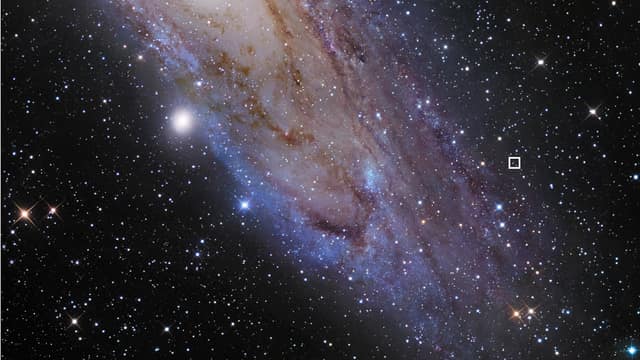
Viraj Karambelkar, Kishalay De (Columbia) and colleagues followed AT 2025abao ('Bao'), a binary on the outskirts of the Andromeda galaxy, from an unusual NEOWISE variable in 2023 to an eruption detected on 17 October 2025. Once the smaller star touched the giant's surface, the merger took only about seven orbits (about seven years), versus thousands for known mergers of smaller stars. Webb observed the system 47 days after the eruption peaked, the earliest follow-up of such an event. Models matched to Webb's mid-infrared data put the primary at about seven solar masses, 350 times the Sun's radius and 18,000 times its brightness, and the companion at about 0.7 solar masses; it was dragged into the giant's core during common envelope evolution.
Image: NASA, ESA, CSA, STScI, V. Karambelkar & K. De (Columbia), A. Pagan (STScI); R. Gendler, DSS · ESA/Webb (CC BY 4.0)
One email a day. 4 science stories, 5 quick results, 1 idea. 3 minutes.
Plus a daily quiz: Answer & Learn. Free, unsubscribe anytime.
Physics · Gravity
A Message Sent Through a Wall by Gravity
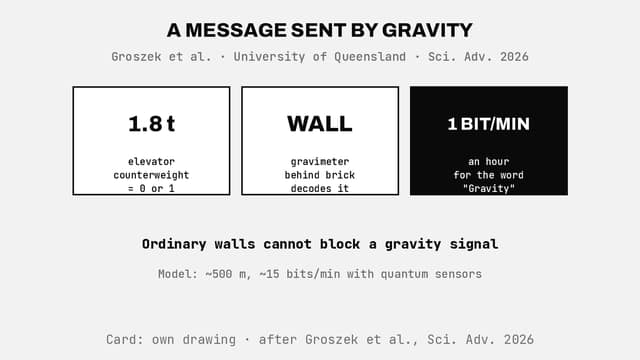
Andrew Groszek, Charles Woffinden, Andrew White, Matthew Davis and colleagues (University of Queensland) moved the 1.8-tonne counterweight of a 1950s elevator in UQ's Parnell Building between two levels to encode binary 0 and 1. A gravimeter in an adjacent bathroom, behind a brick wall, detected the changes in the gravitational field and recovered the word 'Gravity', at 1 bit per minute (about an hour for the word). Unlike electromagnetic signals, a gravitational signal cannot be screened by ordinary material. Their modelling suggests quantum sensors could, under ambitious assumptions, reach about 500 m and around 15 bits per minute. The idea grew out of a contactless truck-scale project.
Card: own drawing · after Groszek et al., Sci. Adv. 2026
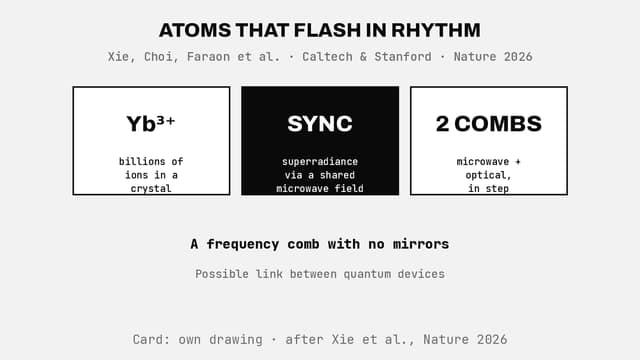
Tian Xie, Joonhee Choi, Andrei Faraon and colleagues (Caltech, Stanford) embedded billions of ytterbium ions in a yttrium orthovanadate crystal under a superconducting microwave resonator. Pumped by a laser, the ions shared one microwave field and synchronised through superradiance; above a threshold laser power they switched from steady emission to regular pulses, producing frequency combs in both microwave and optical light at the same time. Because the rhythm comes from the atoms rather than mirror spacing, the authors argue such combs could in principle be very frequency-stable, and the dual emission could help link superconducting quantum hardware with optical fibres.
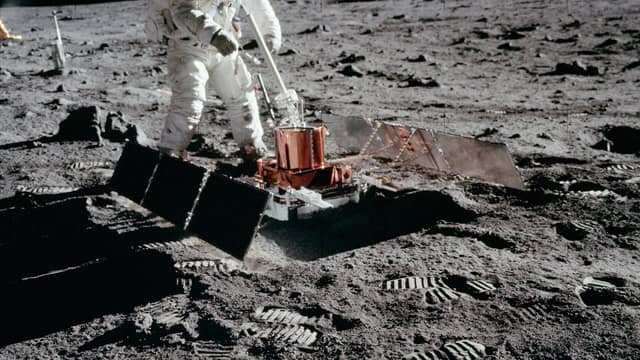
Tessa Williams (Slate Geotechnical Consultants) and colleagues combined Apollo-era moonquake recordings with physics-based simulations using lunar inputs (a colder, more rigid interior that absorbs less energy and a fractured surface that scatters it) to build the first lunar-specific ground-motion model for shallow moonquakes. It predicts much stronger shaking at large distances than terrestrial models: lunar data show strong shaking persisting past 1,000 km even for small events. Apollo records average about 54 minutes of strong shaking, versus typically under a minute for shallow crustal quakes on Earth; the model does not yet capture duration. The data come from only four closely spaced stations in a narrow frequency band.
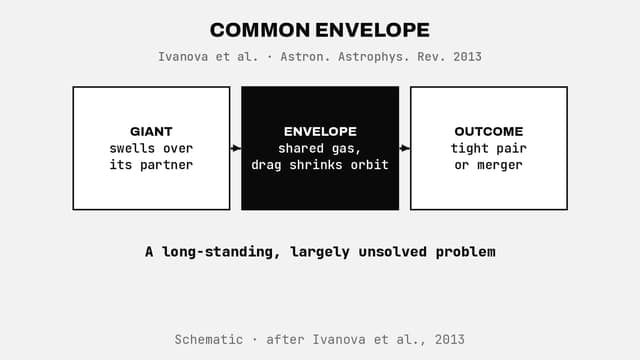
Ivanova et al. (Astronomy and Astrophysics Review, 2013) review common-envelope evolution: when a giant engulfs a close companion, the pair orbits inside a shared envelope, drag transfers orbital energy to the gas, and the outcome is either ejection of the envelope, leaving a tight binary, or a merger. They describe it as an important but long-standing and largely unconquered problem. Bao is a case caught in real time that ended in a merger.
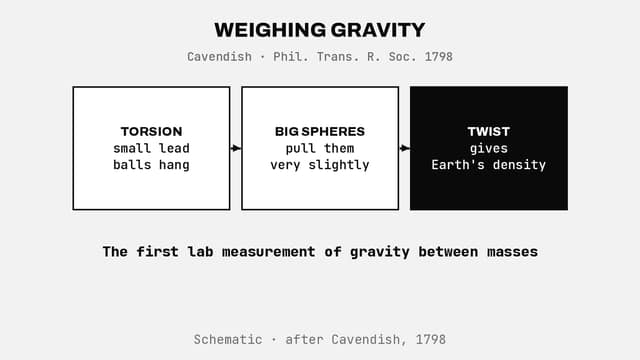
Henry Cavendish's 1798 experiment used a torsion balance with small lead balls attracted by large lead spheres to measure the gravitational force between laboratory masses, from which he derived the mean density of the Earth. Measuring the tiny gravitational pull of a moving mass is the same principle behind the elevator-counterweight message.
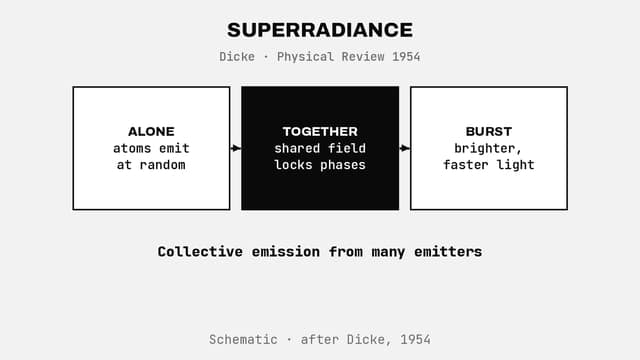
Dicke (Physical Review, 1954) showed that an ensemble of emitters coupled to a common radiation field cannot be treated as independent: in suitable collective states they radiate coherently, producing an emission that is enhanced and faster than independent spontaneous emission. Superradiant lasers and the new superradiant frequency combs exploit this collective behaviour.