News & Ideas is a daily letter for anyone who wants the day's science in one place, not a feed. Each day is 4 news items and 3 ideas across AI & Tech, Physics & Engineering, Biology & Nature, and Mind & Society, and every story names a primary source you can check. The Shorts use a declared synthetic voice.
One email a day. 4 science stories, 5 quick results, 1 idea. 3 minutes.
Plus a daily quiz: Answer & Learn. Free, unsubscribe anytime.
Issue
30 October 2026
2 min read · 1 Short
Physics & Engineering: gravitational reconnection, the physics of hula hooping, a blue laser on a chip, electrons trapped by interference. Then magnetic reconnection, bound states in the continuum, blue light in water.
One email a day. 4 science stories, 5 quick results, 1 idea. 3 minutes.
Plus a daily quiz: Answer & Learn. Free, unsubscribe anytime.
Physics & Engineering
Gravity reconnects, hula hoops, a blue laser
Physics & Engineering: gravitational reconnection, the physics of hula hooping, a blue laser on a chip, electrons trapped by interference. Then magnetic reconnection, bound states in the continuum, blue light in water.
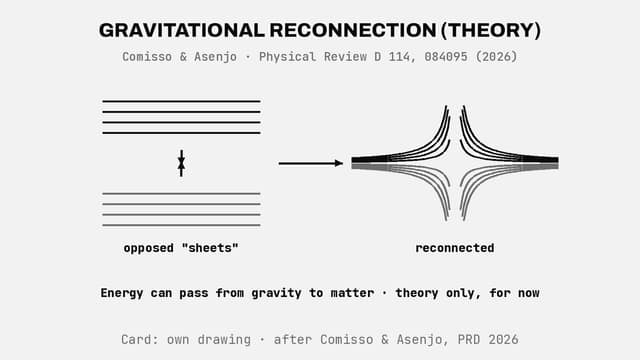
Luca Comisso at Columbia and Felipe Asenjo in Chile applied magnetic reconnection to Einstein's equations. In four-dimensional spacetime, the gravitational field forms mathematical sheets, not lines. When those sheets reconnect, energy can pass from gravity to matter. It is theory only. Published in Physical Review D.
Card: own drawing · after Comisso & Asenjo, PRD 2026
One email a day. 4 science stories, 5 quick results, 1 idea. 3 minutes.
Plus a daily quiz: Answer & Learn. Free, unsubscribe anytime.
Engineering · Biomechanics
The physics of hula hooping
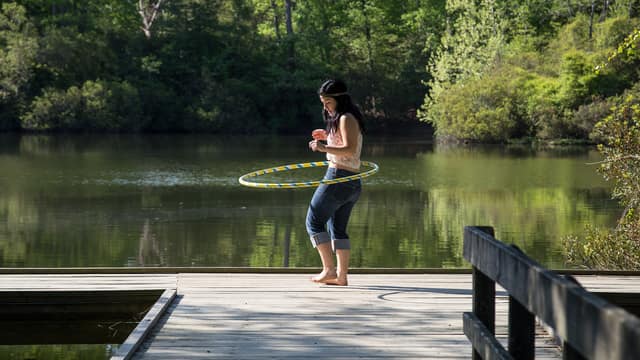
Researchers at UC Berkeley and the American University of Beirut put motion sensors on a hoop and on one leg. Thigh, shin and foot together keep the hoop going, and the hoop's rotation is coupled to its wobble. It is one participant, in nine trials. Published in Nonlinear Dynamics.
Photo: Brian Holland · Wikimedia Commons (CC BY 2.0) · illustration
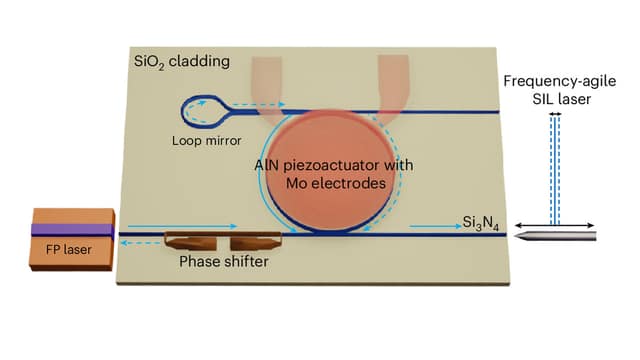
EPFL built a tunable blue laser on a chip, at 461 nanometres, that can sweep its frequency up to a million times per second. It sent data through 30 centimetres of water, and detected candle smoke where an infrared telecom laser saw no difference. Published in Nature Photonics.
Figure: Siddharth et al., Nature Photonics 2026 (CC BY 4.0)
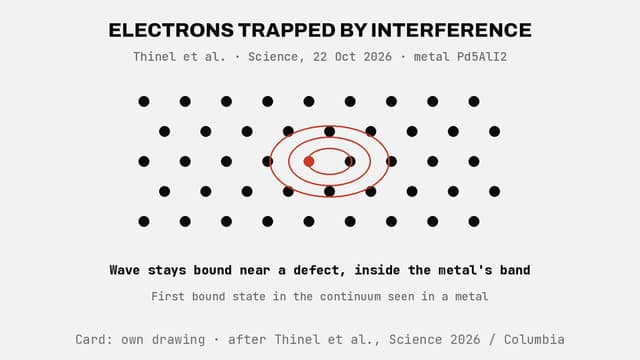
Columbia physicists found electron waves bound near defects in the metal palladium aluminium iodide, even though their energy lies inside the metal's band. Interference cancels their escape routes. It is the first bound state in the continuum seen in a metal. Published in Science.
Card: own drawing · after Thinel et al., Science 2026
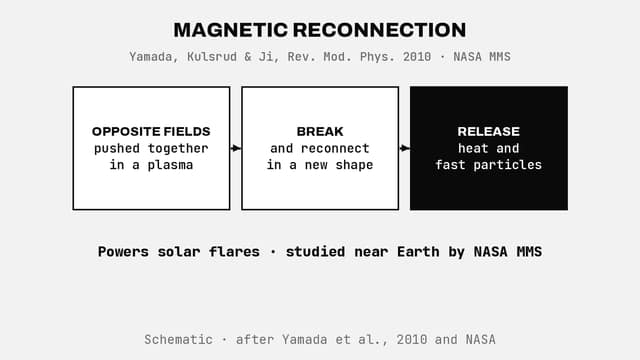
Magnetic reconnection. When magnetic field lines pointing in opposite directions are pushed together in a plasma, they break and reconnect in a new shape. Stored energy is released suddenly, as heat and fast particles. It powers solar flares.
Yamada, Kulsrud & Ji 2010 · NASA MMS
Schematic · after Yamada et al., 2010 and NASA
Magnetic reconnectionReviews of Modern Physics · 2010 · Primary · Yamada, Kulsrud & Ji (2010)
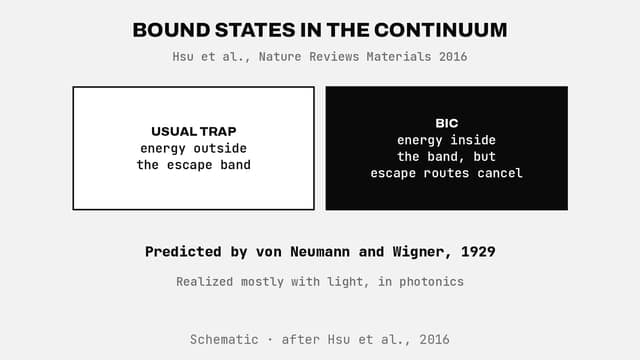
Bound states in the continuum. Normally a wave stays trapped only if its energy sits outside the band where it could escape. A bound state in the continuum stays trapped anyway, because its escape routes cancel out.
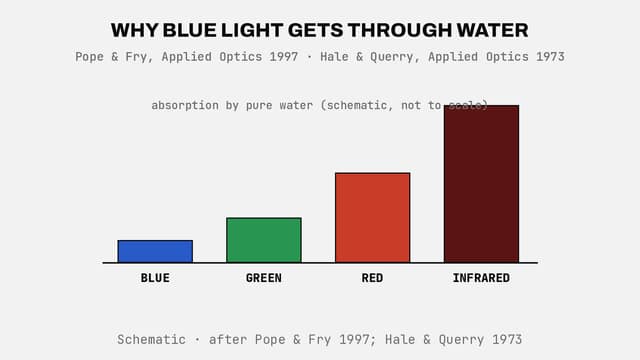
Why blue light gets through water. Pure water absorbs least in the blue. It absorbs more toward the red, and far more in the infrared, where oxygen-hydrogen bonds vibrate. That is why deep water looks blue.
Pope & Fry 1997 · Hale & Querry 1973
Schematic · after Pope & Fry 1997; Hale & Querry 1973
Card: own drawing · after Comisso & Asenjo, PRD 2026
Photo: Brian Holland · Wikimedia Commons (CC BY 2.0) · illustration
Figure: Siddharth et al., Nature Photonics 2026 (CC BY 4.0)
Card: own drawing · after Thinel et al., Science 2026
Schematic · after Yamada et al., 2010 and NASA
Schematic · after Hsu et al., 2016
Schematic · after Pope & Fry 1997; Hale & Querry 1973
Voice: synthetic (neural text-to-speech).
Scripts written from the linked sources.
4 News 3 IdeasNews and Ideasphysics and engineeringphysicsgeneral relativitygravitational reconnectionmagnetic reconnectionsolar flaresNASA MMShula hoopbiomechanicsnonlinear dynamicsblue laserphotonicsintegrated photonicsunderwater communicationEPFLbound states in the continuumquantum materialsColumbia Universitywater absorptionengineering
Physics & Engineering
Question of the day
In EPFL's demonstration, how much water did the blue chip laser send data through?
3 metres
3 centimetres
30 centimetres
The ballot is in the email. Each choice there is counted once.