News & Ideas is a daily letter for anyone who wants the day's science in one place, not a feed. Each day is 4 news items and 3 ideas across AI & Tech, Physics & Engineering, Biology & Nature, and Mind & Society, and every story names a primary source you can check. The Shorts use a declared synthetic voice.
One email a day. 4 science stories, 5 quick results, 1 idea. 3 minutes.
Plus a daily quiz: Answer & Learn. Free, unsubscribe anytime.
Issue
8 November 2026
2 min read · 1 Short
Physics & Engineering: Dwarf Galaxies Keep Little Stellar Oxygen, Tandem Solar Cell Reaches 35.1%, Nanofluid Enables Ultrathin Lithium Foils, Atom Probe Maps Dissolved Hydrogen. Then Galactic Winds Recycle Stellar Material, Tandems Divide the Solar Spectrum, Use an Isotope to Trace Hydrogen.
One email a day. 4 science stories, 5 quick results, 1 idea. 3 minutes.
Plus a daily quiz: Answer & Learn. Free, unsubscribe anytime.
Physics & Engineering
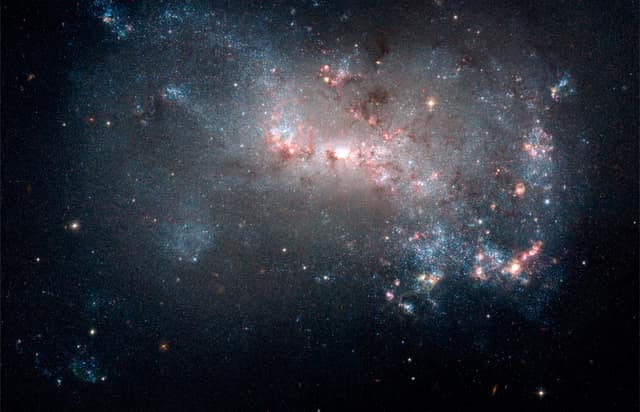
Dwarf Galaxies Keep Only 11% of Stellar Oxygen
Physics & Engineering: Dwarf Galaxies Keep Little Stellar Oxygen, Tandem Solar Cell Reaches 35.1%, Nanofluid Enables Ultrathin Lithium Foils, Atom Probe Maps Dissolved Hydrogen. Then Galactic Winds Recycle Stellar Material, Tandems Divide the Solar Spectrum, Use an Isotope to Trace Hydrogen.
McQuinn and colleagues compared oxygen production with oxygen remaining in the stars, gas and dust of 37 nearby dwarf galaxies. They retained 4–25%, averaging about 11%, mostly in gas. Archival Hubble imaging helped resolve stellar populations. Most missing oxygen is still unaccounted for: in surrounding halos or beyond.
Image: NASA, ESA, A. Aloisi (STScI/ESA), and The Hubble Heritage (STScI/AURA)-ESA/Hubble Collaboration (CC BY 4.0)
One email a day. 4 science stories, 5 quick results, 1 idea. 3 minutes.
Plus a daily quiz: Answer & Learn. Free, unsubscribe anytime.
Physics & Engineering
Tandem Solar Cell Reaches 35.1%
Fang and colleagues engineered self-assembled molecules to cover rough textured silicon without sacrificing conductivity. Their perovskite/silicon tandem reached certified stabilized efficiency of 35.1% and retained over 94% of initial performance after 1,500 hours under ISOS-L-1. Laboratory cell and ageing protocol, not a commercial module’s field lifetime.
Wu and colleagues improved molten lithium wetting on copper and made an 800-nanometre lithium-based foil. Their cycling pouch cells used thicker electrodes: 10 micrometres for over 250 cycles, and 20 micrometres for 100 cycles at 498 watt-hours per kilogram. The thinnest foil was not the high-energy cycling cell.
Huang and colleagues used deuterium, cryogenic transfer and voltage-pulsed atom probe tomography to distinguish dissolved hydrogen-like signals in alloys from instrumental background. Deuterium preferentially concentrated in hydrogen-affinitive phases, consistent with calculations. Minor vacancy-trapping contributions cannot be excluded; electrolytic charging does not measure equilibrium service solubility.
Supernovae can move metal-rich gas from a galaxy’s disk into its halo or farther into intergalactic space. The shallow gravitational wells of dwarf galaxies make them useful tests. GLOW II’s oxygen budget constrains this cycling, but does not yet locate most missing oxygen.
McQuinn et al., GLOW II, ApJ 2026, doi 10.3847/1538-4357/ae93a6
Stacking semiconductors with different band gaps lets each absorb a different part of sunlight. That relaxes the limit faced by a single junction. Fang and colleagues’ perovskite/silicon cell adds molecular engineering to make the interface work on textured silicon.
An atom probe’s background hydrogen can obscure the signal being measured. Deuterium acts as an isotopic proxy with a distinguishable mass signal under controlled conditions. Cryogenic handling helps preserve it, but charging and preparation artefacts still require checks.
Huang et al., Nature, 4 Nov 2026
Nature, 4 Nov 2026nature.com · 4 Nov 2026 · Primary · Use an Isotope to Trace Hydrogen — Huang et al.
Credits
Image: NASA, ESA, A. Aloisi (STScI/ESA), and The Hubble Heritage (STScI/AURA)-ESA/Hubble Collaboration (CC BY 4.0)
Voice: synthetic (neural text-to-speech).
Scripts written from the linked sources.
News and Ideas4 News 3 IdeassciencePhysics & Engineeringresearch
Physics & Engineering
Question of the day
Which isotope did the atom-probe team use as a proxy for hydrogen?
Deuterium
Carbon-13
Oxygen-18
Uranium-235
The ballot is in the email. Each choice there is counted once.