News & Ideas is a daily letter for anyone who wants the day's science in one place, not a feed. Each day is 4 news items and 3 ideas across AI & Tech, Physics & Engineering, Biology & Nature, and Mind & Society, and every story names a primary source you can check. The Shorts use a declared synthetic voice.
One email a day. 4 science stories, 5 quick results, 1 idea. 3 minutes.
Plus a daily quiz: Answer & Learn. Free, unsubscribe anytime.
Issue
17 November 2026
3 min read · 1 Short
Physics & Engineering: Webb finds ice around Beta Pictoris, a diamond maser that boosts quantum signals, quantum dots that paint patterns, the physics of super-shoe foam. Then the quantum limit, debris disks, running economy.
One email a day. 4 science stories, 5 quick results, 1 idea. 3 minutes.
Plus a daily quiz: Answer & Learn. Free, unsubscribe anytime.
Physics & Engineering
Webb Finds Ice Around Young Star Beta Pictoris
Physics & Engineering: Webb finds ice around Beta Pictoris, a diamond maser that boosts quantum signals, quantum dots that paint patterns, the physics of super-shoe foam. Then the quantum limit, debris disks, running economy.
Using JWST's NIRSpec, S. K. Betti and colleagues observed the debris disk around β Pictoris, a roughly 20-million-year-old star about 64 light-years away. The near-infrared spectrum shows amorphous water ice (less than 7% crystallinity) and carbon dioxide ice, including the 13CO2 isotopologue, with CO2 intimately mixed into the water ice at about 1:10. The authors infer the ices formed in cold conditions, likely in the interstellar medium, and that frequent collisions within the disk are needed to explain the uniform distribution of icy grains; low-velocity collisions may also resupply the carbon monoxide gas seen earlier. First direct detection of ice in this disk. Science (2026).
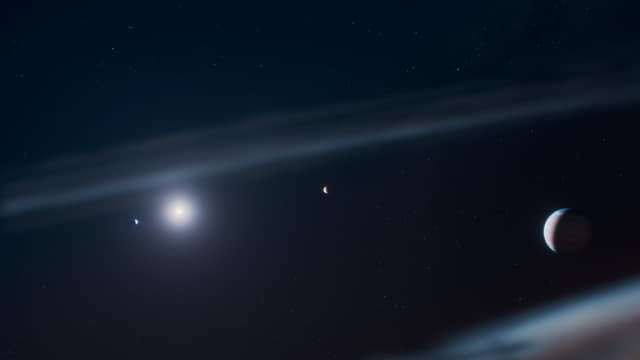
Illustration: NASA, ESA, CSA, STScI, R. Crawford · Wikimedia Commons (public domain) · artist's concept
One email a day. 4 science stories, 5 quick results, 1 idea. 3 minutes.
Plus a daily quiz: Answer & Learn. Free, unsubscribe anytime.
Quantum · Electronics
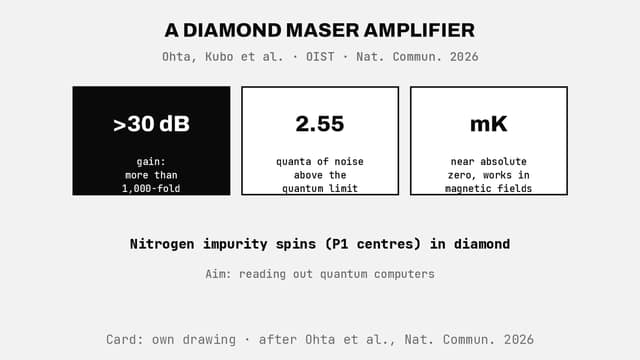
A Diamond Maser for Quantum Signals
Morihiro Ohta, Yuimaru Kubo and colleagues at the Okinawa Institute of Science and Technology report the first non-superconducting, near-quantum-limited maser amplifier operating at millikelvin temperatures. It uses nitrogen impurity spins (P1 centres) in diamond, with population inversion achieved by microwave pumping through a four-spin cross-relaxation mechanism. They report power gain above 30 dB (more than 1,000-fold), added noise of about 2.55 quanta above the standard quantum limit, and a 1 dB compression point of −63 dBm at 6.595 GHz, handling stronger input than Josephson parametric amplifiers. It can operate in strong magnetic fields of arbitrary orientation, relevant to spin-qubit readout, magnetic-resonance spectroscopy and axion dark-matter searches. Nature Communications, open access (CC BY 4.0).
Card: own drawing · after Ohta et al., Nat. Commun. 2026
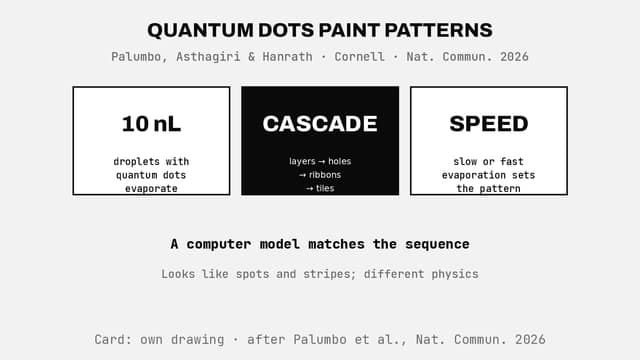
Jonathan Palumbo, Anjali Asthagiri and Tobias Hanrath (Cornell) deposited 10-nanolitre droplets of ethylene glycol carrying semiconductor quantum dots and watched them evaporate under a laser confocal microscope. Each shrinking droplet left a predictable 'cascade' of morphologies, from multilayer to monolayer, holes, ribbons and tiles. A computational model of the ordering reproduced the sequence, and the team controlled it through particle concentration and solvent volatility: slow evaporation gave the full cascade, fast evaporation quenched into an average state. The patterns resemble spots and stripes in nature, though the physics differs. Nature Communications, open access (CC BY-NC-ND 4.0).
Card: own drawing · after Palumbo et al., Nat. Commun. 2026
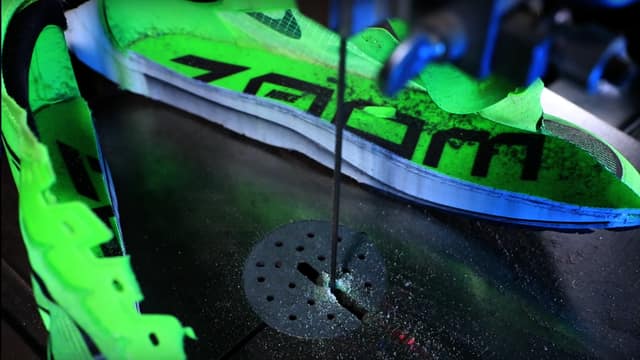
Jeremy McCulloch, Ellen Kuhl and colleagues at Stanford tested the two proprietary foams (FF LEAP and FF TURBO PLUS) of Asics Metaspeed racing shoes in tension, compression and shear. Both were stiffest in tension and least stiff in shear, and returned 90–94% of the energy put in when stretched or compressed. FF TURBO PLUS was about 42% stiffer in tension and nearly twice as stiff in shear as FF LEAP, so swapping which foam sits above the carbon plate changes stability. A neural network constrained by thermodynamics and material symmetry produced equations that matched the measurements closely. Engineering with Computers, open access (CC BY 4.0). A follow-up arXiv preprint (one shoe, one runner) found no significant loss after 300 miles.
Photo: Seth James DeMoor · Wikimedia Commons (CC BY 3.0) · a different racing shoe cut in half; illustrative
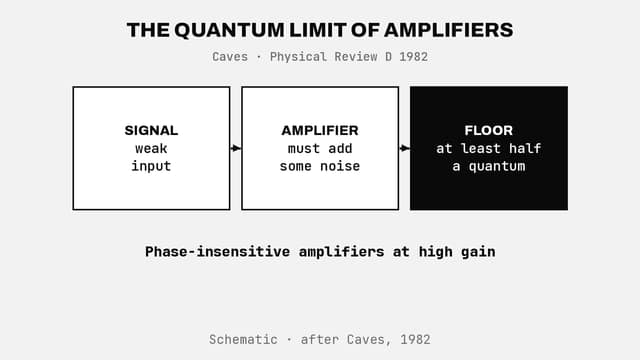
Carlton Caves (1982) derived quantum limits on the noise of linear amplifiers: a phase-insensitive amplifier with high gain must add noise equivalent to at least half a quantum at the input. This 'standard quantum limit' is the benchmark for quantum-computer readout amplifiers; the OIST diamond maser reports added noise about 2.55 quanta above it.
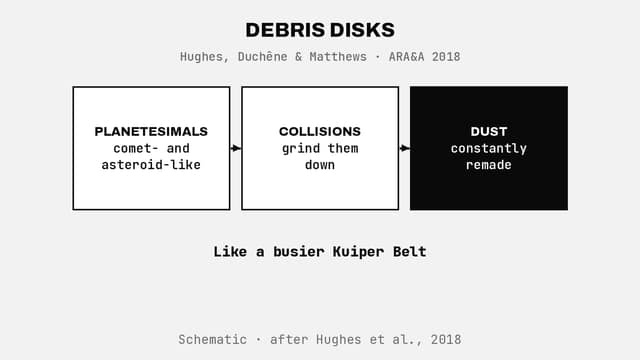
Debris disks are tenuous, dust-dominated disks seen around stars of many ages, analogous to the Solar System's Kuiper Belt and zodiacal light. As Hughes, Duchêne and Matthews review, their dust is believed to be continuously regenerated, mainly by collisions of planetesimals, so it traces the composition and evolution of planetary systems. The uniform icy dust around β Pictoris is read the same way.
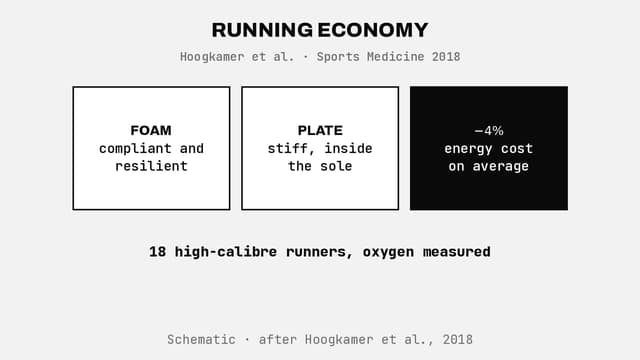
Running economy is the energy cost of running at a given speed. Hoogkamer and colleagues (2017) measured oxygen uptake in 18 high-calibre athletes at 14, 16 and 18 km/h: prototype shoes combining a compliant, resilient midsole foam with a stiff embedded plate lowered the energetic cost by 4% on average versus two established marathon shoes (mass matched), in all 18 runners. Open access (CC BY 4.0).