News & Ideas is a daily letter for anyone who wants the day's science in one place, not a feed. Each day is 4 news items and 3 ideas across AI & Tech, Physics & Engineering, Biology & Nature, and Mind & Society, and every story names a primary source you can check. The Shorts use a declared synthetic voice.
One email a day. 4 science stories, 5 quick results, 1 idea. 3 minutes.
Plus a daily quiz: Answer & Learn. Free, unsubscribe anytime.
Issue
14 November 2026
3 min read · 1 Short
Physics & Engineering: Rubber Blades for Tidal Turbines, Euclid Releases Its First Big Data Batch, A Plasma That Heats Itself, Uranus' Rings May Come From a Kuiper Belt Visitor. Then Reconfiguration: Bending to Survive, Weak Gravitational Lensing, The Lawson Criterion.
One email a day. 4 science stories, 5 quick results, 1 idea. 3 minutes.
Plus a daily quiz: Answer & Learn. Free, unsubscribe anytime.
Physics & Engineering
Rubber Blades Cut Tidal Turbine Strain
Physics & Engineering: Rubber Blades for Tidal Turbines, Euclid Releases Its First Big Data Batch, A Plasma That Heats Itself, Uranus' Rings May Come From a Kuiper Belt Visitor. Then Reconfiguration: Bending to Survive, Weak Gravitational Lensing, The Lawson Criterion.
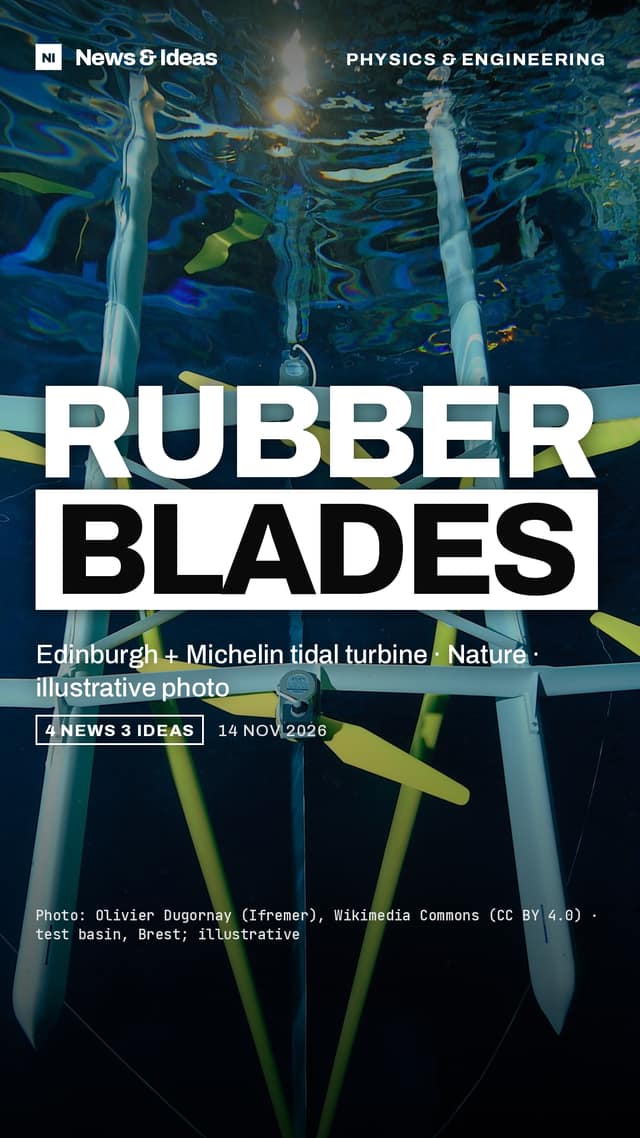
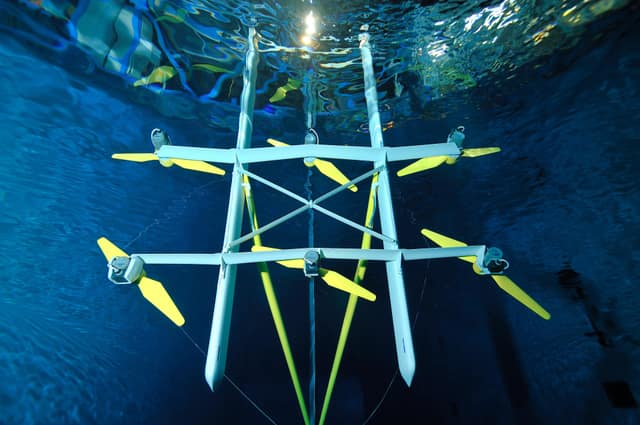
Engineers at the University of Edinburgh and Michelin built tidal-turbine blades with a flexible rubber trailing edge that bends under load and flattens the blade's camber. A 1.26-metre rotor was tested in the FloWave basin in currents of 0.5 to 1.0 metres per second. Over simulated tidal cycles the flexible blades produced the same energy as rigid blades with active pitch control, while cutting high-frequency swings in fatigue loads by up to one-third. Simulations of a 20-metre utility-scale turbine and rubber fatigue tests suggest a service life beyond 20 years. Caveats: model scale only, and Michelin employees are co-authors and Michelin has filed a patent. Open access (CC BY 4.0).
Photo: Olivier Dugornay (Ifremer), Wikimedia Commons (CC BY 4.0) · test basin, Brest; illustrative
One email a day. 4 science stories, 5 quick results, 1 idea. 3 minutes.
Plus a daily quiz: Answer & Learn. Free, unsubscribe anytime.
Physics & Engineering
Euclid Releases Its First Big Data Batch
ESA's Euclid space telescope released DR1-Foundation, about 13 months of observations covering 1,900 square degrees, roughly 14% of the area it will eventually survey. The release includes more than 900 million galaxies, spectra of more than 160 million sources, over 60 million quasar candidates and around 15,000 strong gravitational-lens candidates, the largest strong-lens catalogue ever, for 1.7 million GB of data. The full Data Release 1, with weak-lensing measurements for cosmology, is expected in mid-2027.
Researchers at Japan's National Institute for Fusion Science used the Large Helical Device to follow, step by step, how an unstable plasma heats itself: the instability generates waves, the waves distort the energy distribution of particles, the distortion spreads, and the plasma heats up. The team describes it as one of the key processes behind self-heating in fusion plasmas. Open access in Communications Physics.
Using the James Webb Space Telescope, Matthew Belyakov (Caltech) and colleagues found that the spectra of Uranus' narrow rings and four small inner moons (Juliet, Portia, Perdita and Puck) resemble water-rich Kuiper belt objects rather than the large moons like Miranda or Ariel. Either the impactor that tilted Uranus was a Kuiper belt object, or a second, smaller one broke up and supplied the material. Either way it must have been roughly Pluto-sized or larger. Paper published in October in The Astrophysical Journal Letters (CC BY 4.0), covered by Physics Magazine on 12 Nov.
Plants in wind and water reduce drag by changing shape, rolling leaves into cones or bending branches. Biomechanist Steven Vogel called it reconfiguration. The rubber turbine blades use the same trick to shed load.
Matter bends light, so every distant galaxy appears slightly distorted by the mass between us and it. Averaged over millions of galaxies, those small distortions map dark matter. It is the measurement Euclid's full first data release will add.
For fusion to give net energy, a plasma must be hot enough, dense enough and confined long enough. John Lawson worked out the condition in 1955. Self-heating, the process studied in the Large Helical Device, is what keeps a burning plasma hot.