News & Ideas is a daily letter for anyone who wants the day's science in one place, not a feed. Each day is 4 news items and 3 ideas across AI & Tech, Physics & Engineering, Biology & Nature, and Mind & Society, and every story names a primary source you can check. The Shorts use a declared synthetic voice.
One email a day. 4 science stories, 5 quick results, 1 idea. 3 minutes.
Plus a daily quiz: Answer & Learn. Free, unsubscribe anytime.
Issue
1 November 2026
2 min read · 1 Short
Physics & Engineering: Voyager 1's silent days, the grid's one-minute beat, Hera's first light, IBM links two quantum chips. Then nuclear batteries, grid frequency, the momentum boost.
One email a day. 4 science stories, 5 quick results, 1 idea. 3 minutes.
Plus a daily quiz: Answer & Learn. Free, unsubscribe anytime.
Physics & Engineering
Voyager 1 goes silent, the power grid's 1-minute beat
Physics & Engineering: Voyager 1's silent days, the grid's one-minute beat, Hera's first light, IBM links two quantum chips. Then nuclear batteries, grid frequency, the momentum boost.
Voyager 1 goes silent, the power grid's 1-minute beat
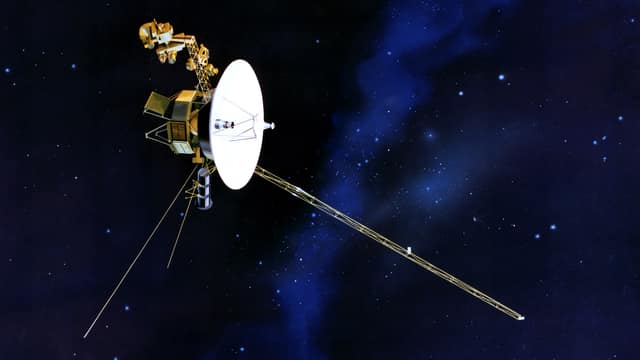
In early September, NASA swapped three Voyager 1 devices for lower-power ones, an operation called the Big Bang. Then, on October 18 and 19, the Deep Space Network heard nothing from 24 billion kilometres away. The signal returned on the 20th, with no commands sent. Backup thrusters had switched on automatically; the cause is under investigation.
One email a day. 4 science stories, 5 quick results, 1 idea. 3 minutes.
Plus a daily quiz: Answer & Learn. Free, unsubscribe anytime.
Energy · Grids
The power grid's one-minute beat
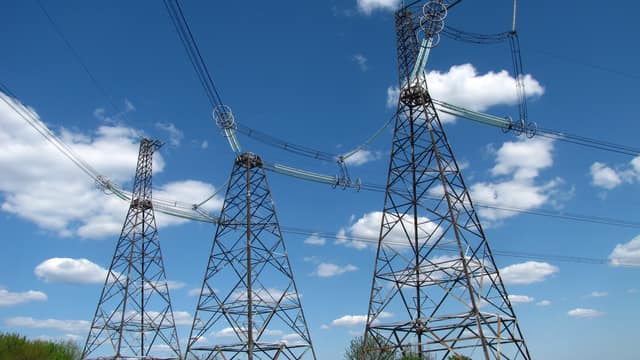
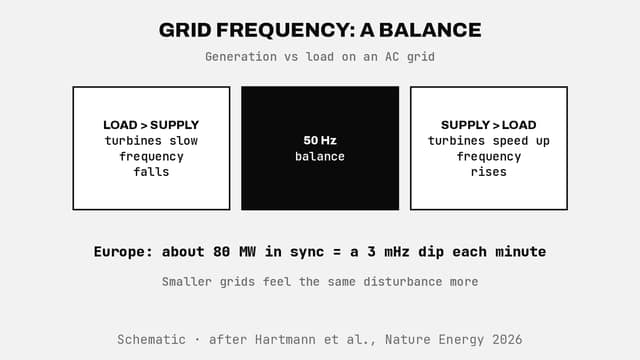
In Nature Energy, Jülich researchers and partners solved a mystery: in 12 power grids on five continents, frequency peaks at exactly one minute. The cause: battery backup systems running self-tests synced to internet clocks. In continental Europe, that is about 80 megawatts at once. No immediate risk, the authors say.
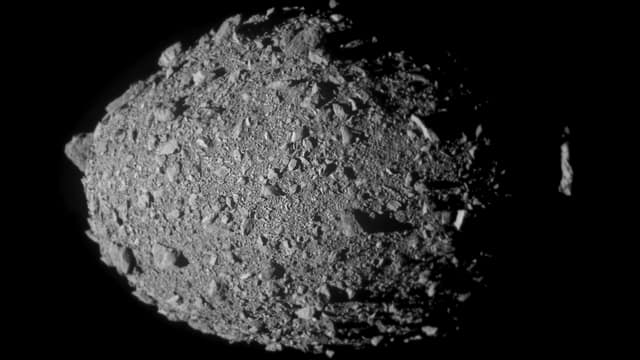
ESA's Hera spacecraft saw Didymos and Dimorphos as two separate objects for the first time, from 1,280 kilometres. Dimorphos, 151 metres wide, covers about one pixel. The image shown is from NASA's DART, which hit it in 2022.
Image: Dimorphos seen by DART, 2022 · NASA/Johns Hopkins APL (public domain)
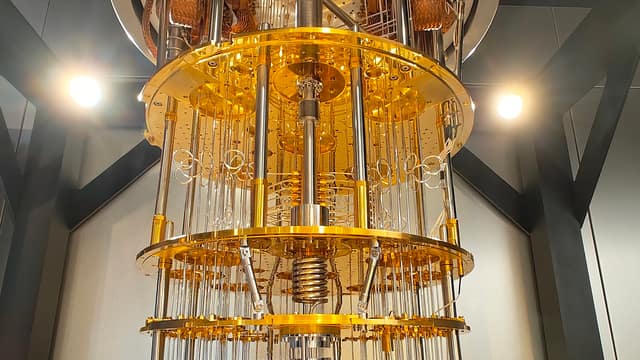
In a preprint, with a company blog, IBM linked two 120-qubit Nighthawk chips with four superconducting cables, 80 centimetres long. Quantum states crossed with 99 percent fidelity on average, and a gate between the chips reached 94.75 percent. Not yet peer reviewed.
Photo: OJB Quantum · Wikimedia Commons (CC BY 4.0) · a generic IBM system
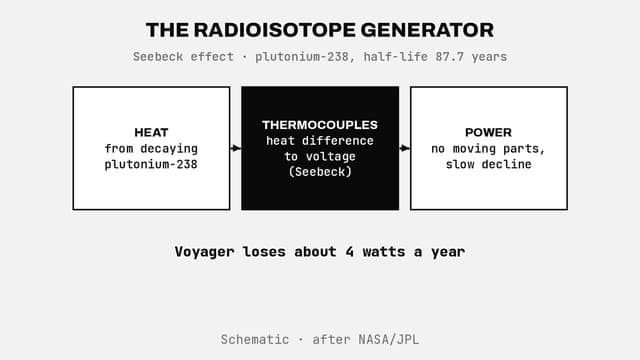
The radioisotope generator. Heat from decaying plutonium-238 flows through thermocouples that turn it into electricity, with no moving parts. With a half-life of 87.7 years, power fades slowly: Voyager loses about 4 watts a year.
Grid frequency is a balance. When demand exceeds supply, turbines slow and frequency drops below 50 hertz; with too much supply, it rises. So 80 megawatts switching every minute means a 3 millihertz dip across Europe.
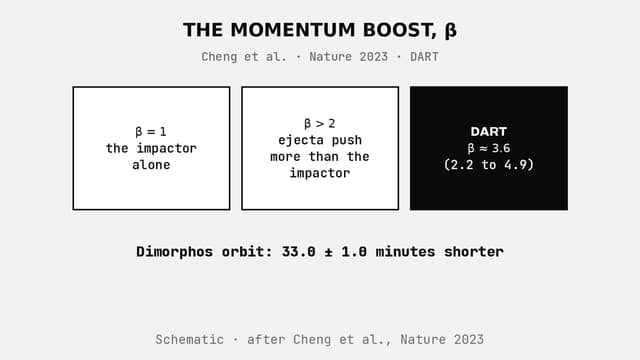
The momentum boost, beta. When a spacecraft hits an asteroid, debris thrown backwards adds a push, like recoil. Beta compares the total push with the impactor's alone. For DART, beta was about 3.6; Hera will pin it down.