News & Ideas is a daily letter for anyone who wants the day's science in one place, not a feed. Each day is 4 news items and 3 ideas across AI & Tech, Physics & Engineering, Biology & Nature, and Mind & Society, and every story names a primary source you can check. The Shorts use a declared synthetic voice.
One email a day. 4 science stories, 5 quick results, 1 idea. 3 minutes.
Plus a daily quiz: Answer & Learn. Free, unsubscribe anytime.
Issue
22 November 2026
2 min read · 1 Short
Physics & Engineering: filling the MeV gap, a gel that grows stronger, a blue laser on a chip, a superconducting memory sandwich. Then blazars, slide-ring gels, a superconducting spin valve.
One email a day. 4 science stories, 5 quick results, 1 idea. 3 minutes.
Plus a daily quiz: Answer & Learn. Free, unsubscribe anytime.
Physics & Engineering
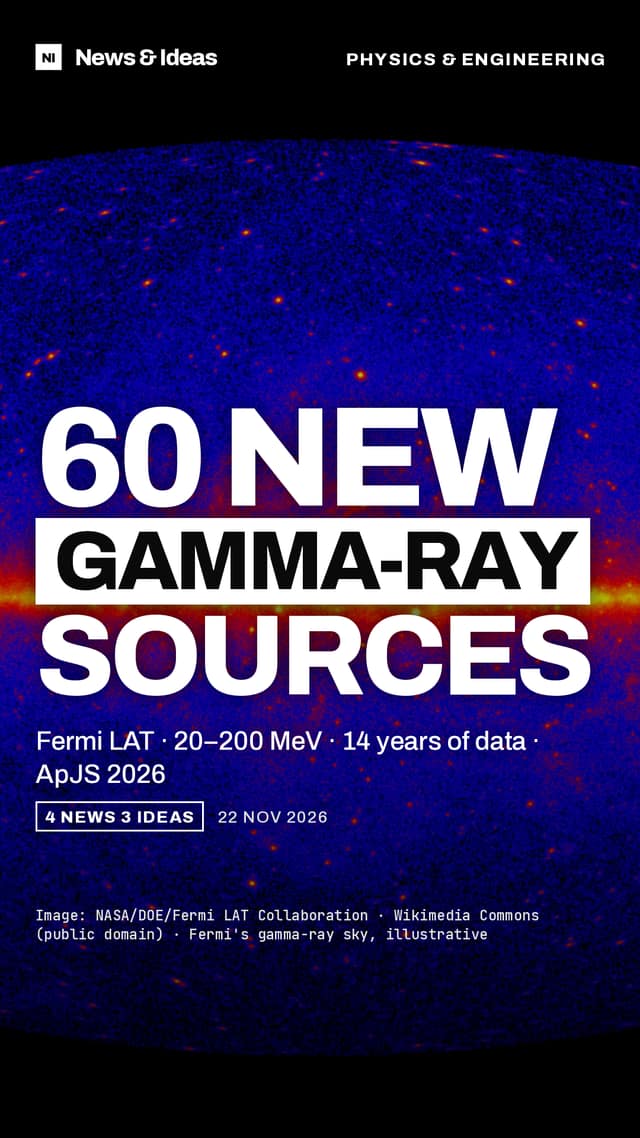
60 New Gamma-Ray Sources in the MeV Gap
Physics & Engineering: filling the MeV gap, a gel that grows stronger, a blue laser on a chip, a superconducting memory sandwich. Then blazars, slide-ring gels, a superconducting spin valve.
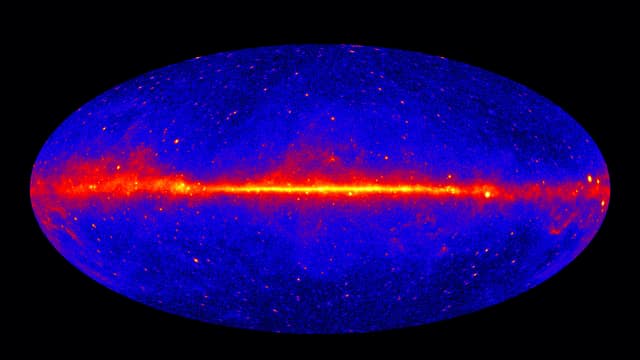
The Fermi Large Area Telescope team combed 14 years of data for gamma rays between 20 and 200 mega-electron-volts. The new catalog lists 450 sources. Most lie far beyond our galaxy, led by a kind of blazar. And 60 are brand-new gamma-ray sources, still unidentified. The Astrophysical Journal Supplement.
One email a day. 4 science stories, 5 quick results, 1 idea. 3 minutes.
Plus a daily quiz: Answer & Learn. Free, unsubscribe anytime.
Materials · Hydrogels
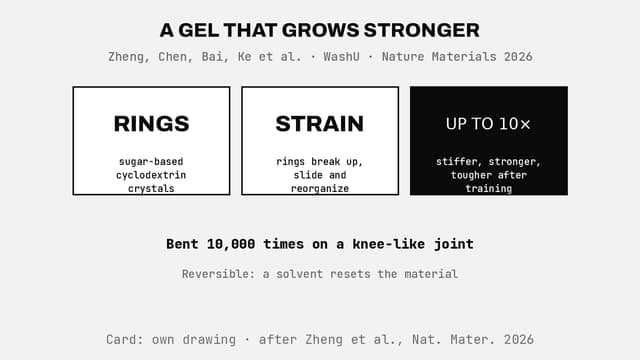
A Gel That Grows Stronger
Washington University chemists made a hydrogel that gets stronger the more it's strained. Sugar-based rings called cyclodextrins break up under stress, slide along the polymer chains and reorganize. Mechanical training boosted stiffness, strength and toughness by up to ten times, and a solvent resets it. Published in Nature Materials.
Card: own drawing · after Zheng et al., Nat. Mater. 2026
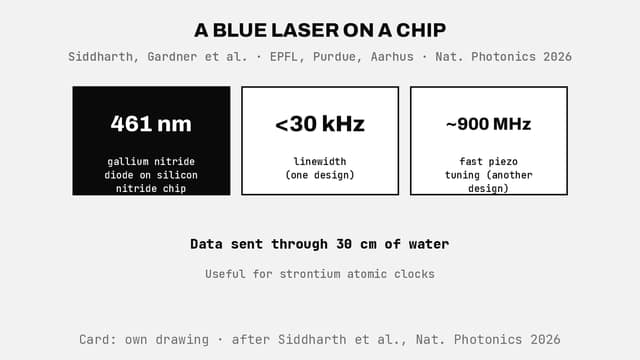
A team from EPFL, Purdue and Aarhus built a blue laser on a chip, at 461 nanometers, locked to a tiny silicon nitride resonator. One design reached a linewidth under 30 kilohertz; another tuned across nearly 900 megahertz. They even sent data through 30 centimeters of water. Published in Nature Photonics.
Card: own drawing · after Siddharth et al., Nat. Photonics 2026
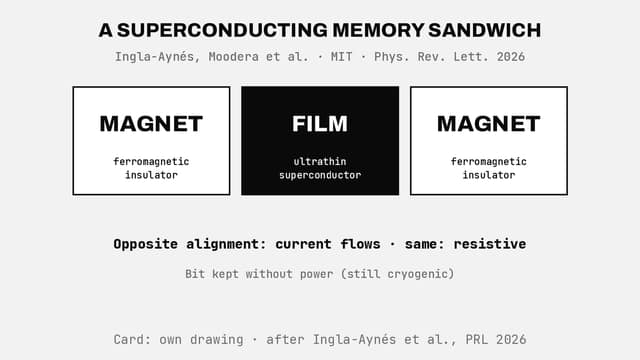
MIT physicists sandwiched an ultrathin superconducting film between two magnetic insulators. Flip the magnets' alignment and superconductivity switches on or off: a bit that stays put with no power to hold it. A heat pulse rewrote one cell without disturbing its neighbor. It still needs deep cold. Physical Review Letters.
Card: own drawing · after Ingla-Aynés et al., PRL 2026
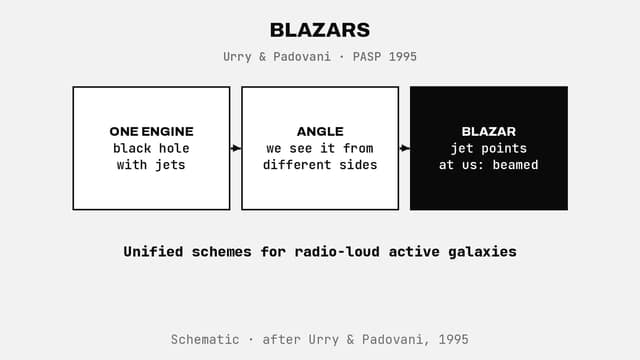
Blazars. In 1995, Meg Urry and Paolo Padovani argued that many active galaxies are one kind of engine seen from different angles. When a jet points almost straight at us, relativistic beaming makes it extremely bright: a blazar.
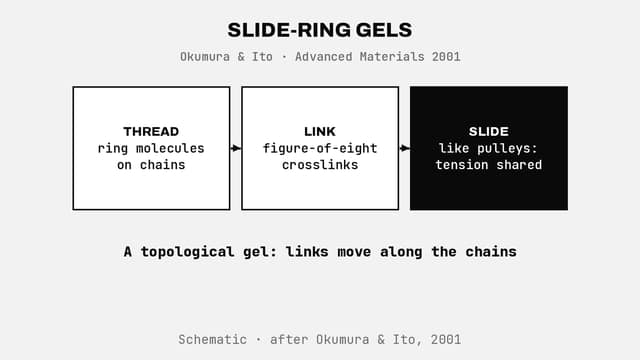
Slide-ring gels. In 2001, Okumura and Ito threaded ring molecules onto polymer chains and joined them with figure-of-eight crosslinks that slide like pulleys, sharing tension. Today's gel also relies on sliding rings.
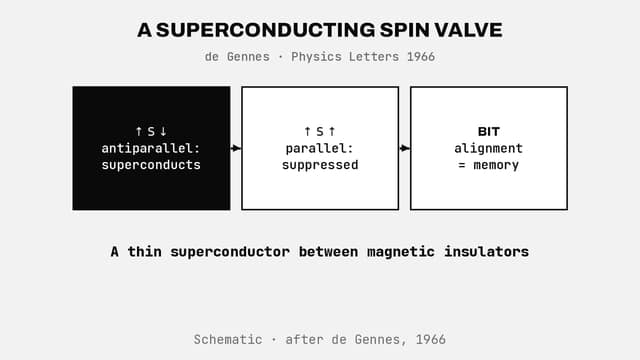
A superconducting spin valve. In 1966, Pierre-Gilles de Gennes predicted that a thin superconductor between two magnetic insulators would sense their alignment, superconducting more easily when they point opposite ways. Sixty years on, that's a memory bit.