News & Ideas is a daily letter for anyone who wants the day's science in one place, not a feed. Each day is 4 news items and 3 ideas across AI & Tech, Physics & Engineering, Biology & Nature, and Mind & Society, and every story names a primary source you can check. The Shorts use a declared synthetic voice.
One email a day. 4 science stories, 5 quick results, 1 idea. 3 minutes.
Plus a daily quiz: Answer & Learn. Free, unsubscribe anytime.
Issue
13 November 2026
3 min read · 1 Short
Physics & Engineering: A 1904 Puzzle, Imaged in Gold, Kuiper Belt Dust Points to Unusual Ancient Water, A Chip Cools a Trapped Ion Three Times Faster, Magic-Angle Graphene Is Extremely Sensitive to Strain. Then Thomson's Plum Pudding, Twelve Defects You Cannot Avoid, Oxygen Isotopes as a Solar System Fingerprint.
One email a day. 4 science stories, 5 quick results, 1 idea. 3 minutes.
Plus a daily quiz: Answer & Learn. Free, unsubscribe anytime.
Physics & Engineering
Thomson's 1904 Charge Puzzle, Imaged in Gold
Physics & Engineering: A 1904 Puzzle, Imaged in Gold, Kuiper Belt Dust Points to Unusual Ancient Water, A Chip Cools a Trapped Ion Three Times Faster, Magic-Angle Graphene Is Extremely Sensitive to Strain. Then Thomson's Plum Pudding, Twelve Defects You Cannot Avoid, Oxygen Isotopes as a Solar System Fingerprint.
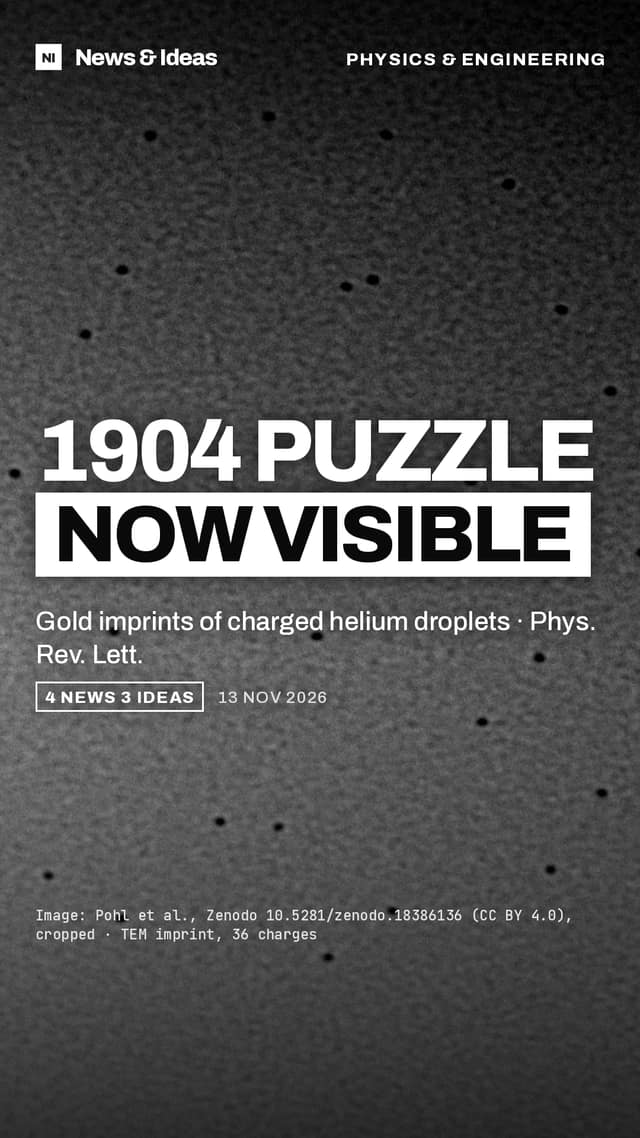
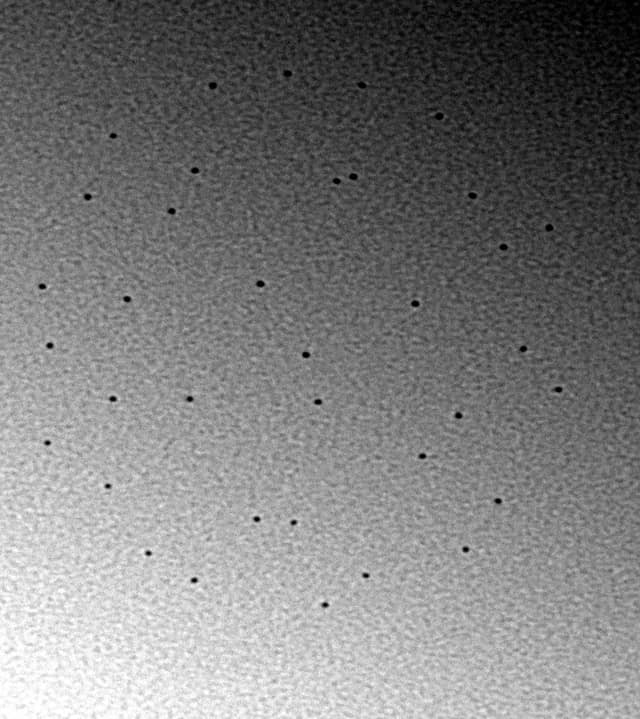
In 1904 J. J. Thomson asked how equal charges arrange themselves on a sphere to minimise their repulsion; beyond small cases the 'Thomson problem' has no exact solution and is still a benchmark for optimisation. A team led from the University of Innsbruck, with theorists including David Wales, charged superfluid helium nanodroplets and doped them with gold: each charge seeded a gold nanoparticle of roughly 700 atoms, and the droplets left imprints on a carbon film that were imaged by transmission electron microscopy. Twenty-five imprints with 5 to 36 charges matched the computed lowest-energy configurations; larger droplets showed hexagonal order with fivefold defects. Peer-reviewed, open access (CC BY) in Physical Review Letters (26 Oct); covered by Physics World on 11 Nov.
Image: Pohl et al., Zenodo 10.5281/zenodo.18386136 (CC BY 4.0), cropped · TEM imprint, 36 charges
One email a day. 4 science stories, 5 quick results, 1 idea. 3 minutes.
Plus a daily quiz: Answer & Learn. Free, unsubscribe anytime.
Physics & Engineering
Kuiper Belt Dust Points to Unusual Ancient Water
Keller and colleagues analysed 12 dust grains collected in the stratosphere by NASA aircraft whose dense solar-flare tracks point to an origin in the Kuiper belt. Hydrated clays in the grains imply they formed with water enriched in heavy oxygen, with an 18O/16O ratio up to about 15% above ocean water (a model-based upper limit), suggesting a primordial reservoir that Saturn likely helped keep isolated. Peer-reviewed, Science Advances.
Cornell researchers delivered a phase-stable standing wave of laser light through a photonic chip to cool a trapped ion with electromagnetically induced transparency (EIT). The ion reached near its motional ground state in about 150 microseconds versus about 500, three modes spanning about 5 MHz were cooled at once, and temperatures went below the Doppler limit. Demonstrated on a single ion. Peer-reviewed, open access in PRX Quantum.
Magic-Angle Graphene Is Extremely Sensitive to Strain
University of Washington physicists stretched twisted bilayer graphene continuously while measuring its resistance. Near the 'magic' twist angle of about 1.1 degrees, the elastoresistance, the change in resistance per unit strain, was more than two orders of magnitude larger than in conventional metals, depending on band filling and temperature; in some doping regimes it diverged at low temperature in a Curie–Weiss-like way. The authors discuss nematic fluctuations and fluctuating isospin moments as possible causes. Peer-reviewed, Science; preprint on arXiv.
Before the nucleus was discovered, J. J. Thomson pictured the atom as electrons embedded in a sphere of positive charge, and asked which arrangements of electrons would be stable. The geometric question outlived the model: placing N repelling charges on a sphere is now a classic test for optimisation algorithms.
A flat sheet can be tiled with hexagons, a sphere cannot: Euler's theorem forces a net 'charge' of 12 fivefold defects, as on a football. On large spheres extra defects line up in 'scars'. Bausch and colleagues saw these scars in colloidal crystals on droplets; the gold imprints show fivefold defects too.
Oxygen has three stable isotopes, 16, 17 and 18. Their ratios differ between meteorite groups in ways ordinary chemistry cannot explain, so they act as fingerprints of where and from what water and rock formed. That is how dust grains can tell us about water in the distant Kuiper belt.
Oxygen Isotopes in MeteoritesAnnual Review of Earth and Planetary Sciences · 1993 · Primary · Clayton, Annu. Rev. Earth Planet. Sci. 21, 115 (1993)
Credits
Image: Pohl et al., Zenodo 10.5281/zenodo.18386136 (CC BY 4.0), cropped · TEM imprint, 36 charges
Voice: synthetic (neural text-to-speech).
Scripts written from the linked sources.
News and Ideas4 News 3 IdeasscienceresearchPhysics & EngineeringThomson problemJ. J. Thomsonsuperfluid heliumnanodropletselectron microscopygold nanoparticlesPhysical Review Lettersphysics
Physics & Engineering
Question of the day
What did the Cornell team cool faster using light delivered through a chip?
A superconducting qubit
A cloud of helium atoms
A sheet of graphene
A single trapped ion
The ballot is in the email. Each choice there is counted once.