News & Ideas is a daily letter for anyone who wants the day's science in one place, not a feed. Each day is 4 news items and 3 ideas across AI & Tech, Physics & Engineering, Biology & Nature, and Mind & Society, and every story names a primary source you can check. The Shorts use a declared synthetic voice.
One email a day. 4 science stories, 5 quick results, 1 idea. 3 minutes.
Plus a daily quiz: Answer & Learn. Free, unsubscribe anytime.
Issue
13 November 2026
3 min read · 1 Short
Biology & Nature: Microplastics Found in Blood of Wild Tapirs and Anteaters, The 'Dark Magic Mushroom' Makes a Psychedelic and a Toxin, Shrinking Elephant Population Fractures Its Social Networks, Darwin Wasps Evolved Along a One-Way Street. Then The Human Footprint Index, How Raman Spectroscopy Identifies Plastic, Genes That Jump Between Fungi.
One email a day. 4 science stories, 5 quick results, 1 idea. 3 minutes.
Plus a daily quiz: Answer & Learn. Free, unsubscribe anytime.
Biology & Nature
Microplastics in the Blood of Wild Tapirs and Anteaters
Biology & Nature: Microplastics Found in Blood of Wild Tapirs and Anteaters, The 'Dark Magic Mushroom' Makes a Psychedelic and a Toxin, Shrinking Elephant Population Fractures Its Social Networks, Darwin Wasps Evolved Along a One-Way Street. Then The Human Footprint Index, How Raman Spectroscopy Identifies Plastic, Genes That Jump Between Fungi.
Microplastics in the Blood of Wild Tapirs and Anteaters
Microplastics Found in Blood of Wild Tapirs and Anteaters
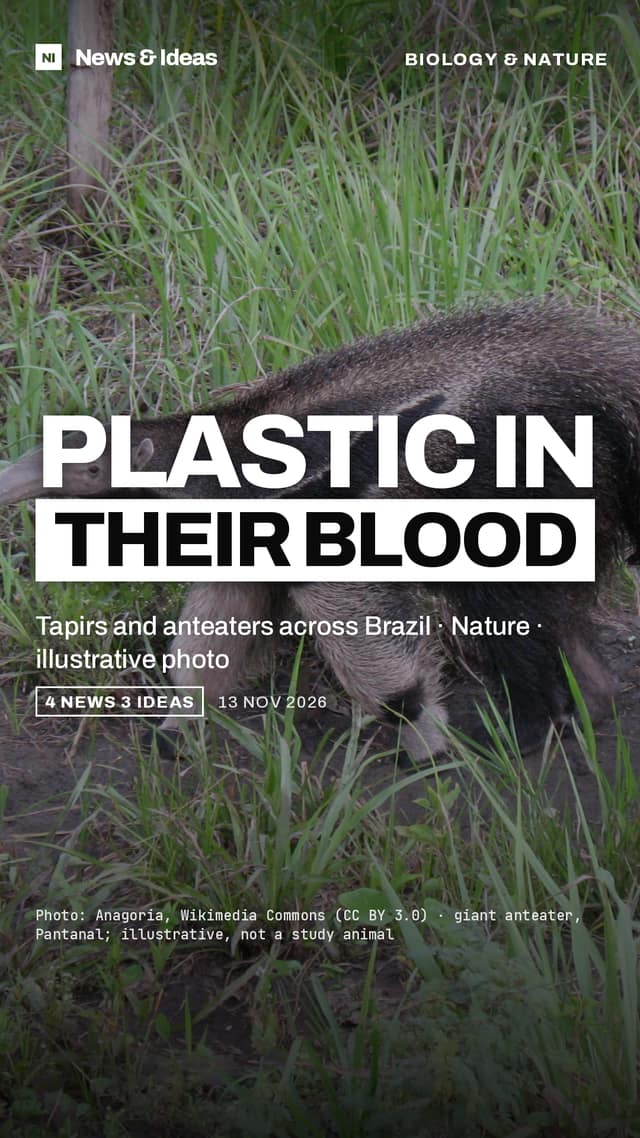
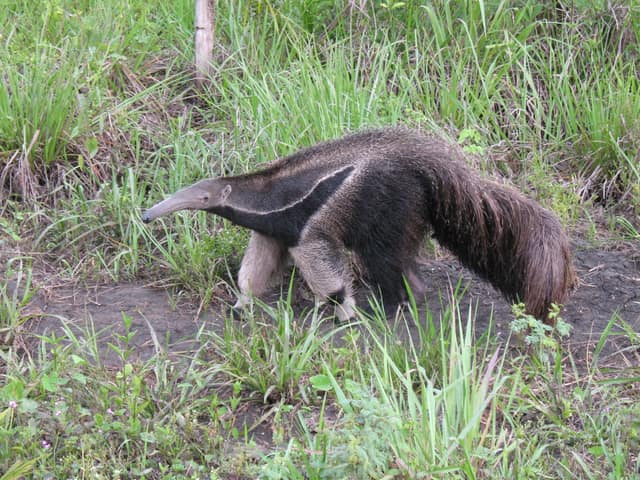
Researchers sampled the blood of 26 lowland tapirs and 21 giant anteaters across the Amazon, the Cerrado and the Pantanal between 2021 and 2022 and paired it with GPS tracking. Raman spectroscopy found microplastics in 43 of the 47 animals, at a mean of 73.8 particles per millilitre. Burdens rose with each animal's exposure to the human footprint and with proximity to development and waste facilities, but animals in the remote Pantanal, more than 65 km from infrastructure, also carried particles, at lower levels. Particles below about a micrometre (nanoplastics) were not measured. Peer-reviewed, Nature.
Photo: Anagoria, Wikimedia Commons (CC BY 3.0) · giant anteater, Pantanal; illustrative, not a study animal
One email a day. 4 science stories, 5 quick results, 1 idea. 3 minutes.
Plus a daily quiz: Answer & Learn. Free, unsubscribe anytime.
Biology & Nature
The 'Dark Magic Mushroom' Makes a Psychedelic and a Toxin
Mass spectrometry and genome analysis show that Galerina indica, a small mushroom found in Florida, produces both psilocybin and the deadly amatoxins, along with the genes to make them: the first species known to combine the two. Phylogenetic analyses suggest it acquired psilocybin genes by horizontal gene transfer after its amatoxin pathway was already in place. Research on fungal chemistry, not on use. Peer-reviewed, Current Biology.
Shrinking Elephant Population Fractures Its Social Networks
Following more than 440 wild female Asian elephants over 12 years in Sri Lanka's Udawalawe National Park, UC San Diego researchers found that losses accumulated gradually, through deaths, emigration and fewer newcomers, until the social network crossed a threshold and shifted from large, densely connected communities to smaller, less connected groups. The authors warn such tipping points may be hard to reverse. Peer-reviewed, Science.
Mapping parasitoid strategies on a phylogeny of 697 species of Darwin wasps (Ichneumonidae), researchers found that the switch from paralysing hosts to letting them keep developing arose at least 23 times with no reversals, and that living inside the host was rarely reversed: an 'evolutionary ratchet' that shaped which hosts lineages could later use. Peer-reviewed, open access in Current Biology.
To measure human pressure on land, Venter and colleagues combined maps of built environments, cropland, pasture, population density, night lights, railways, roads and navigable waterways into one index, and found pressure grew between 1993 and 2009. The microplastics study uses it to score each animal's exposure.
Shine a laser on a particle and a tiny fraction of the light comes back shifted in energy by the vibrations of its molecular bonds. Each polymer gives a characteristic spectrum, so a microscope with a Raman spectrometer can tell polyethylene from a grain of sand down to about a micrometre. Smaller nanoplastics remain hard to measure.
Horizontal gene transfer moves genes between species without reproduction. Reynolds and colleagues found that the psilocybin gene cluster appears in distantly related mushrooms because it was passed between lineages, probably among fungi sharing dung or decaying wood. Galerina indica adds a new twist to that story.