News & Ideas is a daily letter for anyone who wants the day's science in one place, not a feed. Each day is 4 news items and 3 ideas across AI & Tech, Physics & Engineering, Biology & Nature, and Mind & Society, and every story names a primary source you can check. The Shorts use a declared synthetic voice.
One email a day. 4 science stories, 5 quick results, 1 idea. 3 minutes.
Plus a daily quiz: Answer & Learn. Free, unsubscribe anytime.
Issue
9 November 2026
2 min read · 1 Short
Biology & Nature: Two New Howler Monkey Species in Amazonia, Small Populations Can Recover With Direct Action, Genomic Imprinting Found in a Placental Fish, Individual Birds Identified From Song Alone. Then Rivers as Barriers, Parental Conflict and Imprinting, Small Populations Versus Declining Ones.
One email a day. 4 science stories, 5 quick results, 1 idea. 3 minutes.
Plus a daily quiz: Answer & Learn. Free, unsubscribe anytime.
Biology & Nature
Two New Howler Monkey Species in Amazonia
Biology & Nature: Two New Howler Monkey Species in Amazonia, Small Populations Can Recover With Direct Action, Genomic Imprinting Found in a Placental Fish, Individual Birds Identified From Song Alone. Then Rivers as Barriers, Parental Conflict and Imprinting, Small Populations Versus Declining Ones.
Batista, Semedo, Boubli and colleagues analyse genome-wide data for 11 of 13 recognised aloo-atta species and describe aloo-atta ee-roy and A. mato-gross-ensis (Communications Biology, 30 Oct 2026, CC BY 4.0). Most Amazonian diversity arose within the last million years, with rivers as barriers. University of Salford notes this is 84 years after A. puruensis (1941); scripts use “more than eighty years.” A. mato-gross-ensis lives in a rapidly deforesting southern Amazon region.
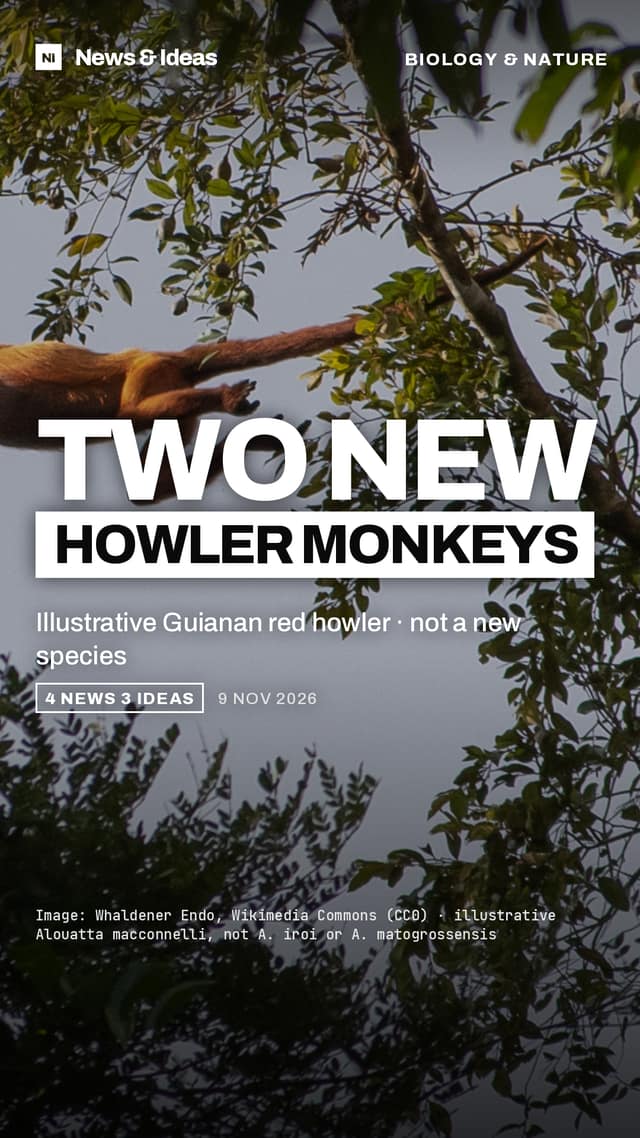
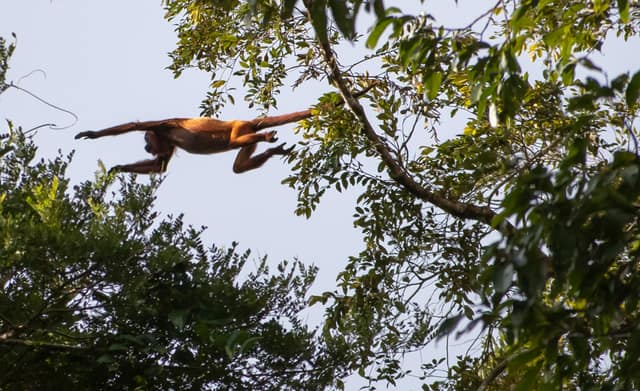
Image: Whaldener Endo, Wikimedia Commons (CC0) · illustrative Alouatta macconnelli, not A. iroi or A. matogrossensis
One email a day. 4 science stories, 5 quick results, 1 idea. 3 minutes.
Plus a daily quiz: Answer & Learn. Free, unsubscribe anytime.
Biology & Nature
Small Populations Can Recover With Direct Action
Smith, Ewen, Clarke, Wessels and Turvey evaluate all 147 bird and mammal species that fell below 50 wild individuals since 1950 (141 assessable). Most species subject to direct conservation recovered to at least 100 individuals; modelled recovery was highest when threat reduction was combined with direct population management (Proc. R. Soc. B, 4 Nov 2026, CC BY 4.0). Specific press percentages (for example 61%) are not used here because they were not verified in the abstract.
Zhang and colleagues report robust genomic imprinting in the placenta of Poeciliopsis prolifica, including an orthologue of grb10 (Science Advances, 6 Nov 2026). First reported imprinting case in a non-mammalian vertebrate in this study's framing.
Lapp and colleagues identify individual ovenbirds from song across four years of passive acoustic monitoring, reporting 96% accuracy on unseen individuals and 405 males at 126 sites (Nature Methods, 5 Nov 2026).
Amazonian rivers can isolate primate populations on opposite banks, a classic riverine-barrier idea dating to Wallace and revisited by the howler genomics.
Where placentas evolve, paternal and maternal alleles can pull nutrient demand in opposite directions; the fish study reports opposing imprinted glucose-related genes.
Trends Genet.doi.org · 1991 · Primary · Parental Conflict and Imprinting — Moore & Haig
Idea · Biology & Nature
Small Populations Versus Declining Ones
Caughley separated the genetics of smallness from the causes of decline; recovery studies and acoustic mark–recapture both need robust abundance methods.
J. Anim. Ecol. 63Small Populations Versus Declining Ones — Caughley · 1994 · Primary
Credits
Image: Whaldener Endo, Wikimedia Commons (CC0) · illustrative Alouatta macconnelli, not A. iroi or A. matogrossensis
Voice: synthetic (neural text-to-speech).
Scripts written from the linked sources.
News and Ideas4 News 3 IdeasscienceBiology & Natureresearch
Biology & Nature
Question of the day
What recovery threshold did Smith and colleagues use for species that received direct conservation?
Return to IUCN Least Concern
Captive breeding only
Zero further habitat loss
At least 100 individuals
The ballot is in the email. Each choice there is counted once.