News & Ideas is a daily letter for anyone who wants the day's science in one place, not a feed. Each day is 4 news items and 3 ideas across AI & Tech, Physics & Engineering, Biology & Nature, and Mind & Society, and every story names a primary source you can check. The Shorts use a declared synthetic voice.
One email a day. 4 science stories, 5 quick results, 1 idea. 3 minutes.
Plus a daily quiz: Answer & Learn. Free, unsubscribe anytime.
Issue
29 October 2026
2 min read · 1 Short
Biology & Nature: millions of eels at a seamount, a giant crane that was never a separate species, the Stephen Colbert spider genome, Chornobyl dogs. Then selection vs drift, ancient DNA, the C-value paradox.
One email a day. 4 science stories, 5 quick results, 1 idea. 3 minutes.
Plus a daily quiz: Answer & Learn. Free, unsubscribe anytime.
Biology & Nature
2.8 million eels, a giant crane, a spider genome
Biology & Nature: millions of eels at a seamount, a giant crane that was never a separate species, the Stephen Colbert spider genome, Chornobyl dogs. Then selection vs drift, ancient DNA, the C-value paradox.
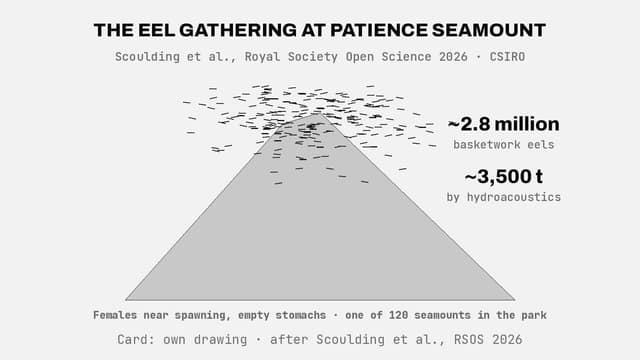
Off Tasmania, CSIRO researchers used sound to count basketwork eels gathered beside Patience Seamount: about 2.8 million, around 3,500 tonnes. Females caught there had empty stomachs and were close to spawning. Why the eels choose this one, out of about 120 seamounts in the marine park, is unknown. Published in Royal Society Open Science.
One email a day. 4 science stories, 5 quick results, 1 idea. 3 minutes.
Plus a daily quiz: Answer & Learn. Free, unsubscribe anytime.
Biology · Evolution
The extinct giant crane was a common crane
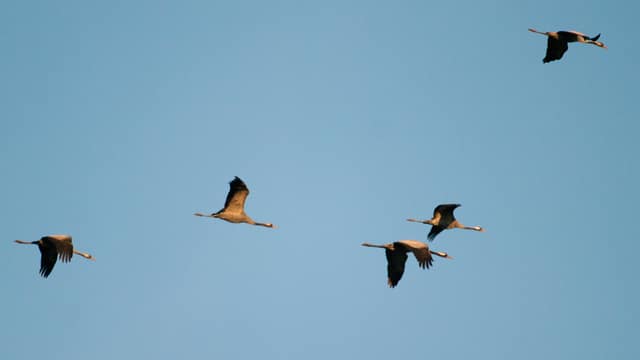
In the nineteenth century, large crane bones from French caves were named a separate, extinct species, Grus primigenia. Ancient DNA from 18 large crane bones across Europe now shows they belong to today's common crane, just bigger. Researchers at Bournemouth University suggest large males helped the mix-up. Published in Royal Society Open Science.
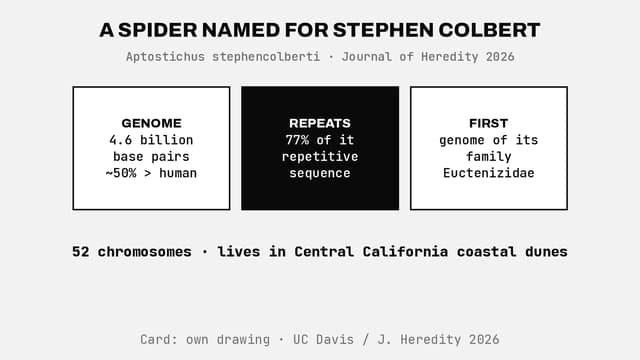
A trapdoor spider named after Stephen Colbert, Aptostichus stephencolberti, has had its genome sequenced: 4.6 billion base pairs, about 50 percent more than the human genome. Seventy-seven percent of it is repetitive sequence. It is the first genome from its spider family. Published in the Journal of Heredity.
Card: own drawing · after UC Davis / J. Heredity 2026
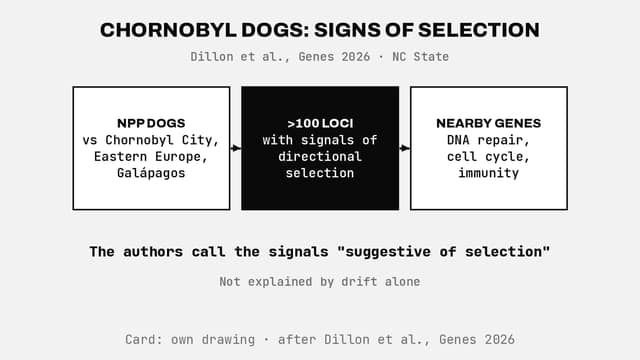
Dogs living at the Chornobyl power plant differ genetically from dogs just 16 kilometres away. A study from NC State found signals of directional selection at over 100 locations, near genes for DNA repair, the cell cycle and immunity. The authors call the signals suggestive of selection, not proof. Published in Genes.
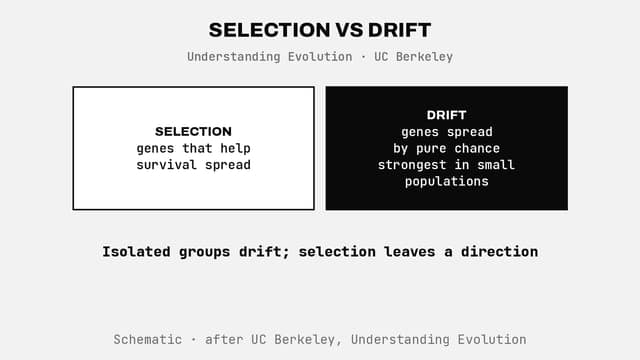
Selection versus drift. Selection spreads gene variants that help survival. Drift spreads variants by pure chance, because some individuals simply leave more offspring. Drift is strongest in small, isolated groups, so telling the two apart is hard.
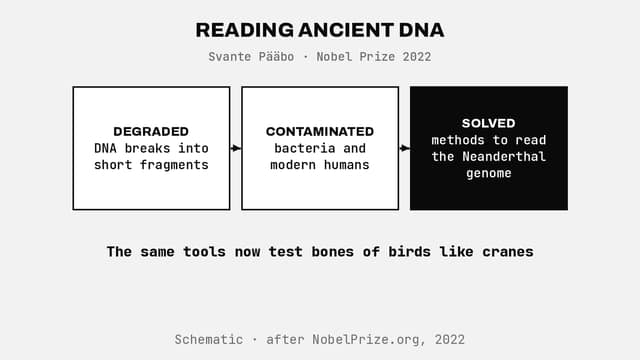
Ancient DNA. After death, DNA breaks into short fragments and gets contaminated by bacteria and by us. Svante Pääbo spent decades developing ways to read it, and sequenced the Neanderthal genome. He won the 2022 Nobel Prize. Bones that look alike can now be told apart.
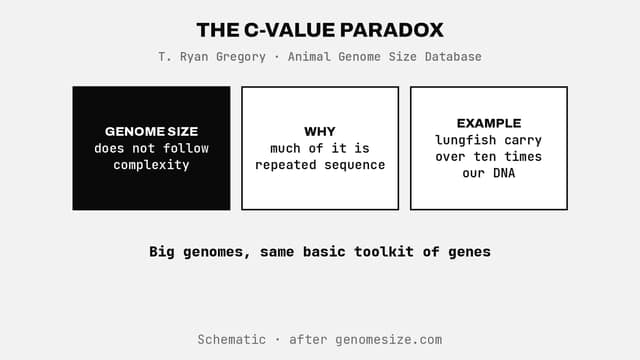
The C-value paradox. Genome size does not follow how complex an organism looks. Lungfish carry more than ten times as much DNA as we do. Much of the difference is repeated sequence, not extra genes, as in today's spider.