News & Ideas is a daily letter for anyone who wants the day's science in one place, not a feed. Each day is 4 news items and 3 ideas across AI & Tech, Physics & Engineering, Biology & Nature, and Mind & Society, and every story names a primary source you can check. The Shorts use a declared synthetic voice.
One email a day. 4 science stories, 5 quick results, 1 idea. 3 minutes.
Plus a daily quiz: Answer & Learn. Free, unsubscribe anytime.
Issue
28 October 2026
2 min read · 1 Short
Biology & Nature: REM-like sleep in spiders, an armoured amphibian at sea, a lipid atlas of the brain, droplets that bundle microtubules. Then ancient sleep, condensates, The Selfish Gene at 50.
One email a day. 4 science stories, 5 quick results, 1 idea. 3 minutes.
Plus a daily quiz: Answer & Learn. Free, unsubscribe anytime.
Biology & Nature
REM-like sleep in spiders, a sea amphibian
Biology & Nature: REM-like sleep in spiders, an armoured amphibian at sea, a lipid atlas of the brain, droplets that bundle microtubules. Then ancient sleep, condensates, The Selfish Gene at 50.
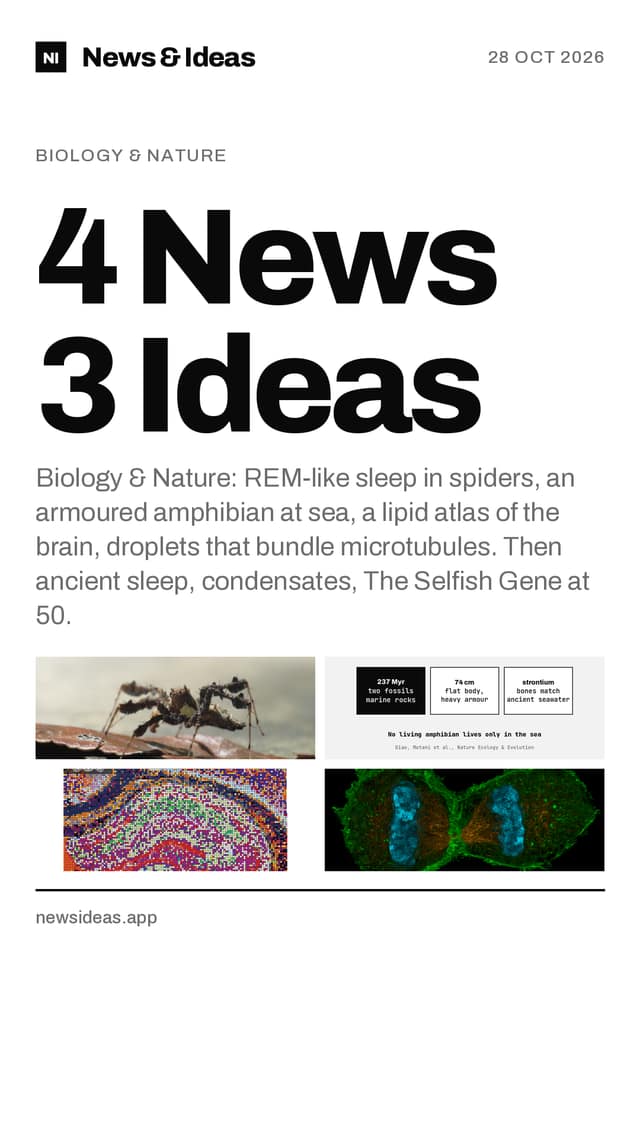
A new study of the jumping spider Portia fimbriata finds the hallmarks of behavioural sleep: a free-running daily rhythm, a stable sleep structure, and rebound after sleep is disrupted. It also finds regular REM-like phases, during which the spiders are harder to wake. The authors call it evidence of REM-like sleep in a land invertebrate. Published in PNAS.
One email a day. 4 science stories, 5 quick results, 1 idea. 3 minutes.
Plus a daily quiz: Answer & Learn. Free, unsubscribe anytime.
Biology · Palaeontology
An armoured amphibian that lived in the sea
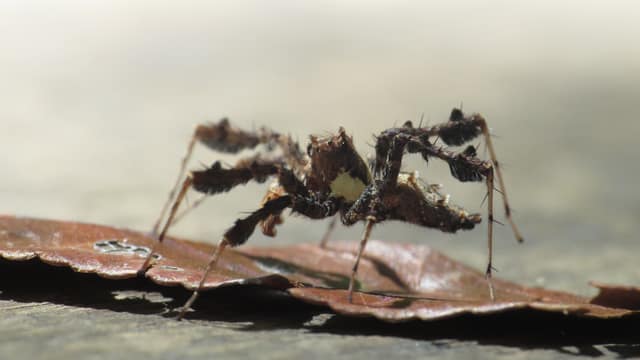
Two fossils from Guizhou, China, show a temnospondyl amphibian living in a salty sea 237 million years ago. Gerrothorax maritimus was 74 centimetres long, flat and heavily armoured. Strontium in its bones matches the seawater of the time. No living amphibian lives only in the sea.
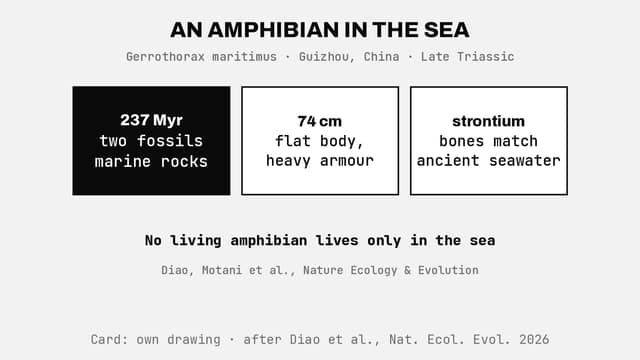
Researchers mapped 172 membrane lipids across 109 brain sections from 11 mice. The lipids sort into 539 territories, called lipizones, that align with the brain's functional anatomy. In pregnant mice, parts of the cortex were remodelled. Published in Nature.
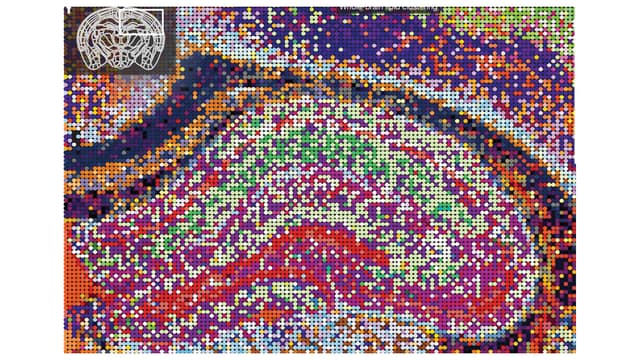
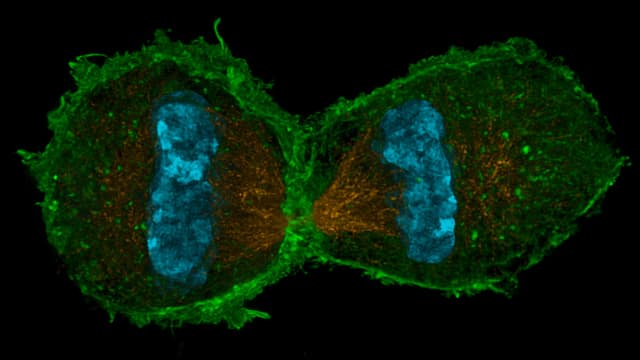
Microtubules form the spindle that separates chromosomes, and need bundling to be strong. Sabine Petry's lab at Princeton found that protein condensates can do it with capillary forces, like water clumping wet hair. They measured a surface tension large enough to pull microtubules together. Published in PRX Life.
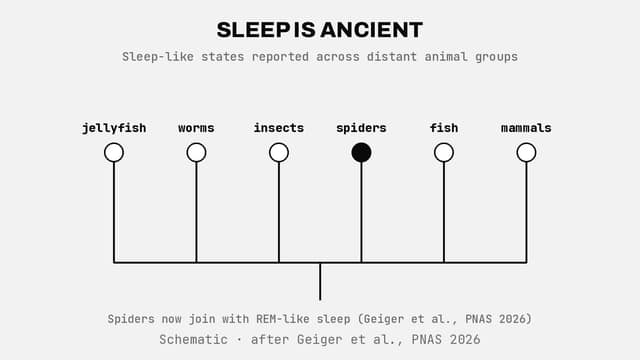
Sleep is ancient. Sleep-like states have been reported in animals as distant as jellyfish, worms, insects and fish. Finding REM-like sleep in spiders suggests that a two-stage sleep either arose very early or evolved more than once.
Geiger et al. · PNAS 2026
Schematic · after Geiger et al., 2026
PNASdoi.org · 2026 · Primary · Geiger et al. (2026); see news 1
Idea · Cell biology
Biomolecular condensates
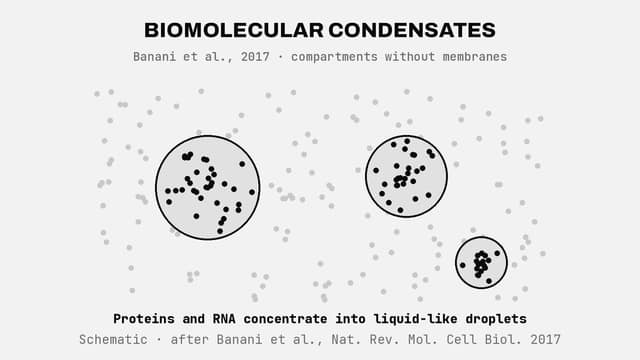
Biomolecular condensates. Cells build compartments without membranes, as proteins and RNA separate into droplets, a bit like oil in water. These droplets speed up reactions, store molecules and, it now seems, can also pull structures together.
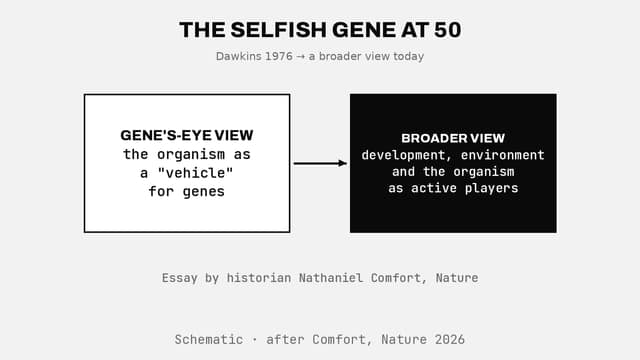
The Selfish Gene, published in 1976, framed organisms as vehicles for genes. Fifty years on, historian Nathaniel Comfort argues in Nature that the gene's-eye view is too narrow, and that newer biology gives organisms a more active role.